
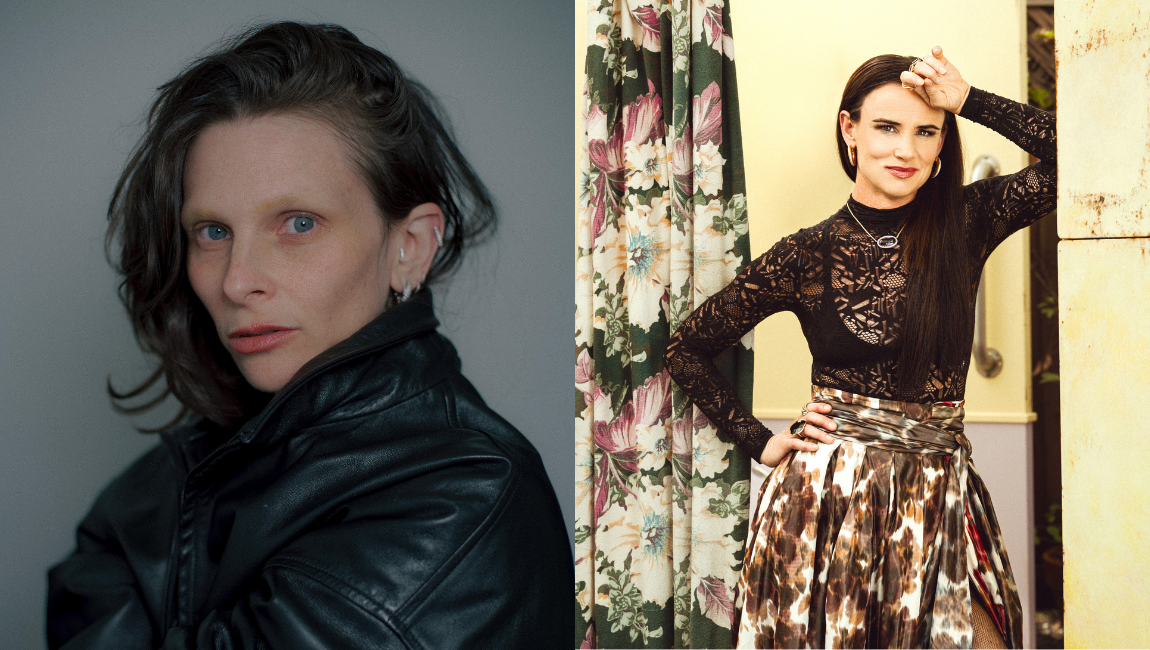
“Amanda Kramer Body Swap Movie” is a description that, if you’re familiar with her work, should get that brain firing with possibility. At the very least, a “what the hell would that look like?” has to cross your mind. The multi-hyphenate makes films unlike anyone else today. Often evoking styles and aesthetics from the past (her last feature, Please Baby Please, calling to mind 1950s greaser pictures), Kramer tears through gender norms and heteronormativity while leaning on artifice. It’s an odd balance at first, a tone or vibe you sort of have to be willing to ride with, but if you can catch it, she’s something special.
Unafraid of her films looking like they were shot on soundstages or in confined sets, Kramer relishes working in that flat, intentionally static zone. It allows her create worlds where intentions are stated plainly and barriers can be torn apart away easily. Gender constructs become the paper-thin cardboard cutouts they already are and queer taboos are taboo no longer, desire existing on the surface where it ought to be.
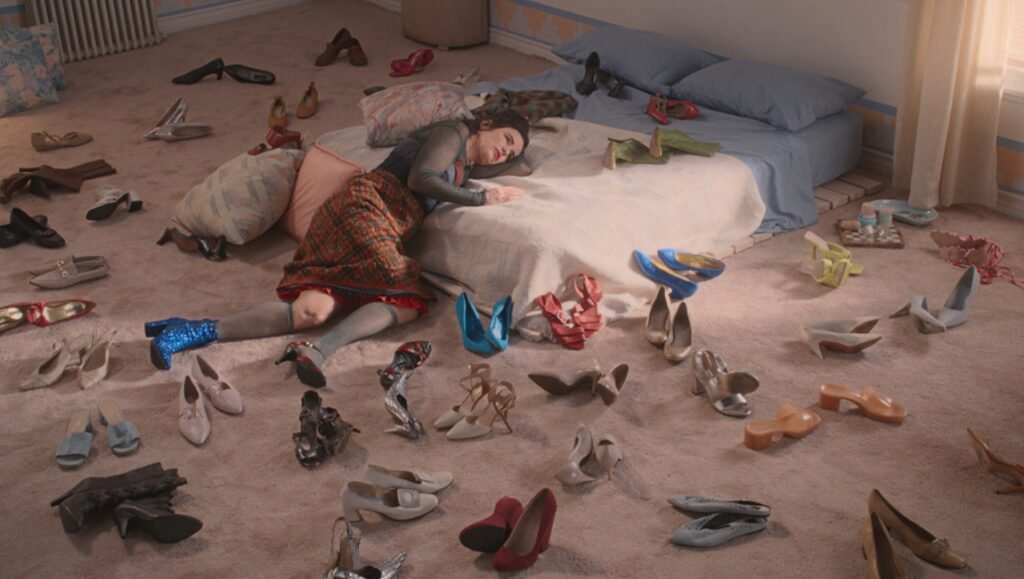
In her latest feature, By Design, Kramer dissects what it means to be coveted and the desire to live a full life by having Juliette Lewis swap bodies with a gorgeous designer chair. Camille (Lewis in an astonishing performance of still physicality) yearns to be more like her two closest friends (played by fellow ’90s icons Robin Tunney and Samantha Mathis) and entrench herself in the upper crust of society. While visiting a furniture showroom, she becomes enamored with a chair. When she returns the next to day, to her devastation, she finds it’s been reserved for a prospective buyer. Sitting in the chair one last time, writhing in the agony of being too late, fate steps in and swaps the soul of the chair with Camille. Ending up in the hands of the buyer’s ex-husband Olivier (a terrific Mamoudou Athie), who then falls for her in her chair form, Camille makes some startling discoveries about herself.
Narrated by Melanie Griffith, a star no stranger to being underestimated by society, By Design is a body swap film that navigates what happens when you find yourself in the body that feels right. Camille, as the chair, is finally desired in the ways she never was before. With every caress by Olivier along her wooden exterior, Camille’s sense of self blossoms after years of tamping it down. It’s a bold choice to express the truth that some of us may find our happiness in another body, something many body swap films end up rejecting. As ever, Kramer finds a way to bring what we’re afraid to admit to ourselves and others to the forefront, creating one of the most radical depictions of gender in quite some time.
Ahead of its release, I sat down with Kramer and star Juliette Lewis to talk the film, the Christian center of body swap films, losing a beloved object, and how to navigate stillness.
Brandon Streussnig: Unlike most body swap movies, I’m so taken with how Camille is unequivocally happier as a chair. Usually, the resolution would be “Ok, I had fun in a different body, but the one I have is where I truly belong.” That always feels a bit dishonest to me, though, because there are many people who aren’t happy in their bodies. Can you talk to me about landing on that as a way to, as you’ve said in the past, “fuck with the body swap movie”?
Amanda Kramer: Well, body swap movies, I think, are very moral. They have a Christian center to them, which is “don’t covet other lives; appreciate, show gratitude.” So the journey of the body swap movie is always one where, somewhere in the middle or heading into the third act, you’re like, “Oh shit, my life actually was wonderful. Why didn’t I appreciate it when I was living inside of it? I got to get back to it. This isn’t right!”
I’m not sure everybody would feel that way, and I don’t know if that’s honest. So yes, for Camille specifically, that is not what she comes to. You can tell in Juliette’s performance by the very end, the look on her face, it’s not that she’s devastated that she’s back to Camille, but she’s just going to live in that fantasy of what she was able to have. It’s such a beautiful final moment, but it’s complicated because that was actually a gorgeous little adventure she was able to have in a life without many gorgeous adventures.
Juliette Lewis: I feel like it’s actually, to use that word, timely when you have humanity going, “Wow, AI is fun. How about I just become an inanimate object?” I mean, it’s everywhere in everything. Let’s put filters on that or get rid of this. Everything is erasing humanity today in this bizarre way. When I first read this script, I couldn’t believe the honesty in it. Also, the wanting to be coveted, the wanting to be wanted and desired. And yes, to escape any responsibility of the have-tos, the having to create one’s existence, and Camille being ultimately trapped by an existence she probably didn’t even show up for. The ambivalence of that. Then the awakening is within the being coveted. It’s such a movie to analyze. These are just my analyses, but I know I jumped at the chance to inhabit her.
I think Amanda felt this, I know I felt it, but that there was this subversive pleasure to have me, someone who really is expressive, or who has been onscreen, and ask “what haven’t I done?” Oh, I haven’t done nearly nothing. What is the challenge of turning ultimate nothingness into somethingness? Can I do it? Can we do it? This was a total free fall, a game of trust. I was up for the challenge of it.
BS: Juliette, I’m glad you touched on that because you are such a physical performer. When you become the chair, you don’t just disappear. There’s a real sadness in your eyes, and you make the lack of physicality, physical. What were the conversations like on how to play that?
JL: I asked Amanda a lot, “Do we like this position? Are my eyes closed?”
AK: I have this brilliant actor, and I’m asking her to do something that could be quite uncomfortable physically. Every day, it’s like, “Well, what do you need? A pillow? Do you want to be arched this way? Do you want to be arched this way?” Juliette has this incredible dancer’s body, and is so strong. She would contort and say, “I’m good. I can be in this position.” We’re all trying to help her not feel so uncomfortable, and she was just so strong. That gave me such gorgeous shapes. Again, that’s what I’m thinking about in the frame: how can I get a really gorgeous shape? I don’t want her to just lie there. The point is not to be a corpse or a dead body. It’s to be an architectural object, and she just sort of immediately understood that.
As far as the face, it’s interesting because definitely, I’m like, “Juliette, go somewhere. I can’t tell you where to go. That’s your passion as an actor, and that’s your muse. I know I will inevitably feel an emotion come across on your face in the stillness. You don’t have to not blink. I’ll figure all that out. But you just have to feel rest in your face and go somewhere in your eyes.”
We had two cameras, one was always covering the other actor, and one was always covering Juliette in case we got her responding in real time to a line where you could see a little flicker of something in her eye, a sensation. Juliette, you can speak to this, but there were moments where she was across from Robin and Sam, and they were being hilarious. It’s not like she’s breaking, but she has a moment of taking that very funny or ironic thing in, and you see a little twinkle. It was amazing to be able to cut to that. Similarly, with Betty Buckley, it’s like she’s really processing what her mother’s saying to her, and I have this camera on Juliette to just feel that, what she’s pulling in just through her eyes.
JL: That was so special. To be across from everyone you just mentioned, who are so unique in their delivery and who they’re being in this film, and to have the nano… I don’t know the measurement, but a microcosmic flicker of reaction from that personality, and establishing what that relationship was — that was the challenge. But actually, those actors were really incredible to be across from. The dominance of Robin’s character and the saccharine sympathy of Samantha. Both of them were so great. I couldn’t believe it.
But this movie, gosh, I wish I could do it all again. That’s the thing, as an actor, you’re always wanting to be braver. “Was I brave enough?” Because going into Amanda’s world is so singular in its inventiveness, and so I was like, “Oh, did I arrive enough?” That’s why, and, Amanda knows this, I want to work together again because I feel like I could have even more to offer.
BS: Amanda, you aren’t afraid to wear influences proudly on your sleeve, but your work is also so much in conversation with heteronormativity, gender roles, and artifice. It ends up becoming something so singular. How do you keep your own voice so present?
AK: Well, you should walk through a museum with me. I’m like this [mimes screaming]. I walk into a room, and I see a Picasso everyone’s seen. I’m still just like, “Oh my God.” I’m screaming. You know what I mean? That’s all going into the film. I take in art. I take in music. I take in everything. I try to be a baby, like the Buddhists say. I try to let it be my teacher, and I try to have my work influenced by all of the art forms. That’s why you get this mashup of styles, influences, genres.
But really, it’s so funny. I’m sure Juliette has had a question similar to this in her career. It’s like when someone asks you, “How are you so singular?” You’re like, Look, you think my mom doesn’t want me to be Steven Spielberg? It doesn’t work like that. When you’re singular, you’re singular. You can try to fit in. You can try to take your brain and shove it into the exact pattern, but it just doesn’t work. There are times when I say, “I’m going to make a regular body swap movie, or I’m just going to make a body swap movie that everybody watches, like Freaky Friday, and I’m just going to make it.” Then what comes out is what comes out. I don’t know if that’s because I’m just a lover of so many things that I can’t silence everything and just make a movie, if that makes sense. I’m still trying to contend with being a musician, a dancer, and all of these things that I want to incorporate, so every single movie has to be this giant fishbowl of all of the little organisms I need swimming around.
BS: Juliette, are there any challenges or freedoms that come with playing in the artifice Amanda’s creating?
JL: Oh yeah. I cut my teeth with Oliver Stone on Natural Born Killers, and that had a lot of inventiveness, but I like boundaries and parameters. What I mean to say is I could improvise and stuff, but I loved the structure and the sets. The sets, in and of themselves, when you walk into them, are like a dream, and everything is an extension of Amanda’s creativity and Camille’s orbit. Even the color palette of her room spoke to me of her. Everything communicates an emotionality, because I deal with emotions. So the peaches, the pale pinks of, I don’t know, 1983, things I’d seen in dentist offices; the set, that color or lack thereof, was like a dream.
The things that Amanda gave me to play with were interesting. That’s why I would want to play again, because she had set up these beautiful shots that maybe, as a human being, I’m like, “I would look over here at the person, and I would say, ‘Blah, blah, blah.’” Like a shot-reverse shot. But she had designed this exquisite shot of the two women, this was in the store, looking out as she was conveying her sorrow. That structure, the cinematic vision that she was creating, was new for me because I come from the character, how they move, what they’re talking about, and how they behave. It was neat to have something so stylistic, but also so human and so filled with all the pathos and all the stuff that I, Juliette, relate to on many levels.
When I received a script, I wept. I’m looking at the narration and some of the monologues, and I’m like, “Yes, yes,” in a hotel room, desperate to express deep humanity when I was in the confines of a plot. I was doing another job that was very much steeped in plot, plot, plot, plot, plot. Character or people were sixth on the checklist of what the project wanted to do.
To then step into Amanda’s world where it’s so deep and rich was just… wow. Amanda, when you said when she goes somewhere else… my work, and I don’t know if other actors speak this way, but it’s very spiritual. When Camille was in orbit or suspended, I pictured when spirits are connected to their body, but they can’t leave. I believe in reincarnation, so I’m going to a different place through metaphysics. Even though we’re just like, “Here’s the cool shape and she’s staying still,” I’m trying to bring something spiritual and metaphysical into the equation. With intention, you hope that it arrives.
BS: That was beautiful, and it feels silly to end this way, but this film got me thinking about this incredible green chair I lost during a breakup.
AK: Oh, I’m so sorry for your loss. [laughs]
BS: No, no it’s ok. [laughs] But I do relate to Camille’s deep, primal connection with that chair. Has there ever been an object that either of you has ever had that kind of longing for?
AK: Oh, yes. Oh, yes. I had a cashmere sweater. It was the first cashmere sweater that I could afford. It was so expensive. I spent all of the money that I made in my little paycheck. I had a mall job. I went, I bought the sweater. I was obsessed with it. I had it for years. I kept it in plastic. I sprayed it. I was like, “This is not getting any holes.” This is the first cashmere sweater that I bought that was so nice and expensive. I got it at Barneys. I went to Paris. I was running around Paris feeling like a young woman in Paris. I was drinking wine. I was going all over the streets. I looked down, realized my sweater’s not wrapped around my waist.
I have no fucking clue where it went. I had the sweater for years. At this point, it was like a second skin. At the time, I had a boyfriend. He turned to me, and he said, “Paris has your sweater, and you have to give it to Paris.” I had to sacrifice my fucking sweater to Paris. But you know what? If anywhere deserves it, okay, Paris, take it. It was so sad, but what’re you gonna do?
JL: I lost something recently, and it still hurts. My boyfriend had a ring made. Not a proposal ring, just a very special ring. I was riding my bike in the hills where I live. I was in a sundress. It had an opal in it, and he picked the stone and everything. He was like, “Okay, but you can’t wash it a lot.” I’m terrible with rings. I tell every prop department on every movie, “Please watch me with things you put on my hands because they will come off. I’ll wash them.” I was obsessively taking the ring off around the sink to make sure the opal didn’t lose its shine, and I wrapped it in tissue when I dried it. I was taking such good care of it. Anyway, I lost it. It got thrown away. It’s gone forever.
Comments are closed.