
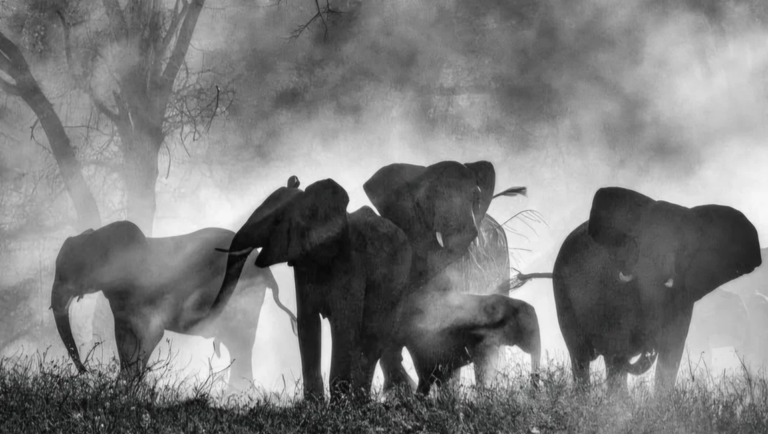
There is a scene, not long into Werner Herzog’s Ghost Elephants, that may explain the purpose behind not only this movie, but the entire catalog of Herzog’s many anthropological and geographical documentaries. It’s a short sequence, seemingly just one of the movie’s several little asides, offering color and context. In it, conservationist Steve Boyes is seen by a felled baobab, speaking to the camera about the elephants that have recently visited this site. In the background are two men atop one of the tree’s massive branches, introduced to the audience in voiceover as its guardians, an indication of how far humanity has come in its respect for the natural world. But the focus remains on Boyes and the elephants he tracks and seeks to protect. Then, after a mere moment, the movie moves on.
Boyes is, in Herzog’s depiction, a noble figure, humble and principled. His quest for knowledge and evidence of the elephants of the Angolan highlands, which he believes may be a hitherto unknown sub-species of elephant, is an ostensibly righteous one, though its significance is largely argued here in terms of what it might mean to Boyes as an individual. And its scientific nature contrasts with the more harmonious relationship we observe between the natural world and the bushmen with whom Boyes and Herzog spend some considerable time here. To the question of why Boyes’ quest is at all righteous, then, or indeed why Herzog has devoted so much of his career to exploring the hidden wonders of our planet, the baobab’s guardians hold the answer.
We first see Boyes at the Smithsonian Museum in Washington, D.C. He stands beneath Henry, the largest land mammal in recorded history, an elephant so vast in mass that his skull and tusks had to be removed from his body in order to be mounted for exhibition. Boyes is fascinated by the legend of creatures like Henry, elephants that he thinks may reside in the huge, uninhabited part of the Angolan highlands, but of whom Henry, killed by a hunter in 1954, is the only physical evidence, or perhaps suggestion. It’s his dream to see one of these “ghost elephants” in person, if they do even exist, though Herzog hasn’t made a movie about something non-existent.
Mostly, this movie is about Boyes and the people who’ll accompany him on a six-week trek to find further, supporting evidence. Much time is spent in a community of the San people of Namibia, living in small villages in the bush. In true Herzog style, he’s driven to divergence, darting off in various directions for charming incidental explorations of his own. He captures their nocturnal dancing rituals, in which the spirits of elephants are said to enter the entranced participants. He films a village elder patiently tending to his musical instruments, surrounded by chickens. He devotes a solid five minutes to a detailed description of how the poison on the San people’s arrows, used to kill wild animals for food, is retrieved and cultivated. Herzog has respect for these people, and for the value of the information he gleans about their lives, and so every detour feels enriching, rather than distracting.
If a European’s presentation of the lives of indigenous Africans may smack somewhat of white saviorism, alas, there is an element of that in Ghost Elephants. There’s an unavoidable hint of orientalism in how Boyes, a white South African, extols the virtues of the San, speaking on their behalf while situated in their village, and more than just a hint when Herzog’s narration labels their lifestyle “primordial,” even if it’s not intended to be derogatory. This, however, is not the case when the movie leaves the village for the trek, when it turns to subjects who need to be spoken for on their behalf. Here, Herzog positions himself alongside Boyes (whether intentionally or not) as a guardian of our planet, seeking knowledge that might aid its protection — the scientists, too, who appear in the closing few scenes, whose multi-million-dollar equipment could hardly be further removed from the simple swabs and wooden tools used by Boyes and the bushmen in monetary worth, yet hardly closer in true worth.
Only Werner Herzog, a filmmaker as clear-eyed as he is kooky, could make a movie like this — informative yet whimsical, tranquil in tone yet possessed of a distinct urgency in message. It’s never so focused on said message that it’s afraid to follow a scarab rolling a ball of dung, though, or survey a table of dead birds in a university laboratory, yet it’s never so scattershot that these detours don’t feel germane. With sincerity, and some degree of artistry, Herzog crafts a sense of wonder that’s wholly necessary — the key pieces of footage that Boyes and his team capture on their trek might appear utterly inconsequential otherwise, yet Herzog affords them the majesty that they deserve. Ghost Elephants is a true act of guardianship.
DIRECTOR: Werner Herzog; CAST: Steve Boyes; DISTRIBUTOR: Abramorama/National Geographic Documentary Films; IN THEATERS: February 26; STREAMING: March 5; RUNTIME: 1 hr. 39 min.
Comments are closed.