
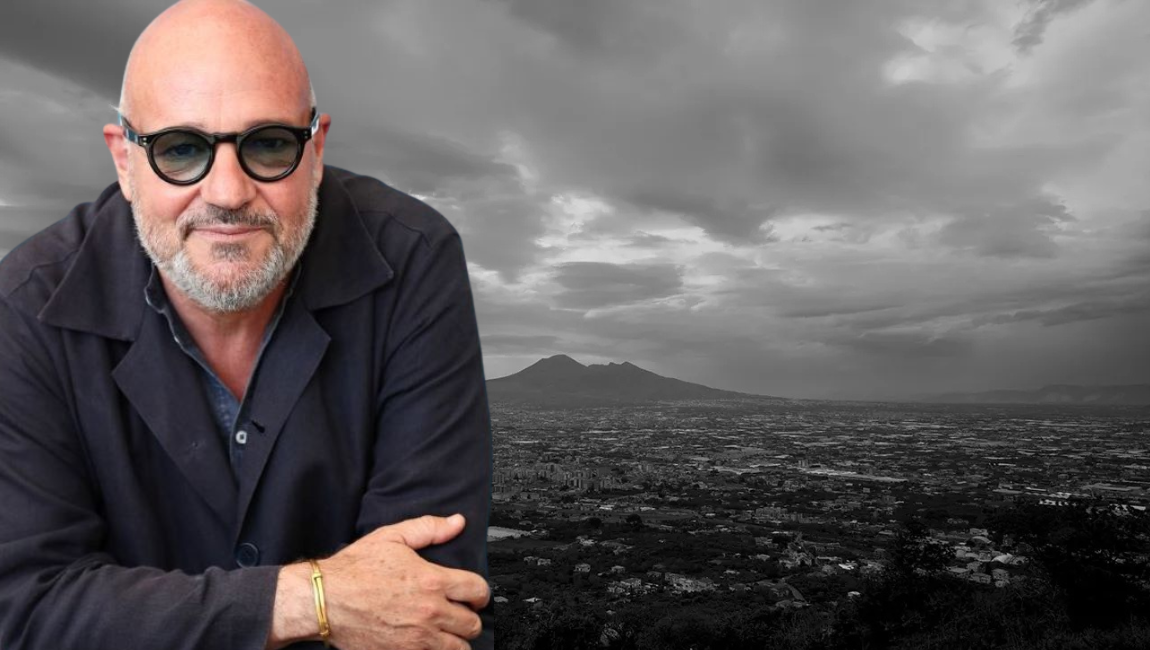
Italian-American documentarian Gianfranco Rosi has been making films for 30 years, but they’ve never quite been entirely about what is shown on the screen. His 2010 critical breakout El Sicario, Room 164 found him alone in a hotel room with a Mexican cartel hitman who’d previously used that very space to torture and kill his victims. The sicario’s face was covered and the only illustration of what had occurred was via his notebook drawings and his words. He’d follow it up with two titles that would win the top prizes at the Berlin and Venice Film Festivals, respectively: Sacro GRA (2013) focused on Rome’s giant ring road and the people who lived off of it, while Fire at Sea (2016) looked at the lives of the people of Lampedusa as they dealt with the North African refugee crisis. The former film was all about what gets left at the side of the road and who gets overlooked as a result; the latter was a juxtaposition of the harrowing urgency of the refugee crisis against the doomed attempts to live an ordinary life when it perpetually lingered in the background.
His subsequent Notturno (2020) tackled the enormity of Middle Eastern war zones, turning them into a series of oblique impressions of post-traumatic pain that have brought the titular darkness to an entire region. And now, after a world tour examining the public persona of Pope Francis with In Viaggio (2022), Rosi returns to Italy with his new film Pompei: Below the Clouds. A monochrome study of time’s passage through Naples, the key theme is destruction: the eruption of Mount Vesuvius and its destruction of Pompeii that birthed the city to begin with, the looting of museum artifacts related to the lost city, the fire department’s constant calls about fire and earthquakes, the lingering presence of war and the refugee crisis in transport hubs, and the dying days of physical media. On the occasion of its U.S. release, I spoke to Rosi about his latest, and perhaps most ambitious, film.
Andrew Reichel: I wanted to start by asking about Below the Clouds’ visual approach, because this is your first time working in black-and-white since your 1994 debut Boatman, and you’ve said in prior interviews that it was a necessity for Below’s visual approach. What was it like to return to black-and-white after 30 years, and in a digital format?
Gianfranco Rosi: Yeah, my first film was in 16mm film, and since then I never really approached that. But from the beginning I felt that it was a necessity for this new film’s storytelling. It was not an aesthetic choice but a visual narrative choice to work in black-and-white, ever since I had the idea of this sense of suspended time and stratification, a past and present and hypothetical future in the film. All these elements… I thought that only the space of the black-and-white would force you to look at things in a different way and force you to create a separation between the present and the past somehow. The coordination of these elements, the sense of a time that is suspended in the film… the time that is going through its own perception of that reality. And so, I had to learn again how to look at things in black-and-white; it’s a different way of approaching reality and transforming reality into something else
The digital is different, but also not so much; the only thing I had differently from the past was that I was able to look at my viewfinder and see reality in black-and-white, while before I had to look at my 16mm camera’s viewfinder and look at reality in color, and then imagine it in black-and-white. And then it took months and then years to develop my film from India, and see if it was working or not, while now I have immediate confirmation of what I was looking at through my viewfinder, so it was easier. But there was no Plan B — when you film in black-and-white, that’s what you get and what you have to go with until the editing. It wasn’t easy to convince people to make a film in black-and-white; you cut off a lot of possibilities of distribution. A black-and-white film, it’s not such a granted thing, and I had sustainment from my producer and other people who supported the film. I think at the end, that was the right choice for the film.
It happened, when I did Boatman, it was funny — Italian television asked me for the film to go on air, and then I received a call from the head of the programming, and he said to me, “What the fuck, you sent us a black-and-white movie!” And I said, “Well, the film is in black-and-white!” and he said, “No, I saw it in London, at the festival, and it was a color film! I remember — the red, the yellow… it was all in the film!” [laughs] But you know, that was the beauty that people could watch color in black-and-white, so that means that the projection of our mind is still confronting that. But I see black-and-white as part of life and part of reality, and you have to be able to watch the color of the black-and-white. The grey that you can create in a black-and-white print, there are colors for me, so that’s the beauty of it.
AR: Something else you’ve also mentioned in prior interviews was that this project was started on the back of a suggestion from Pietro Marcello to make a film about Naples. Were there any elements of Below the Clouds that felt like they were in dialogue with him as a person, or with his own films?
GR: Definitely. He gave me the incentive to look at the archival footage in a different way, and Pietro is a master of using archival. I didn’t want to show archival as something separate from the film, or just as counterpoint like it usually is done — a few people can do that, and Pietro is one of those. But for me, by showing those images inside the abandoned cinema — when I found this location, this is where I said, “Okay, this is where I want all my archival material to be screened,” and I wanted them to feel like a form of collective memory. Almost as if the past could come alive again in those spaces where there were people once watching cinema together. So this abandoned theater seemed like an archeological site, stories buried under the peeling walls and broken seats and destroyed screen… somehow, this was possible because of Pietro, because I wanted to use archival in a different way. Like, he’s the master of archival, Pietro — I don’t know if you saw Duse, the last film he did, the use of archival is absolutely outstanding. So somehow, knowing Pietro so well, it gave me the push to try to use archival in a different way in the film, and to somehow find a dead cinema, which brings through the memory of the screen a live sense of moving images. I felt that was the only way I could approach archival footage. So yes, to answer, there is a connection with Pietro, absolutely. Plus Pietro is my great, great friend. He was the one who told me that I must do a film in Naples, which I never thought before to approach such a difficult place narratively. Naples is such a complex city, and this is what I wanted to do with this film, to show the complexity of a town like Naples — I wanted to show not a place, but an undefined time. A time that has not destroyed, but stratified reality. I wanted to show the stratification of time.
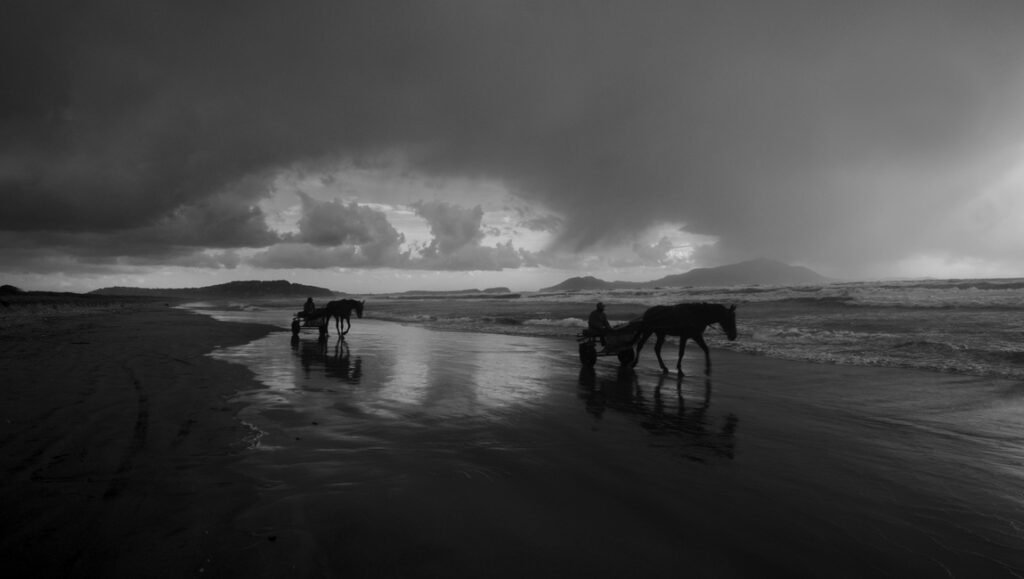
AR: It’s good that you brought up the scenes in the abandoned cinema, because I wanted to ask about that. You’re generally seen as a documentarian, but those scenes showing Roberto Rossellini’s Journey to Italy and the other older films are a challenge to that assumption in the way that they’re staged. Which portions of the film required a more planned and staged approach, and which were more spontaneously centered around a more conventional form of documentation?
GR: I don’t know! I am a documentarist, I hate all those definitions — cinema du real, reality things, all those — because I am a documenter! I deal with reality, I don’t write a script, I don’t have actors, I work with what is in front of me. But then my approach is absolutely linked to the language of cinema. I don’t care about documentary and fiction, I care about what is true and false in what I’m filming, and the only way I can use that is through the element of cinema. And that’s what I learned from Rossellini, to transform reality into something else constantly, although Rossellini was one of the most loyal and rigid persons in representing reality. But then, the reality has to be transformed into something else. In order to do that, you have to use the language of cinema, and that is what’s most important to me, the language of cinema.
And I was lucky in that most of the time, my films didn’t show in documentary film festivals, but Venice and Berlin in competition. And the film now was competing at Venice with, you know, the huge budget, $500 million film while my small film was also able to be there. And I think that’s because what’s interesting to me, and what was always important, was to break that division between documentary and fiction. Not because I don’t want to be a documentarist, but just because the way I deal with reality with the language of cinema is, to me, what’s important — the language of cinema is always there for me. Documentary is the most beautiful way for me, because I work as a one-person crew, and on a conventional feature film I could not work as a one-person crew. Ross McElwee, he gave me this possibility to say, “Okay, you can be alone and work on a film and be able to tell a story,” and that’s what I love, to immerse myself in reality and then transform that reality in the language of cinema.
And that’s where I believe documentary can experiment so much — unfortunately, less and less and less, because the way we are now producing documentaries is detrimental, and somehow killing that approach of experimenting and letting reality talk and be your partner in the narration. But the moment you break experimentation, documentary dies. The moment you have to write a 50-page script and the film has to be exactly those 50 pages is the death of documentary associated with cinema. But that’s still my battle, I hope. [laughs] But we are very few left, and I have the privilege and the determination to keep fighting that.
And I really have to thank MUBI, because they allowed a film like this to be shown and supported. They still give a voice to independent cinema and authors, and now more and more, that point of view has been cancelled. Certain platforms don’t even have the name of the director anymore, and that’s terrible. You’re killing the trust of the audience and the trust in a point of view, which is terrible.
AR: When shooting, do you have any strategies to keep it closer to the reality that you are seeking out?
GR: If I had a strategy, I would probably stop making films, because for me, I would get so bored. And that’s why I don’t do fiction, because the idea of writing something and being approved and finding actors to do so-and-so is something I’m not interested in. What I like is to let reality conduct me in a story where I have no idea where it will take me, and all the time is driving me toward the idea of a structure of a film, and that’s what I love. To be immersed in reality and to have that reality talking to me constantly in different ways, and try to understand what the language has to be.
Every film is different, every film is a total immersion, and the challenge for me is something I don’t know — to find a different way of telling that story, because every film is different. There’s no method; well, the method is full immersion, like finding the full encounter. Without that, my films would not exist. Without time, my film would not exist, because if I had spent two months or three months or one year in Naples, I would have made a different film. So I’m privileged enough to have a producer and production that trusts me starting with very few words and a very small script, which most of the time I forget completely, which allows me to spend so much time on the location and try to find a narrative in this journey. The only thing I have is that I have to meet people, I have to have an idea of the space and place where I want to tell that story and just immerse myself in that reality. So every time is completely different. I have to find a different way of approaching, a different way of interacting, a different way of listening, a different way of embracing reality.
And for example, music: I never used music in my work. For me, music was always sound. This time, in this film, I found that I needed to have a composer working, on the last scene of the film especially. And I have a very close relationship with Daniel Blumberg, we’ve been close friends for years, and I called him when I was finishing the editing of the film and I said, “I need you in this film.” And for the first time, I worked with a musician and a composer, and it’s incredible, because that gave, to the film, what it was missing. My connection with Daniel goes back 14 years, and I always loved the way he experimented with music, the same way he liked my work experimenting with images and the idea of documentary. I didn’t want a traditional score; I don’t even call it a score — I call it a soundscape. I told him, “I need you to create a suspended space in certain moments, and to give it a texture of sound where the instruments become unrecognizable.” Somehow, he was the only one for me able to do that, and he had this incredible genius idea to record the music underwater in the same place where I shot the last scene of the film, which for me was fundamental. And he was able to transform… what is fantastic is that you don’t realize there’s music there, you realize there’s sound and you don’t know what. It’s very subliminal, and over halfway into the film you realize there’s a rhythm and it’s recognizable. There’s musicality and there’s something that comes in your subconscious that transforms your perception of the images and of the film. And in the credits, you have a full score of what was bits — bits-bits-bits — accompanying the film to the end.
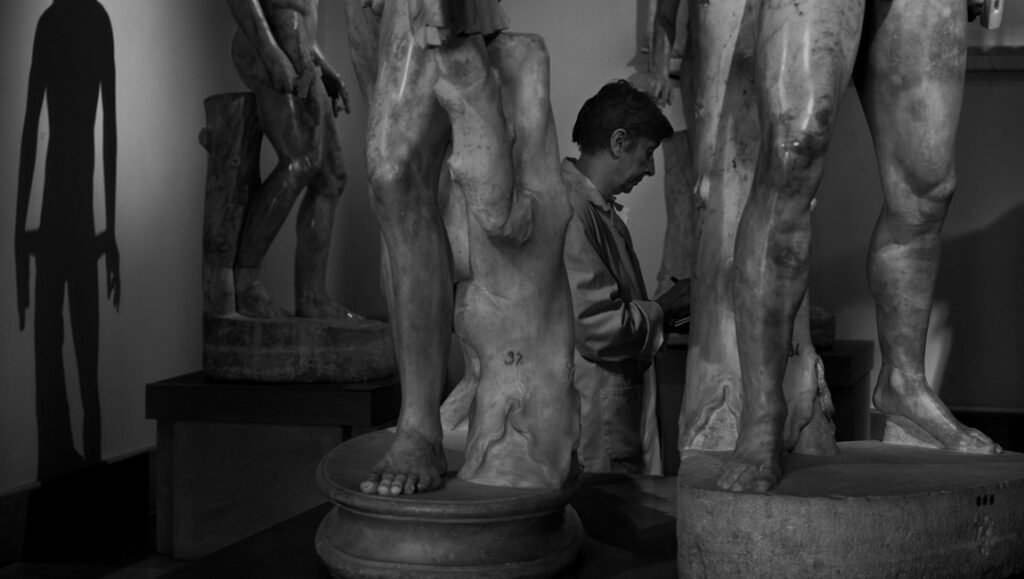
For me, the end of the film was fundamental. At the end of the film, I would like the viewer to ask themselves the question, “Is there still hope? Sooner or later, will our civilization be submerged like the Roman statues at the end of the film?” And for me, the real question is, “What will we have left behind?” And this is what I want the film to be, and the sound that he created brings you exactly to this question, and that is why I think the work of Daniel was fundamental to this film. And again, that was the first time I worked on a score with a musician.
So that is all just to say, every time you have a different approach. You don’t go there with a predefined idea, you just let reality talk to you constantly, constantly, constantly. You are the one adapting yourself to the encounter, to the people you meet, to the process of narration: reality is dictating you, almost, you know? In fact, when I finished the film, I said to myself, “you almost go in a zone… you never wrote this film, how did it come?” I never wrote anything, it was all there, and that’s the beauty for me of working with reality. It’s the beauty of the word “documentary,” but again, you need to associate the word documentary with the word cinema, because otherwise it’s just boring and ideological and a euphemistic way of making reportage.
AR: Do you have anything else you would like to say about this film or the making of it?
GR: I think sometimes we talk so much about political cinema right now, and I have a different idea of what makes a political film right now. So much of what I see right now is not political, it is just ideological (unfortunately), and there is always a message. Good and bad; “I am never bad — they’re bad.” A judgement. I would like this film to be, and I think this film is, an extremely political film. I present in this film a constellation, and for me what is important is letting the viewer discover the connections. I ask the viewer to participate directly in the film. The film has so many gaps of silence that have to be fulfilled by the perception of individual viewers. And I believe in this, to leave the freedom to those watching the film, to make his own idea of the film. It’s a really strong political element, because I really strongly believe politics is not about delivering an answer. And unfortunately, most of the films we have around are about delivering an answer, but politics is about reading the complexity of the world. And to read the complexity of the world, you have to see who is looking at you and the footage of the things that you filmed, to live the freedom of making their own… uh, you find the word to say, I put “dots dots dots.” To make their own? You find the word.
AR: To make their own… vision of the movie, perhaps?
GR: Okay. You choose it. [laughs] I give you “dots dots dots.” You put the word.
AR: I’ll make sure to transcribe that. [laughs]
GR: So, this is important for me to say. I believe this is maybe the most political film I made without being political, you know? It’s a point of arrival…
AR: Yeah, I mean, there’s definitely a contrast between this and the more overtly political material in Notturno and Fire at Sea, but it is very present.
GR: Yeah, but even in those movies, there was an element… to find this kid Samuele in Fire at Sea, we find our own visual, we become the kid with occhio pigro (lazy eye). This kid becomes us, but I was only able to do this because I spent four years on that island. If I’d met Samuele in one month, he would not have that problem in the eye, so in that moment, he became us. He stopped killing animals; he originally wanted to be a hunter and then a fisherman… and then his point of view is us, you know, we are the lazy eyes. But I didn’t put that in the script, it just came, because I was able to spend time — time — time there! Also, in that film, there are elements of narration of things that come from reality; as I say, every film is different.
Maybe in this new film, I work more on subtraction, on transformation, on dealing with space. There are so many stories in this film, but then each story in this film could’ve been a documentary in its own right. The fire department, the prosecutor, the teacher. And then my challenge in this film was, “okay, let’s take out information, off-off-off-off.” It’s like Giacometti statues, you take it off-off-off-off until the statue breaks, and then this statue still has to be holding there. Giacometti used to say, “how much can I take off before it breaks?”
And in this film I really tried to challenge myself, saying “how many stories” — I know from experience, I only made eight films, but I know that you cannot handle more than four or five stories in a one-and-a-half or two-hour film. This, I went from one story to another, one story to another, and built a structure. This film, there are like nine very solid stories, so it’s really raising the bar really high on putting so many characters and giving so much information about all of them. But then, they all talk to each other, and what do they have in common, all these people? There’s a sense of devotion in all of them, their whole story is that they are part of an institution. And all characters in this film, they give themselves to the other.
And this arrives only after I finish shooting, you know? “Institutions are the means through which civilization preserves and passes its memory, keeping knowledge and meaning alive” — that’s what Pasolini used to say! And this is the thing, that’s what all these characters in the film do. They keep memory and knowledge and meaning alive, which is the meaning of civilization, that’s when civilization starts — when you give yourself to the other. And all the characters, they somehow enact resistance against fear. I think each person in the film has this incredible thing, that they are an act of resistance against fear. And that’s where, maybe, the film is political.
And the idea of fear in the film is a universal sentiment. We live in such a shaky world right now, that the sense of unsteadiness in things is almost a perfect metaphor for this film. In this film, it comes out of the earthquake, but the core is the same. It’s war, it’s social. I say Naples is a universal city, it’s a laboratory of the future, like New York. Naples and New York, they are in the same geography horizontally — the same latitude. They are both incredible cities, they are both laboratories of the future. And that leaves these two cities in a constant sort of future perfect. In Naples, you never ask when the disaster is going to happen, but more like “how come we didn’t realize that it did already happen?” So it’s a perfect metaphor of the condition we are all living in this shaky and uncertain world. This world, how come we didn’t realize the disaster we are living in now, it happened 40 or 50 years ago?
And in New York, you never realize — how come we didn’t realize when we sell this city to the rich people constantly? Funny that we now have a mayor that’s maybe putting an end to that — I don’t think he’s going to make big changes, this mayor, but at least there is a need of this population to reappropriate themselves of an identity of this city that was incredible. How can this city live with no artists? All the artists have to go somewhere else; when the artists go somewhere else, it’s dying. Maybe the fact that still, New York voted for this mayor is like, “We need that, we’re missing that.” So there’s still a memory here, that we’re missing that. And the richest city in the world voted for this mayor, which I think is fantastic. And again, I don’t know how much he’s going to change it, but there’s still a need to reappropriate ourselves.
I’ve been living in this city for many, many years. I was 21 when I moved here, and when I was a student I was living in what we used to call the meat market, and now it’s like a fucking mall for rich people here, unfortunately. And all these trust fund kids around. So, maybe New York has to reappropriate itself and become again a universal city and a laboratory for the future with the directors like Spike Lee, Jim Jarmusch, all these guys that were able to breathe things, you know? Now there’s not a single filmmaker in New York that we can say, “oh there’s an artist, someone who comes from here,” and that’s what the city’s missing. But again, going back to Naples, the fact that Naples deals with disaster in that way — it’s a perfect metaphor for this condition we are living in now, in this uncertain world. And that’s why we go back to the end of the film: what will we have left behind at the end? At least the Romans left us some statues and the water. What are we going to leave? [laughs]
AR: Well, that sums it up. [laughs]
GR: It’s good you asked me what else I wanted to say! [laughs]
Comments are closed.