
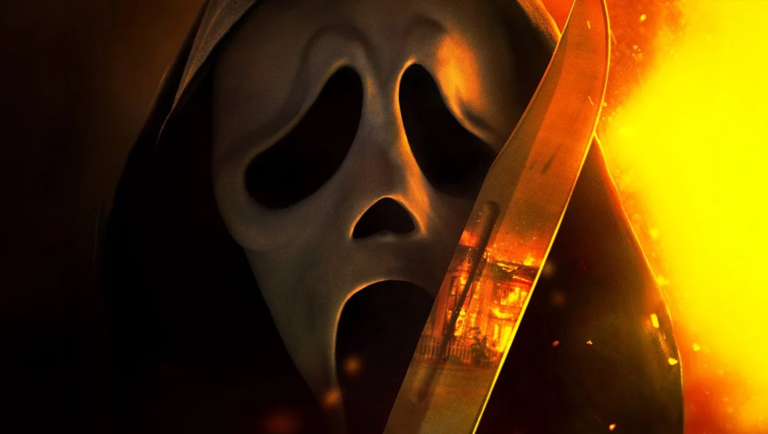
Given the franchise’s downward trajectory since its requel resurrection, reasonable hopes were never bound to be high for Scream 7. But then came the reprehensible firing of Melissa Barrera after she had the gall to throw her support behind the Palestinian people and call genocide by its name, and overnight what has been arguably the genre-defining horror franchise of the past 40 years suddenly found itself perfumed with the stink of settler logic and corporate overreach. In response, Paramount did its best to weaponize nostalgia as a distraction to its abhorrent politicization of a core studio property, not only by returning Neve Campbell as the film’s lead, but also by bringing back Matthew Lillard to the franchise for the first time since the inaugural entry (excepting a few uncredited cameos credits in Scream 2 and the 2022 reboot) and handing original scribe (of three out of the first four films) Kevin Williamson both the pen and director’s bullhorn. Still, given Hollywood’s writ large abstention to meaningful political engagement outside of its fundamental bothsidesism, the whiff of shit kicked up around Scream 7 wasn’t going to be easily blunted by the return of legacy characters and behind-the-scenes talent — at least in the present — regardless of its relative quality or lack thereof. Pro-genocide is just a tough look to pull off.
And with that in mind, Scream 7 is… well, still quite bad. But first, the positive. At this point — seven entries deep into a series that has proudly made a mode of meta-reflexivity, trope-trading, and reaching skyscraper heights with the number of hats it puts on other hats — it’s no stretch to observe that the franchise has basically become and exercise in making photocopies of photocopies. Williamson’s return marks something of a spike strip in that trend, as his intent seems less a get-the-gang-back-together legacy proposition and more of a reset. The setup follows this logic: squarely back in focus — and in Ghostface’s crosshairs — is Sidney Prescott (Campbell, natch), whose mission this time out is less mere survival than imparting those skills to her daughter, Tatum (Isabel May), whom the robed slasher is now gunning for. Turns out, she’s done a poor job in the preparation department, employing a PTSD-informed version of helicopter parenting in her desire to protect Tatum from the dangers of an outside world beset by endless iterations of Ghostface.
More specifically, however, what Williamson seems to be attempting with Scream 7 is arguably the most straightforward slasher entry the series has seen, and that intent is basically hardcoded into the screenplay. The aforementioned Lillard is back as Stu Macher, threatening Sidney primarily from a tablet screen, with characters spending the entire film debating whether he’s alive or is being deepfaked. The answer is pretty obvious for anyone paying a lick of attention or with brainstem activity — and that’s even taking into account the difficulty of maintaining interest when confronted with yet another limp, facile, Boomer-stamped critique of AI — but that’s besides the point: Williamson’s jab feels particularly directed at entries five and six, which were largely soulless reproductions of superficial similarity that seemed designed only to surface legacy characters. Fair enough, but as executed in Scream 7, the censure feels contaminated by a clear case of Williamson having and eating his cake; at least Lillard is a gas on screen, leveraging Stu’s unnerving cartoonishness, tantrum-esque mouth noises, and penchant for talking like he has a gob full of marshmallows to even eerier ends when coming from an aged-up psychopath.
Unfortunately, not doing something isn’t a cheat code to achievement. Scream 7 might not be 5 or 6, but it is a project plagued by endless internal illogic, one which builds a bonfire out of previously beloved franchise tropes — “shoot them in the head” is run into the ground to the degree of reaching mantle — and indulges so much high-on-its-own-supply winking that Narcan is needed just to keep this thing moving toward its climax. And speaking of that ultimate franchise staple of winking, while Williamson might abstain from delivering an entry that’s self-referential in its construction and conception, the dialogue struggles to resist. Jasmin Savoy Brown and Mason Gooding are back for a more-than-cameo despite the absence of their core four friend group, and while the latter remains a balm of charm, the former is given another of her long-winded and long-ago-DOA meta monologues about horror tropes and narrative mechanisms — with the joke here being that Williamson is shaking things up rather than leaning in.
But as is the case in any Scream film, all roads lead to Ghostface. And on that front, Scream 7 crosses the franchise finish line in last place. Williamson’s efforts to reorient formula in this latest entry are a mixed bag across the board, but the motivating factor conjured here for the latest Ghostface is as bland as they come, relying on a soft, mostly implied mixture of shared trauma, celebrity worship, and the kind of mental illness that only exists in the movies. This is also the most parseable Scream to date, failing to develop a believable constellation of suspects as Williamson seems too anxious to disabuse the likeliest avenues of suspicion while failing to structure his screenplay in a way that occludes a clear view of the primary killer. If one were to be generous and acknowledge the value of Williamson harboring the same frustrations with the series’ development as viewers, perhaps Scream 7 could be regarded as a prescribed burn, renewing the terrain for Scream 8’s grand reclamation of Wes Craven’s original vision. More likely, we’re just witnessing the final transformation of a generational franchise into the kind of sanitized horror kitsch poked fun at in the film’s novelty Airbnb cold open. At least a movie’s cheaper.
DIRECTOR: Kevin Williamson; CAST: Neve Campbell, Isabel May, Courtney Cox, Joel McHale, Matthew Lillard; DISTRIBUTOR: Paramount Pictures; IN THEATERS: February 27; RUNTIME: 1 hr. 54 min.
Comments are closed.