
Dao
Alain Gomis’ new film achieves something both impressive and paradoxical. It is simultaneously intimate and panoramic. Dao is built around two very large family gatherings, a wedding in France and a memorial service in Guinea-Bissau, and Gomis deftly cuts between these two ceremonies across a three-hour running time. The effect for the viewer is also somewhat paradoxical, since we are fully immersed in these events while also feeling free to drift off or withdraw our close attention. In other words, Gomis creates an environment that we respond to in attenuated terms, producing a very distinctive experience of film time.
Part of this has to do with the two events we are observing and the way they are represented. Although there are very specific cues that tell us where we are — the wedding or the memorial — Gomis never makes it clear which one happened first. The director’s cross-cutting provides a sense of simultaneity, even as the events themselves cannot possibly be happening at the same time. This element, together with the nature of the celebrations and the very long breaks between narrative incidents, means that we experience Dao a bit like being in a flotation tank, buoyed by the procession of ritual acts: songs of praise for the bride and groom, a funeral in effigy, lots of drinking and sharing of stories. We notice patterns and continuity, despite the very different tenor of these two family gatherings.
Even though Dao is driven by family and friends as a broad collective subject, Gomis gives us a personal anchor point in Gloria (Katy Correa), the mother of the bride (D’Johé Kouadio) and one of the daughters of the deceased family patriarch. While Gloria is not always onscreen, hers is the presence that the audience feels closest to, since she ushers us into the gatherings at the start of the film. She and her daughter Nour live in France, part of the Guinean diaspora, and as the two of them ride the bus to the village where Gloria grew up, it’s clear that she has been away a long time. Nour, meanwhile, has never been there before. One of the key themes of the film, seldom stated outright but never out of mind, is the liminal position of the immigrant returning home, someone experiencing both the joys and struggles of living between two cultures. In the memorial scenes in particular, Gomis lets us see Gloria reacclimating to Guinean life and ritual, as they return to her like muscle memory.
But there is an additional layer of meaning that Gomis uses to complicate the events we’re watching and our relationship to them. Near the beginning of Dao, we see Correa and Kouadio in a bare studio area, speaking with an offscreen Gomis about the film and the roles they are going to play. We frequently return to this studio to hear from the various performers — some professional actors, but most of them not. They reflect on their lives and roles in their families, as well as the pull between tradition and modernity in Guinea-Bissau. This documentary material reminds us that, despite Gomis’ remarkably casual, naturalistic filmmaking, we are not actually watching a wedding or a ritual for the dead. Instead, we are observing two meticulously constructed filmic simulacra.
This recognition places the viewer in a fascinating position with regard to Gomis’ aesthetic project. The wedding sequences, with their singing and dancing, arguments and recriminations, recall such classic wedding-ensemble films as Jonathan Demme’s Rachel Getting Married and Mira Nair’s Monsoon Wedding. The memorial sequences in Guinea, meanwhile, directly echo the ethnographic fictions of Jean Rouch. This distinction is most notable for the ways in which it frequently evaporates due to the fluidity of Gomis’ directorial style. This slippage reminds us of two things we often forget: one, that every family ritual is a performance of some kind; and two, that the cultural practices of both the Western and the developing world are equally amenable to the ethnographic gaze. Neither is truer or more authentic than the other.
The conceptual acuity of Dao is clearly connected to its use of expanded film time, and so this viewer finds himself of two minds about the project in its present form. On the one hand, there’s no question that within these 185 minutes, there is a possible two-and-a-half-hour edit of Dao that would be an unqualified masterpiece. But on the other hand, Gomis isn’t being indulgent by asking so much more of us. Dao isn’t a film that wants us to lock in from start to finish. Instead, we are intended to ride it like a wave. The point isn’t to move from one narrative event to the next. In its very essence, Dao simply invites us to just be there. — MICHAEL SICINSKI
We Are the Fruits of the Forest
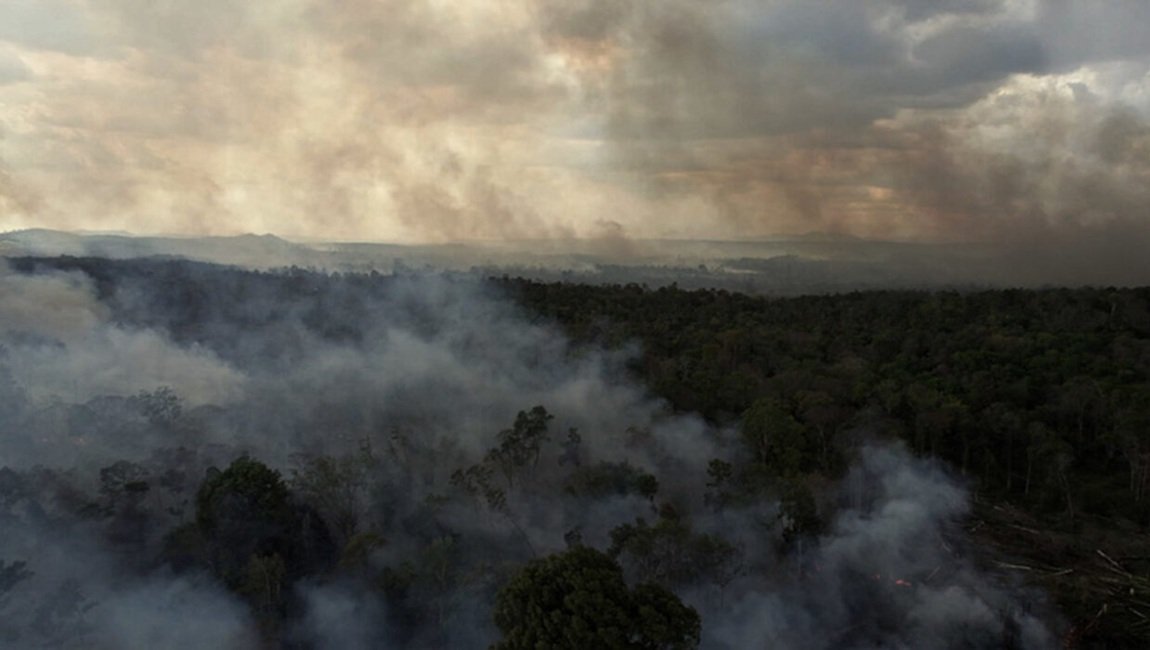
Rithy Panh, the relentless chronicler of the atrocities perpetrated by the Khmer Rouge, shifts his attention to another kind of destruction in his latest film, We are the Fruits of the Forest, one that is less dramatic but more dispersed across many years. Setting his film in the present that remains in constant awareness and conversation with the past, Panh refracts the urgently global theme of ecocide through the lens of the local erosion of the forest inhabitants’ culture. Beginning with an overhead shot of a verdant forest whose eventual destruction is already embedded in the frame through its gloomy palette, Panh pans toward the canopy, almost drawn in by the percussion accompanying the frame. The percussion forms a part of an acoustic canvas that, at least in the film’s universe, no longer exists, for Panh immediately shifts to a split-screen series of archival footages that show the ceremonies, and dances of the Bunong tribe, the arrival of their colonial overlords, their attempts at converting the locals, and, finally, the destruction of forest by the succession of wars, bombings, and Cambodian governments. The archival footage at last ends with forest fires, barren lands, private enclosures, and tree stumps as the credits roll.
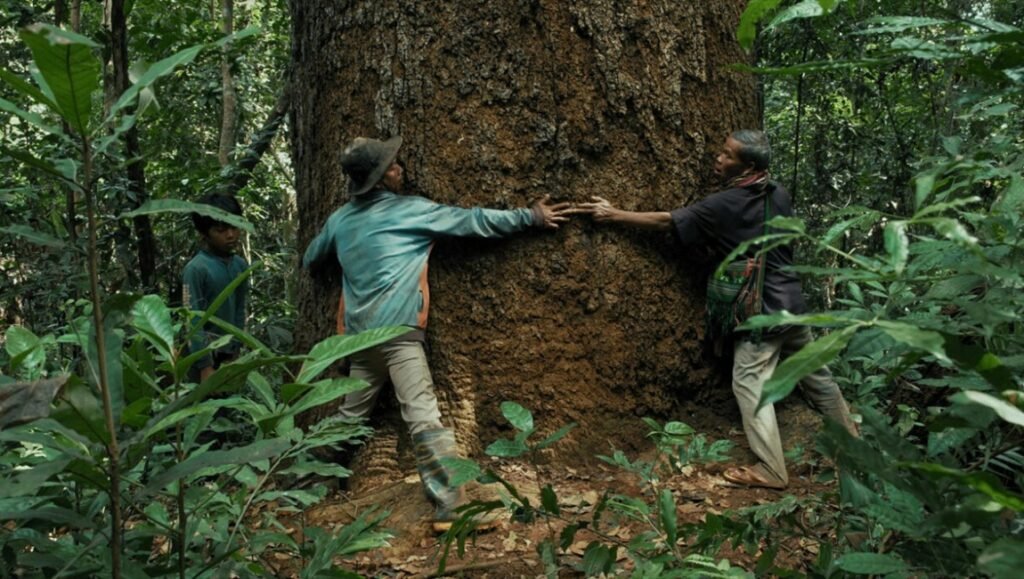
This recapitulation, accelerated by the use of split-screens, condenses an entirety of history of culture and destruction through fragments available as footage, to the extent that it almost feels as if Panh has exhausted everything he wished to say in this 2-minute segment that serves as a warning because of its breakneck pace. However, the arrival of the title card is met with the arrival of a man, clad in a blue and orange jacket and cargo pants, posing alongside the ravaged landscape. A voiceover narration begins, accompanying the man and his tribe even if we never see him speak. The destruction is seen and summarized, but Panh recognizes the need to preserve and contextualize the archival footage, even as the jaws of destruction in the form of corporations are closing in. We are the Fruits of the Forest is this man’s, whose name we do not know, and by extension, his culture’s, lament, a lament for the loss of a forest whom they revere as gods (though they do hunt and cut trees down, but at nothing close to the catastrophic pace of colonizers and corporations ), and the loss of their existence, history, and independence as they are displaced to the margins of their ancestral land and governed by the dictates of bank documents.
The narrator’s family are among the few in his village who have resisted the pressures to convert to Christianity, and therefore function as an important source of “living” history. The narrator becomes our guide to remind us of a rapidly eroding past, detailing their rituals, ceremonies, and beliefs, while at the same time, bemoaning his actions that run contrary to his beliefs, such as his woodcutting, which helps him clear some of his debts. His dispirited tone infuses an aura of pessimism into the film, with Panh continually showing the despoiling in case we ever needed reminding. Panh, like his narrator, feels that these last acts of resistance are no more than sighs of a defeated community, and his duty, as a filmmaker, is to record them for posterity. The only sign of hope is the dedication of the narrator and his family, but when their children are already immersed in the world of phones and have no visual correlatives for their older generation’s recollections, what else remains but to record their lives?
Fortunately, Panh shows some dedication to the filming of their rituals, particularly in their acts of labor. He lights his film up with lively close-ups of faces and hands cooking, harvesting and praying, even as he devotes the same treatment to other labors forced upon them by their condition, such as hunting with guns and chopping trees. His split-screen gambit continually resurfaces, both as a means of juxtaposing the past and present and to lyrically link their traditions with the movements in nature — the rustling of grass in the wind, the shifting of the clouds, and the rising of the sun. But they are also employed in their strict, functional sense, chronicling a simultaneity of actions from different angles to further illuminate their traditions. Though overwhelmed by loss, the best scenes in We are The Fruits of the Forest let the cries of the Bunong tribe resonate, serving as a document for future generations to take up.
But sadly, this mood doesn’t sustain, as Panh singlehandedly matches the narrator’s pessimism with shots that puncture the slightest glimmers of hope. Panh doesn’t see a future for the Bunong tribe in this economic landscape, so he relentlessly underscores the destruction, seldom letting their culture linger. The only way out for him seems to be to reclaim the past, which, as he rather monotonously indicates through an archival video of a Bunong woman that repeatedly flickers on the screen, haunts the landscape of the present with its suppressed cries. However, the present, no matter how broken, still exists and converses with the past, and this writer, for one, wishes that Panh devoted a lot more time to their wearied defiance instead of insistently telling us how doomed the situation is, an aspect that was made amply clear in the first two minutes of the film. — ANAND SUDHA
Also Playing
Relicto
Sixto Muñoz lives alone, but he likes to visit town to have a few beers (which his friends are happy to buy for him) and dance. Thus we are introduced to the character of the last survivor of the Tinigua people, most of whom were murdered around 1950 by a bandit named Hernando Palma as vengeance when one of their women rejected him. This massacre happened only a couple of decades after the first recorded contact of the Tinigua by Spanish-speaking missionaries. Only Sixto and his family escaped, and lived in hiding in the jungle for eight years after. Even after it was safe to reemerge, they lived in relative seclusion; Sixto’s aunt and brother never learned Spanish, and nearly everything known about their history was recorded by researchers who came to interview the lone available survivor.
Filmmaker Guillermo Quintero travels to the small town of La Macarena in hopes of finding the last Tinigua, who had reportedly vanished alone into the jungle in a canoe several years earlier. Quintero’s voiceover notes and camera record the stories of those who used to know Muñoz, and speculate on where he might have gone. These recollections blur the line between memories and tall tales. Sixto is said to be 105 or 110 years old, and to never have aged. He is a healer who could mix wild herbs to cure headaches and other pains in an instant. He could see perfectly in the dark and bullseye small animals in the brush or fish in the water in the middle of night.
Such an exaggerated, even mythical character study can’t help but play into exoticized notions of indigeneity. To an extent, then, Relicto can be seen as a study of how the rural Spanish-speaking populace recalls their former neighbor through that distorted lens, but the filmmaking plays into it as well, and not just through its editorial choices. Recurring shots of canoes paddling into the waters of the jungle or guides leading the filmmaker through brambly paths suggest an epic journey toward a primordial destination, even bringing to mind comparisons with Apocalypse Now or Aguirre or, even more closely, Embrace of the Serpent.
The effect is surely intentional, and likely meant to be visible to the audience, but it’s not a pure flight of fancy. Quintero’s conversations with interviewees mostly take place over mundane daily work, and many of the subjects in the middle section of the film — as it moves from the town into more rural farmland around a lagoon — worked with Sixto or his brother as farmers, and speak about that work, how he moved his farm about the land, planting a mango tree whenever he relocated and sold off his previous property to another family. (The land here had once all belonged to his people, and much of it ultimately therefore to him.) A contrast, albeit a fluid one, is established between the more fanciful memories of the man’s life, and the real economic terms on which the life was lived.
All of this leads to a very different concluding section, which is both more definitive and more ambiguous than the earlier parts of the film. It may be odd to talk about spoilers for a biographical documentary, but the film is structured in such a way that there is real suspense about where it’s going until it gets there, and those who plan to see the film may want to skip the rest of this review until they do so. But it’s impossible to evaluate all that came before without discussing this conclusion.
Relicto begins with a prologue that asks, “what is a relic?” The Latin root of the word refers to something left alone or abandoned, like a widow. Obviously, the question posed is what it means to be a relic of an extinct people and way of life, though this preamble also makes a questionable visual analogy by including drawings of extinct animal species along with the text.
For the last 15 minutes or so of the film, we watch a new subject at work on similar tasks to those we’ve seen throughout. But this person doesn’t speak, and as the duration runs on, it becomes clear we’re watching Sixto himself, whose discovery was never announced by the film (and who had never even been confirmed to be alive or have been seen in the past five years). He is indeed very old, but seems to get around quite well for a man who must actually be at least 90, if not truly over 100 years old. He lives alone with a dog, whom he seems to communicate with only by hand gestures.
Quintero has spoken earlier of his hope that he will find Sixto and in doing so clear up what is real and what is legend in all these accumulated accounts, but we get none of that. We learn nothing at all of the truth, beyond the appearance of the man’s hut and how he prepares some meals. When his voice is finally heard, he speaks in his native language, which no other living person can understand, and which is not translated for the film, and then it ends. There’s no doubt this simple and quiet ending has emotional and thematic power. What has been speculated on so frequently and fancifully for the previous 80 minutes can’t be answered by what is “real,” nor is this latter even legible to an outsider. But was the whole exercise a critical interrogation of such an outsider’s view, or just an elaborate confirmation of the mythical unknowability of the Indian? Has the film achieved any greater cultural or epistemological wisdom than the townspeople who gossiped about Sixto’s magical secret herbs and “jungle medicine”? Probably not, but it does at least try to pose the problem in a formal and aesthetic frame, which can’t be simply reduced to the academic one. — ALEX FIELDS
And the Moon Sets Over the Temple That Was
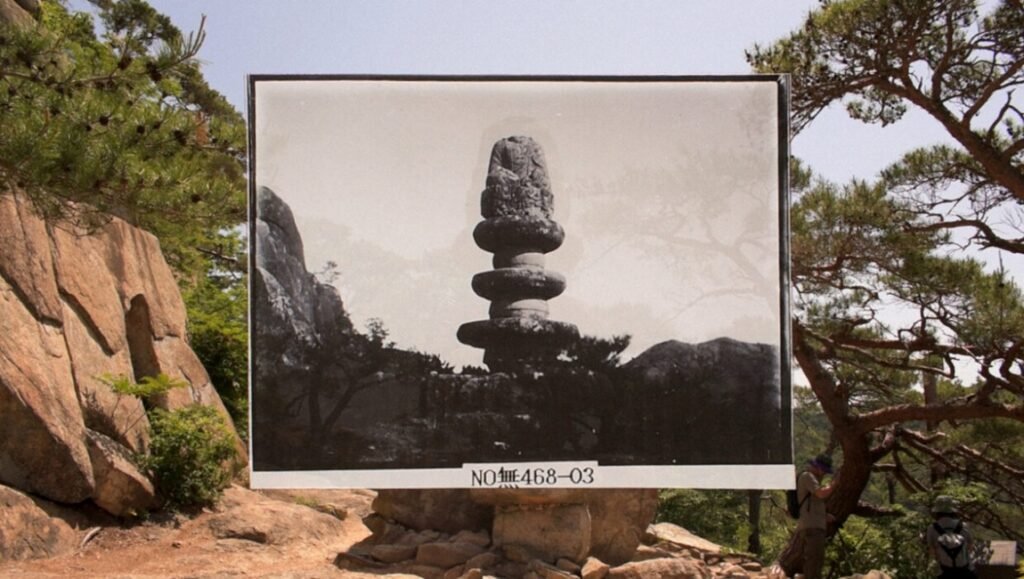
At the center of Justin Jinsoo Kim’s And the Moon Sets Over the Temple That Was lies an impulse to excavate the past through memory. What at first might seem like sovereign images on the screen ultimately get damaged, dispersed, and made to survive in fragments to catalog one’s personal history. It is to this end that the film layers inherited pictures over contemporary footage, so a photograph becomes a relived reality and a now-dead memory of a beachside trip, a rock-face, a suburban road is granted a second life today. What is noteworthy here is Kim’s reluctance to treat nostalgia as an act of yearning. In his visual grammar, images function as mere conveyors, each altering the meaning of what came before and what would come after.
Borrowing its title from Debussy’s famous composition, the film sets out on a search for a temple, for the headless Buddha statues scattered across Namsan Mountain in Gyeongju. During the trip, we scour urban spaces, rural outskirts, religious monuments, without a coherent itinerary to orient our attention. We soon realize what is really being pursued here is not really the lost objects themselves, nor even the forensics behind their mutilation. At no point in the film does Kim resort to justifying his search by historical restitution; instead, he tries to figure out what the vanished pieces mean in the face of cultural amnesia, who should be the beholder/recorder/caretaker of their symbolic afterlife, and in what ways their symbolism can be remembered and reenacted in today’s world. In the process, he allows all layers of personal, familial, and national history to accumulate on top of one another, each a porous surface through which several pasts can simultaneously be projected and gazed upon.
Perhaps that’s why virtually nothing in And the Moon Sets Over the Temple That Was offers a sense of finality. Every frame and gesture is a blatant work-in-progress, a building block to a larger mnemonic architecture. Even the Buddha figures are deprived of their wholeness and, like everything else about the film, survive as torsos, as evidence of historical erasure. Instead of taking on an academic rigidity, Kim drifts his lens through mountain paths, riversides, and coastal stretches to mimic the unpredictability of a traveler, a mere tourist. Like him, almost everyone that swims in and out of the frame strolls about the damaged monuments, pauses, photographs what’s left behind, and moves on. Their act of recording is being interspersed with old photographs (or, at times, 3D scans of the said place) that are laid over present-day views, and the resulting superimposition not only brings together past and present, but also forges a refreshed field of perception for the viewer.
Such a malleable and loose approach to the subject matter at hand also gives the film its unique visual sensibility. Kim’s images are often static, though never inert. Each holds the world in a state of constant pressure in the same way the missing monuments occupy a gravity in their wake. An otherwise idyllic view of a hillside becomes charged with meaning through the ominous presumption that something irreversible has taken place here and we are now left behind with the obligation to keep looking, to make out the shape of its absence. In this sense, it can be argued that the film’s essayistic structure stems less from theory than demonstration. Sure, from time to time, Kim lays out some historical tidbits from Korea’s participation in the Chicago World Fair to an accidental excavation of an archeological site in Italy, but these instances function less as expository anchors than as connective tissue. It’s only by performance, by the accumulation of images, gestures, and revisitations, that the structure of the scenes takes its ultimate shape.
There’s also an often overlooked cultural significance at play here. The question of the missing heads is inseparable from a broader meditation on what a nation chooses to preserve, forget, and fetishize. The so-called fetishization is also evident in some of the film’s seemingly mundane passages where we see throngs of tourists congregating in the shops to buy souvenir-shaped replicas of the Buddha. Kim’s oeuvre is too subtle to collapse any of these registers into a statement on national identity, or even history. What he’s more interested in is how each of us would respond to these moments through our own experiences. Personal memory takes precedence here and helps us make sense of the filmmaker’s motivations. Familial memory infiltrates the narrative not as a sentimental counterweight, but as its intimate correlative: the old photograph, the revisited site, the stubbornly unassimilated image of a childhood; they all suggest that history is first experienced as a disturbance in one’s relation to time and place, then grasped as part of a shared inheritance, a public consciousness.
In the light of all this, And the Moon Sets Over the Temple That Was can be most closely described as a film about what is gained after loss, on a variety of scales. Absence, as a structuring force, echoes through Kim’s narrative and assumes its own tangible afterlife on the screen. Just as Debussy’s compositions hover between ruin and reverie, we see the Korean landscape as a site where several temporalities pool and diverge in uneven measure. Nature is ancient, the photograph modern, the digital frame contemporary, and yet none is granted supremacy over the others in the way Kim builds his spatial compositions or in the way we make sense of them. The result is a cinema of delicate disjunction, one in which even the very need for excavation comes under scrutiny. Every attempt to retrieve the past risks aestheticizing the trauma, on both a collective and personal scale.
That’s perhaps why we leave the film with less certainty than one might expect from a work so plainly organized around history. Even the other sojourners that Kim comes across in his quest give him contradictory instructions, advising him to either climb higher or go back down a little in order to find the headless Buddha statues. Like many works that traffic in memory and myth-building, we are left behind by a keener sense of how our minds give the visible world its fluid edges. In the end, what is certain is that the statues persist against the test of time somewhere outside the screen, the mountains and the photographs linger within the frame, yet both are now altered by their transmission in their own way, by the very act of looking. And the Moon Sets Over the Temple That Was understands this as a formal problem in its frugal finale: it puts the actual itinerary of the filmmaker into a wider context, breaking down its surfaces and textures as the constituent materials of a never-ending semi-fictional personal narrative. While wavering between the tactile density of the place and the diaphanous instability of its map, we can’t help but wonder whether we traversed the road at all or have been nothing but mere bystanders. — SARP SOZDINLER
I Crossed the Desert With a Gun in Hand
Although the draft was last sprung more than five decades ago, America’s fortunate sons have since fathered their own lucky offspring. Called to arms out of a misplaced love for country or a displaced sense of self, these valiant heroes have ventured forth into battle and returned, whether in hordes of body bags or in the masses of zombified flesh spent, coked-up, and forever traumatized. On paper they are immortalized with eulogies and medals; in person, they lurk in the shadows, frequently anonymous and lost to the living dead. For Daniel Aaron Torres, this anonymity is official: he was deported back to Mexico, after his tours in Iraq and Afghanistan, because he never was a citizen to begin with. Having mobilized Torres and countless other young illegal immigrants to fight a trillion-dollar war without paying much heed to their status, the U.S. military apparatus just as quickly found them dispensable afterward, and dispensed with them accordingly.
Torres is the tragic subject of I Crossed the Desert With a Gun in Hand, the latest documentary feature from French filmmaker Laurence Garret. Born in Tijuana but having spent most of his years in Salt Lake City, the Iraq vet and later law student switches seamlessly between his mother tongues; his tattoos and bulky stature form a rugged if gentle demeanor, suggesting a sense of peaceful, moral temperance. But years prior to the reinstatement of his right to reside and eventual approval of citizenship, Torres was broken, suicidal, and wracked with PTSD. “Names, numbers, events. They were all a blur for me,” he confesses, not only to the aimlessness of life after wartime or the crushing fog of betrayal from the country he offered his life for, but also to the brutal exigencies of combat. Recounting a harrowing in-camp story of soldiers hardening themselves to death by shooting a pig repeatedly, Torres disappears from the camera’s view, replaced by the barren landscapes of desert Americana flitting past.
Garret’s miniature portrait of her subject is slight in narrative but nonetheless creepingly somber. As she follows Torres on both sides of the border, from his younger sister in Utah (unable to visit him for the longest time for fear of deportation) to Torres’ relatives and friends in Mexico, I Crossed the Desert raises, quite naturally, the metaphorical question: whose desert is this? The film’s contemplative and unhurried rhythm resembles that of a road trip, and Torres has had plenty of time, both in exile and upon his return, to reflect on the desolate terrain of his life, saved by a thread by a support group of veterans that campaigned and fought for his constitutional rights. These “bare dead mountains” are at once the province of the United States, the arid Baja California of Mexico, and the sands of the Arabian Peninsula. They constitute the myth of American exceptionalism, fetishized in Alex Garland’s Warfare and crystallized in the lone sojourner of America’s “A Horse with No Name.” Sing the trio: “I’ve been through the desert / On a horse with no name / It felt good to be out of the rain” — until the drought itself is dead from shame. — MORRIS YANG
Also Playing
Nova ’78
Sometimes the footage is the thing. Nova ’78 represents the completion of an observational documentary by the late Beat-adjacent filmmaker Howard Brookner, perhaps best known for his 1983 film about William S. Burroughs. Howard’s nephew, Aaron Brookner, found the unedited footage and shaped it into a perfect time capsule of a very particular moment in NYC underground culture.
The Nova Convention in 1978 was a multimedia event held at the Entermedia Theater, which now houses the Village East Cinema. The long weekend was centered on Burroughs and his work, and featured performances by a who’s who of late-‘70s avant-garde culture: Merce Cunningham, John Cage, Philip Glass, Patti Smith, Laurie Anderson, Frank Zappa, and several poets from the downtown Dial-a-Poem scene, including John Giorno, Ed Sanders, and Anne Waldman.
Most people haven’t seen these performances before, but some have probably heard them. Giorno’s record label issued an LP entitled You’re a Hook, which included many of the music and poetry performances from the Nova Convention. Those familiar with that record will notice certain editorial decisions Brookner and co-director Rodrigo Areias have made, shortening some performances (especially Zappa’s) and lengthening others. Some of the acts, like Cunningham/Cage and a brief work by performance artist Julia Heyward, were absent from the recording, since they were largely dependent on visual information. But what’s most interesting about Nova ’78 is the portrait it offers of Burroughs himself.
The writer of Naked Lunch has long represented a specifically masculinist corner of mid-century experimentalism, one that can lapse into misogyny very quickly. His infamous “William Tell” act, in which Burroughs shot his wife Joan Vollmer, to death, is perhaps the most concrete example of this unseemly queer conservatism. But what we see in this film is something quite different. Of course Burroughs’ fascination with guns is on display, and during his performance as Dr. Benway, he exhibits his fascination/repulsion with the female body. (Jackie Curtis is alongside him, amplifying the joke.)
But he is also gracious and surprisingly unguarded in this footage. And he makes what can only be described as strong statements in favor of progressive politics. The conference happened to coincide with the campaign for Proposition 6 in California, AKA the Briggs Initiative, that sought to ban gay and lesbian teachers from the classroom. Burroughs speaks out on the proposition, noting that Briggs and his sort are only starting out by targeting the queer community, and will soon move onto Blacks and Jews — as Briggs himself said, he’s after “the whole tamale.”
Burroughs is also seen chatting with Allen Ginsburg, Brion Gysin, and others about the impending revolution in Iran, noting that while the Shah may not have been a terrific guy, the Shiite fundamentalists poised to take over are much worse. Burroughs enfolds this narrative into his prepared statement on Prop 6, observing that religious fundamentalists, not homosexuals, are the true threat to life on earth and should be banned from public life.
These remarks allow us to see another side of Burroughs, although one may wonder whether Areias and Brookner included certain viewpoints, perhaps omitting others, to proffer an image of the man that would be useful for 2025. Without access to the raw footage, there’s no way to know. Regardless, Nova ’78 is an invaluable record of (as Guy Debord put it) the passage of a few people through a relatively short period of time. — MICHAEL SICINSKI

Suburbia, There and Back
Suburbia, There and Back is a landscape film set in the area around Paris, and eventually in the city itself. With static shots ranging from less than a minute to over four (but averaging around two), a compositional emphasis on geometry and negative space, and a thematic inclination toward the political economy of landscape, it is much in the style of James Benning’s California Trilogy. The film’s first and longest shot, which prefigures the rest of its structure, opens with a rainbow in the sky over a tranquil suburban landscape, birds chirping. We see houses and trees in the foreground, followed toward the horizon by a large cleared field and then a series of taller buildings which could be offices or apartments. A road is just visible in front of these. The whole upper half of the frame consists of a blue grey sky, and as the storm and rainbow clear away the distant skyline of Paris is gradually revealed.
After the title card ends this prologue, there’s a sequence of agricultural scenes of grain-harvesting machines, hand-pushed plows, rows of nearly planted fruit, oil rigs, and so on. Then there are small shops and rail stations and children playing in fields, and eventually scenes of the city itself, including for the first time interior shots and relative close-ups of human figures. In one, a Black teenager in a blue jersey sits reading contemplatively on a concrete structure, skaters and apartment high rises and a French flag behind her, while Josephine Foster’s “I’m a Dreamer” plays, perhaps the first obviously non-diegetic sound in the film. (In many, perhaps a majority, of the film’s images, either roads or rails with moving vehicles are seen, constantly reinforcing the logistical connections between all that is shown.) In this way, like the best of the Benning tradition he follows, Cattinari puts plenty of material on screen for his audience to reflect on as material evidence of our civilization and its imprint on the natural world, but never hammers home a political thesis. The film rather gives space for viewers to explore its (and their own) world.
Just as importantly, it understands that the success of this cinematic grammar relies as much or more on building formal interest through composition and editing as on anything more transparently ideological. As we move closer into the metropole, the wide shots and expansive landscapes evolve into closer and tighter frames whose shapes are informed not so much by the literal horizon and the sun’s light as by the camera’s framing of manmade structures and patterns of electrical light. In the middle sections, buildings, statues, or trains are the major geometric units that negative space is framed around. Later, images of a couple on a couch in front of a TV or a can on a road are spotlighted by highly directional artificial light and the negative is darkness. The glowing yellow rectangles of a bus stop or a train car take this nocturnal unreality to a further extreme.
All of this makes for a successful venture into familiar territory, but the prevalence of Benning look-alikes in every arthouse documentary or experimental film program for the past many years raises questions about what we want from experimental film, or whether that’s the appropriate term for a work like this, given the decades of tradition around this formal vocabulary and its many contemporary proponents. It can be called formalist or avant-garde relative to the dominant commercial cinemas of today or any other period, but its audience is different, and that audience is accustomed to everything that happens here. Perhaps there is still new territory to explore, and some artists are pushing this form in new directions, but one can’t help but wonder what it means that the best films in this vein are largely the ones that are comfortable sticking with what clearly works. — ALEX FIELDS
Comments are closed.