
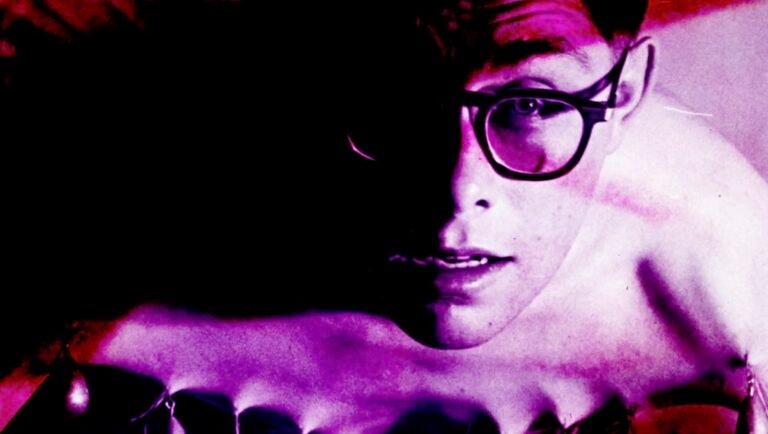
Documentarian Angelo Madsen, in his new documentary of BDSM performance artist Fakir Musafar, captured a tension at the heart of Musafar’s philosophy within the film’s very title: A Body to Live In. Musafar was a self-styled spiritual guru as much as he was a practitioner of alternative sexual practices, and his lifelong experimentation with piercing and body modification connected to his conception of the physical body as a “condition you’re in at the moment” (a quote from an interview Madsen conducted with Musafar shortly before his death in 2018). By pushing his body to extremes, Musafar found a connection to a metaphysical world that reflected his own internal life and values better than the confines of 20th century America. In his exploration of Musafar’s life and work, Madsen crafts a thoughtful overview of the complex life and work of an individual who was massively influential in kink communities and in the art world, yet whose life was perhaps even more defined by his search for communal, divine transcendence than by his role in popularizing certain kink practices.
In 1930, Musafar was born with the name Roland Loomis in a sleepy South Dakota community. In an adolescence defined by feeling apart from his peers, he began engaging in private “experiments” with bondage in his parents’ basement, inspired by world cultures’ religious and social practices as portrayed by National Geographic magazine. As an adult, he moved to San Francisco, where he created community around body modification and sadomasochistic sexual practices, eventually re-christening himself as Fakir Musafar and leading self-styled rituals on retreats with a group called the “Black Leather Wings” (the name of which was inspired by a comment made by Harry Hay, leader of the queer countercultural group the Radical Faeries). Musafar viewed piercing, in particular, as a profound spiritual experience — as he explains to Madsen, he believed that physical openings created spiritual openings. Musafar developed a broader following known as the “modern primitive” movement, and he was lauded as a performance artist in the 1990s.
Musafar can be thought of as a sexual and cultural radical, and Madsen takes care to thoroughly represent the full scope of his body of work; he is admirably unflinching in his incorporation of footage and images of kink scenes some may view as extreme. Counter to Musafar’s unconventional life, though, the structure Madsen gives the film is essentially straightforward. A Body to Live In consists of shrewdly curated archival footage in conjunction with voiceover interviews, and Madsen follows a cradle-to-grave structure, with detours to contextualize the scenes Musafar participated in throughout his life and public responses to his work.
Madsen’s perspective is often a laudatory one, but the sequences addressing critiques of Musafar’s work are some of the most fascinating in the film. Musafar reached a level of public prominence when he was featured in the documentary Dances Sacred and Profane; depicted in this documentary is a ritual Musafar created inspired by the Sun Dance, practiced by multiple Native American tribes. Musafar came under heavy critique by tribal communities for what they perceived as an unwelcome cultural intrusion. The question of cultural appropriation hangs over the film, and while Madsen addresses it directly and repeatedly, it still feels that he occasionally shies from the substance of these critiques. The distinctions between traditional incarnations of the Sun Dance and Musafar’s appropriation of it remain blurry, for instance, and Native criticism of Musafar is relegated to archival footage from a daytime talk show.
A Body to Live In suffers from missing context and formal gaps in other instances, as well. Madsen’s interview subjects, which include Musafar’s wife Cléo Dubois and performance artists Ron Athey and Annie Sprinkle, are identified briefly and mostly speak in voiceover, so that it is sometimes difficult to identify the speaker. The order of events in Musafar’s live also grows blurry in the film’s final stretch. With these caveats accounted for, though, Madsen has still crafted an accessible and engaging portrait of an artist and community leader whose idiosyncratic, deeply personal views of sexuality and spiritual life leave a lingering cultural influence.
DIRECTOR: Angelo Madsen; CAST: Fakir Musafar; DISTRIBUTOR: Altered Innocence; IN THEATERS: February 27; RUNTIME: 1 hr. 37 min.
Comments are closed.