
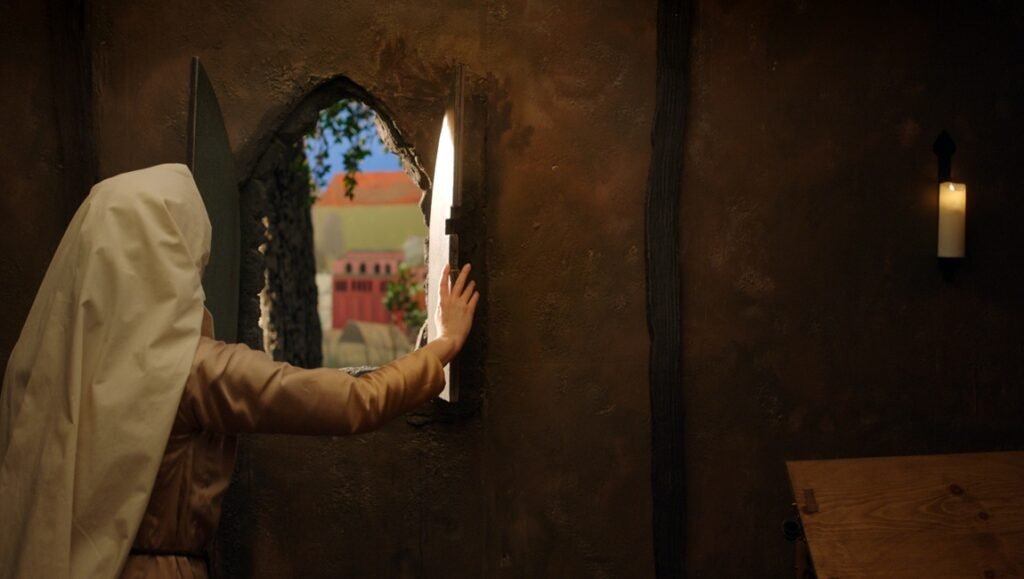
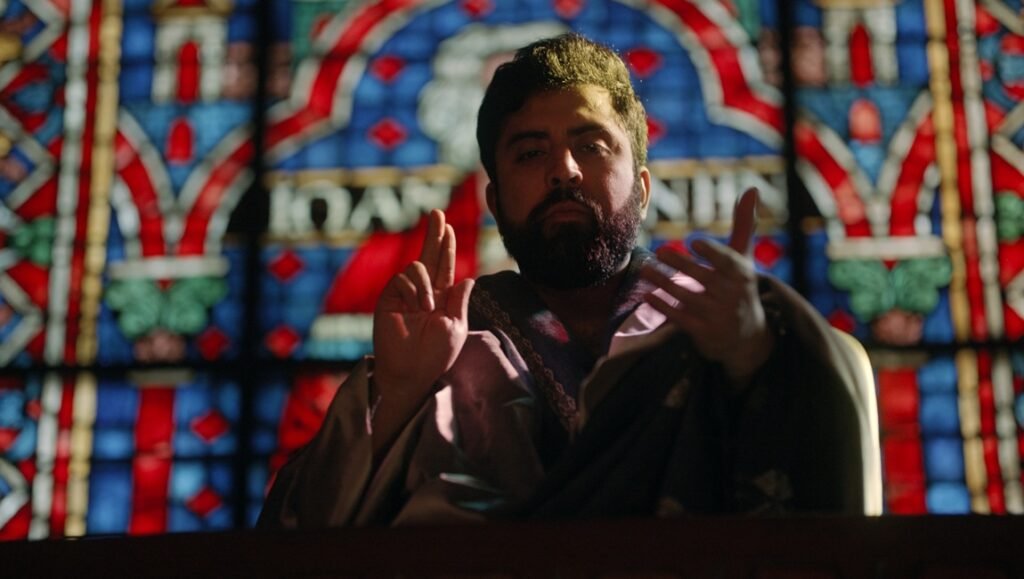
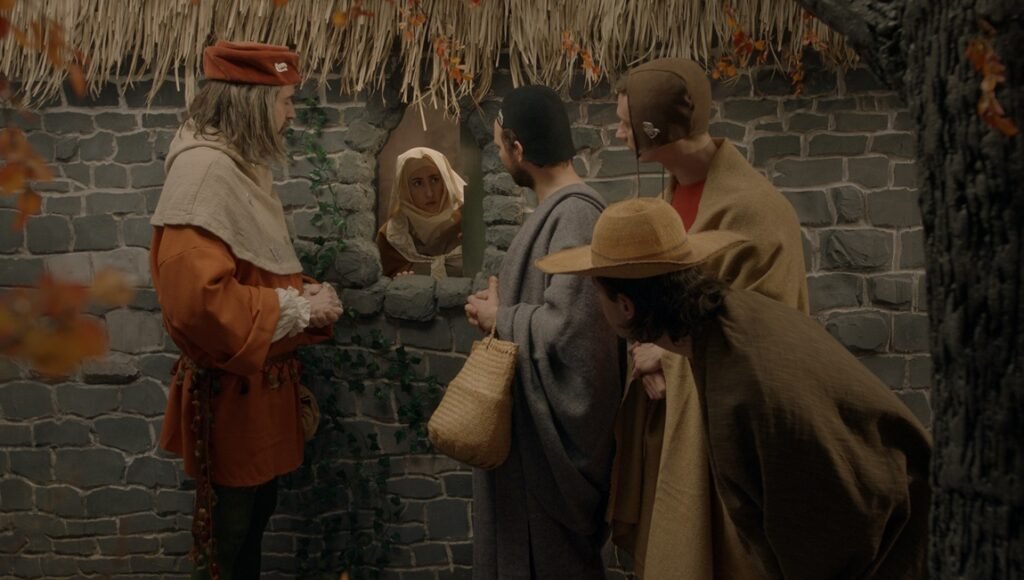
From its opening frame, you realize that Caroline Golum isn’t interested in creating a world you’d recognize as “real” in her newest feature, Revelations of Divine Love. Based on the life and writings of Julian of Norwich, a 14th-century theologian and mystic largely credited for publishing the oldest surviving English-language texts written by a woman, Golum’s film is a handwoven delight. Eschewing the traditional trappings of the cinematic Middle Ages, those grimy grays and dirty browns are replaced by gorgeous blues, pinks, and yellows. Her handspun costumes and stage-like sets call to mind Vermeer by way of stop-motion. There’s truly nothing that looks or feels like Revelations of Divine Love.
Your brain quickly moves past any sense of artifice because the world Golum has created is so rich and dense. The seams are visible, but they’re very much a part of the film’s language. Textured sound moves through the sets, filling Julian’s world with unseen life. Golum’s tactility serves a story of creation through any means necessary. Julian was compelled to write by a faith stronger than anyone around her. Similarly, Julian’s story has been rolling around Golum’s head for over a decade. A community of filmmakers came together around her to create this singular work, resulting in a film as singular as you’re likely to ever encounter, one that finds parallel stories of art persevering in the face of either patriarchal or capitalist oppression, often both.
There’s an empathy to Golum’s vision of Julian. Many films about spirituality default to poisonous irony or pathology, both painting faith as something to either mock or feel sorry for. Here, Julian’s visions are shown with real sincerity, Golum treating them as a product of honest, tangible faith. The film meets Julian where she is, not from a place of reflection. It results in one of the most moving depictions of faith in film.
As Revelations of Divine Love opens at Anthology Film Archive in New York, I sat down with Caroline Golum. Through a winding, spirited conversation, I was treated to a much-needed lesson in art history, talked through the deep parallels of Christianity and Judaism, and learned why this story has been swirling around her head for all these years.
Brandon Streussnig: I want to talk to you about artifice. I think there’s something so special about the overt handwoven quality of the film. The sets, the costumes, the props — they’re all made with clear intentionality and love. There’s never a fear of looking “fake.” You even see shots of Tessa’s tattoo at one point.
Caroline Golum: I’ve come to appreciate it. On the day, literally the day we were filming, we were like, “Oh, you can see your tattoo.” And then I just went, “Well, who cares?” We decided to roll with it. Honestly, we were hoping that people would be so caught up in everything around the random shot of her tattoo that it wouldn’t matter. You’re not the first person to point it out, but I don’t think it matters.
BS: No, not at all. I think it only adds to the atmosphere you’ve created. What helped you abandon any fear you may have had around artifice or anachronism and embrace it?
CG: Two things. One was the necessity, the real material necessity of knowing that we were limited in what we could recreate and accomplish. Leaning into artifice and anachronism gave us a lot of freedom in that way. There were a lot of constraints that we were working with, but I believe that there’s a lot of freedom in those constraints because it forces you to think creatively. The other thing is the theological aspect of the script that Dr. Lawrence Bond, PhD, and I were baking into the story early on, which is St. Augustine’s City of Man and City of God. So if you’re familiar at all with the writings of St. Augustine — and I only became familiar with them because of this film, honestly — he describes the world that we occupy, this world, as the city of man, but it’s fake. The real real is the City of God, which is where we all aspire to be. I don’t know if I buy that letter for letter for my own reasons, but as an aesthetic that we could recreate in the film, it was very handy.
From a narrative standpoint, it behooved us to make Julian’s visions, or the things that happen in her visions, as familiar to the audience as possible. Because this story is very strange, I think people would be really quick to write off her experience as being some mental episode or whatever. This movie doesn’t operate in the same way. It’s baked into the process. The artifice is baked into it because it’ll make the visions more plausible if her real world is fake. If her real world is really artificial, her visions being realistic seems more plausible to the average viewer. I think that’s the biggest hurdle I think that a viewer has to overcome: that this really happened to her. Creating that difference, that aesthetic difference, is a big part of how we told that story.
BS: Speaking more to the aesthetic, I think medieval imagery is often conveyed to us through grit, grime, and dirt. A lot of browns and…
CG: My least favorite thing.
BS: Yes! I hate it. This film looks more like, for lack of a better term, a Renaissance painting. What were you looking toward for that?
CG: No, it’s the classic trope that Monty Python satirized really smartly in Holy Grail, where they talked about how “he must be the king because he doesn’t have shit all over him.” What’s funny about that is that the cats in Monty Python were all historians and medievalists, and they met in Oxford. So they understand these tropes really, really well. Medieval art is really singular and beautiful. When you identify that aesthetic as being like a Renaissance painting, that builds on medieval art.
Now with Renaissance, let’s specify, because there are multiple Renaissances. You’re talking about the Florentine Renaissance in the 15th century. There’s a Carolingian Renaissance in the 12th century that also informs a lot of that art. If you want to do the art history dive into this movie, we can, absolutely. There is no Florentine Renaissance without the work of the 14th century that precedes it and the work of the 12th century that precedes that, the work of artists from Italy and the Levant and the Mediterranean that predate that either.
The ground glass technology that allowed Renaissance painters to render their work in a “realistic fashion,” and that’s big air quotes, “realistic fashion,” is a technology that existed well before those paintings emerged on the cultural scene. That technology doesn’t exist without the innovations that were pioneered in the Middle Ages. So yeah, okay, it’s a Renaissance painting. But let’s be honest, people are not renewing their everyday household articles with any regularity. Fashion changes in a very subtle way. Architecture isn’t changing radically. You get the Gothic era that pops off in the 14th century. The change from the 14th to the 16th is… some historians would argue it’s pretty drastic. I don’t think it’s that drastic, at least in the realm of this movie.
When you’re trying to create something that looks like a commonplace interior, the Renaissance is a natural fit for that. A lot of that is also the art direction and the cinematography. Grant [Stoops], our art director, really likes the Dutch masters and Renaissance painting, and drew a lot from that in his work. He can speak to it a little better. With Gabe [Elder], it’s the same way. Of course, we’re looking at Vermeer, we’re looking at Caravaggio and Botticelli, and all those guys. Because it’s easier to replicate than the 14th-century look that we think of, people being flat and conventional. Even within that era of artwork, even though it isn’t “realistic,” it still has a lot of realism and a lot of humanism.
BS: I genuinely appreciate this because I think many people, myself included, would use “Renaissance” as a catch-all term to describe this look. This is helpful.
CG: No, no, I fuck with the Florentine Renaissance. The Siena painting show that opened at the Met a couple of years ago, that’s all paintings from Siena from 1300 to 1450, and then the town was ravaged by plague. You look at that stuff, and you think this is a 14th-century painting at the absolute vanguard. Of what you’re seeing in 14th-century image-making, the way that they use scale, the use of architecture in the paintings, the use of color in the paintings, and allegory and symbolism, all that stuff is there and rendered just a touch more… I don’t want to say realistically, but recognizably. What we’re talking about is recognition here. The ability to recognize something that is familiar to you, relevant to you. It gets back to what you had asked earlier, too, about that anachronism and that staginess versus that realism. What is recognizable to the viewer? Medieval art is all about taking the sublime and making it recognizable to the viewer. People are wearing 14th-century costumes, even in scenes of The Christ, which happened 1,400 years prior. It’s all about adapting things so that people understand what they’re looking at because they can situate it within their own everyday lives.
BS: I feel like there’s usually only one or two ways we see spirituality in film. It’s either the hardcore evangelical side or one filtered through a person having a mental break. There’s very little sincerity, to me. You have such empathy toward Julian and depict her faith as something deeply sincere and meaningful. Where did that approach come from?
CG: I think of the spiritual films that I really admire from the European masters, like Procès de Jeanne d’Arc by Bresson, as a classic example. Flowers of St. Francis, another joint that I really appreciate. I don’t have a problem with people understanding their life through faith or understanding the world through a religious text. I think it’s really beautiful. Even though these things may be completely made up, who’s to say? I would love to wake up tomorrow and learn that all this stuff is actually real. It would be great. It would solve a lot of problems for many people around the world. It’s probably not true, though. But I feel like we owe it to anybody in history, when we’re talking about them or making works about them, or in the case of Dr. Lawrence Bond, PhD, and his colleagues, studying them or deriving scholarship from their work — we owe it to them to meet them on their terms.
When I think about what people will think about our way of life and our principles and our way of thinking, in God willing a hundred years, 200, 300, 400 years, wouldn’t you want them to meet you where they are too? I think it’s very convenient and easy for us to go back in time and look at people 600 years ago and say, “Oh, well, clearly they were all unwashed, illiterate, ignorant, hallucinating peasants who are slavishly devoted to the institution of the church.” I don’t know if that’s necessarily true. I think people have fundamentally been the same throughout most of our history as a species. People are questioning these things and negotiating the relationship to them. What kind of movie would this be if we just made a movie about a woman going slowly insane? There are a million of those films out there. I’m not interested in that. I’m going slowly insane. A lot of people I know are going slowly insane. I don’t know if I want to see a film about it. I don’t know if I want to make a film about it either.
BS: This is going to sound weird at first, but you’re Jewish, correct?
CG: Guilty as charged.
BS: I was raised Catholic, and watching this, I’ve seen so few depictions of Christianity and Catholicism depicted so accurately. Just being raised Catholic, the ornate nature of it, like the guilt that you feel, it’s all here in some way. Did Judaism inform this at all? Did you find any parallels?
CG: The guilt is a big one. When I think about the flavors of guilt that your diaspora and my diaspora are reckoning with on any given day, I like to think that the Catholics feel guilty about sex and nothing else, and the Jews feel guilty about everything but sex. That’s the parallel or the overlap. All the best movies about, at least in the States and in Hollywood especially, all the best movies about Christ were made by a bunch of Jews, Commies, and queers, right? So it’s not outside the realm of possibility that we would be treading in these things. A lot of it is aesthetic, too. It’s a very beautiful culture. The Catholic Church is very beautiful. The other thing is, when I think of my favorite aspects of Jewish culture, it’s like leftism and humor and solidarity and all the things that we prize, or that I’d like to think that we prize as a people. The Catholics have been right there the whole time. The labor movement in this country owes a lot to Catholic immigrants who came here. There’s a very strong tradition of charity and also a very strong aesthetic, a strong cultural tradition too.
So, inasmuch as my upbringing, which was not that religious even to begin with, informed my interest here, I don’t know. I always like to joke that Easter is the yard site of the most beloved and famous Jew who ever lived. When I found out Jesus was Jewish, it made a lot of sense. I was like, “Oh, of course, totally.” It’s all the same shit, right? We’re all drawn from the same fucking pool. You guys just have better decor. I think that’s what it boils down to. Better interior design. Catholics really do seem to love this move. I think it’s because faith is powerful. Your attachment to the doctrine is really powerful, even if your disenchantment with the institutions keeps you away from it.
BS: I mean, I haven’t believed in anything in years and years, and I still feel those pangs of “I hope I don’t go to Hell” every once in a while.
CG: I get it, too. It’s baked in. I think it’s very similar. I’m in a baseball group chat that has no Protestants. It’s all Catholics and Jews, which is how your baseball chat should be, I think. And that is very real. Growing up with something that is part of your family’s history and your grandparents and their grandparents and their grandparents… it used to be really tough in this country to be a Catholic or a Jew because you were a religious minority and you were probably an ethnic minority. And that’s before you adopt the mantle of American whiteness that gets you to pass through life. So I think that part of our twinge that we’re feeling at holidays and stuff is epigenetic. It’s leftover from that. I love the Catholics, though. They’re my favorite people. You guys have great taste in everything.
BS: You were developing this all throughout COVID, which I think is apt. There’s so much disease in this film, she’s living through a pandemic. Did living through one yourself inform how you conceived this?
CG: Yeah, absolutely. Because there was already a plague in it. I don’t think that you can look at medieval history without looking at the history of the plague and the impact it left on Western Europe. So that had to be part of it. In Julian’s writing, when she talks about seeing the rotting face of Christ, things like that, there’s plague imagery in the work. We didn’t get to put it into the film because we did not have the effects and budget for it, which is a huge bummer. So it would have really helped. Doesn’t matter, I can’t worry about it now. But plague is a big part of everybody’s life. I wouldn’t say that this film is a COVID film, but if you’re making a movie that already has a plague in it and then a plague happens, well. There are rewrites of this movie or different iterations of this movie where I thought, “Okay, I’m feeling this. It sucks. I hate this. It’s hurting me. I’m crying every day. People are dying. There’s nothing I can do about it.”
I thought to myself, “Well, shit. Surely the people in the 14th century, even if they were praying to an absent God for some sort of restitution or supplication or whatever, surely they felt the same way. Why me? Why this? What can I do?” They didn’t even have germ theory back then, but they were still worried about it. So there are things that I was feeling at the time, aspects of that time that made their way into subsequent rewrites in the script. But at the same time, I don’t want to think of this as being like a COVID movie. Although who knows, we’re still processing it. I think everybody was really quick to let this whole thing go into the rear view, the same way they did with the Spanish Flu a hundred years ago. You never hear about the Spanish flu because everybody was traumatized. They wanted to just forget about it. Maybe it was the same with the Black Plague.
BS: Sound is so important to your film. Even within the confined sets and the limited budget, you create an entire bustling village around Julian. You can hear it all around her, it’s quite something. What went into designing the sound?
CG: I worked with Wren Haven, our sound designer, very intimately. Right out of the gate, she totally understood the assignment. She’s really smart, she’s really talented. She also has an appreciation for the subject matter that shows in the work. This was many sessions of hanging out, just watching the movie, and talking about what it should sound like. Some of it was very specific. I said, “I want this, that, and the other here.” Then other parts of it, she’d go, “Well, what about this? I have an idea.” Every idea she had was great. So we had this very, very equal exchange of ideas and conversations about this as it was happening, which really helped the process in a big way. It was, in many ways, the most fun part of the post-production process for me. Which is not to say that I didn’t enjoy the edit or the color or any of that stuff, but the sound is a new element.
It’s where a parallel story unfolds on top of the story that you’re seeing. So it’s like its own narrative unto itself, but it also has to inform the foundational or underlying narrative there. Just for fun, we just drop stuff in there and go, “Well, how does this sound?” Et cetera, et cetera. And I told her, I said, “There’s a lot of stuff we couldn’t film and a lot of stuff you can’t see. But if the audience can hear it, then it’ll evoke a specific time and place.” And she was completely in agreement because she’s a genius. So you’ve got little things like wagon wheels or the sounds of bells tolling or livestock or whatever, that feel as though they’re just offscreen. I think what that method does is it makes the audience feel as if they are privileged to get a little quiet part of this much more vast thing that they can sense, perhaps, exists outside of what you’re seeing in the frame.
BS: I find it so interesting that Jesus, despite being a figure of supposed purity, is so often depicted as a sexual being in film. You do it here, Verhoeven did it in Benedetta. Where does that impulse come from, do you think?
CG: Well, he was a regular guy, and I think for a contemporary audience that does not have the same relationship to Christ or images of Christ that a 14th-century person would have, the quickest way to get somebody to feel as though they would follow someone to the ends of the earth and provoke their lives to them is to make them hot. So, with a kind of nod, even though Julian’s work is very different from Margery Kempe’s, there was a nice little nod to Margery Kempe because her visions of Christ are very different from Julian’s. She’s the other English mystic or visionary who wrote around the same time. She’s considered the first woman to write an autobiography in English. We had scenes with Margery Kempe that were part of this movie that didn’t make it into the final cut for a litany of reasons.
The attachment to Christ, the desire to, if you’re a young woman, you want to be married to him. That’s what nuns were, they were married to Christ. If you’re an older woman, you look at him and you go, “This is like my son.” He’s a cipher that people project onto. You would probably know better than I because I didn’t grow up in the church, but he’s a container for everything that you feel.
BS: I mean, some of those crucifixes hanging in churches I’ve been in have Jesus looking pretty cut, hanging there in his underwear.
CG: Well, it depends. There are some really scrawny, miserable 12th-century depictions of Christ, but who would want to watch that? I’ll tell you what kind of movie I wanted to make. Perhaps it’s as simple as I just wanted to cast a hot dude as Jesus.
BS: So you’d been developing this for quite a bit, and it’s a story you’ve long been attached to. You’ve previously made a short about Julian [The Sixteen Showings of Julian of Norwich]. What’s kept you coming back to her?
CG: I always wanted to make a feature. That was the whole point from the jump. I’m not really a short filmmaker, and that’s probably why I only make one movie every eight years, because it’s a lot harder to do. I thought about throwing in the towel a lot because this movie was a big lift. I thought, “Oh, I could just throw in the towel.” I don’t even mean in my life. I could just make a different movie. I could give up on this. But I was so invested in it, it’s so much work, and I’ve been talking about it. I will say telling people you’re going to do something is a really good way to hold yourself accountable. Because what’ll happen is they’ll ask you about it. “Oh, what’s going on with your movie?”
I thought about a nightmare scenario where people are asking me, “Oh, well, what’s going on with the movie?” I say, “Oh, I scrapped it. I don’t really want to do this. It’s too hard.” I thought that’s pretty sad. But the even sadder thing would be that people stop asking at all, that they’re not even asking about what’s up with the movie. So I had to do it to prove it to myself and to prove it to other people that it could be done, I suppose. Also, it’s just a wild ass story. I fucking love the Middle Ages, bro. I never get tired of it. So I don’t know. I would be remiss if I didn’t try to do this thing to the best of my ability. Everybody who worked on the film, I think, feels the same way. They all give 110% because it’s such a big swing. Even though it’s a small film and it’s very humbly made, and it’s a short movie, and it’s very confined, it’s still a big swing.
BS: I want to circle back to the beginning, before we started recording. You mentioned our mutual friend Sophy [Romvari] and how her posting about the film helped it reach certain investors. I think that’s all of a piece with the movie itself in a lovely way. Julian has so much community around her, even if she’s isolated in a room. It made me think a lot about mutual aid, for one, but also the community of filmmaking and how everyone is on set coming together to achieve a common goal. Were those parallels ever apparent when you were making this?
CG: That’s a good question. There is no one light bulb moment where I go, “Oh, being an anchoress is a lot like making a movie where you are both craving the solitude and also bristling against it, or knowing that you can’t do it without other people.” The easy answer I can give you is that this film is kind of about its own making in that way. I think that ultimately, if you make work of any kind, if you’re a painter, if you’re a writer, if you’re a filmmaker, if you’re a singer, whatever it is, if you have some personal vocation or devotional thing that you do, there’s always going to be that strife between what you owe yourself and what you owe other people.
You can’t make work in a vacuum, it will be boring. You will have nobody to share it with. It’s not even about having an audience for something. It’s about sharing with somebody that you’ve made this thing and that you can do it. So it shook out like that. I wonder if maybe the meaning of the film or my understanding of the meaning on a personal level came through in this lengthy process. I think you work on something for eight years, it can’t not be personal. Right? But maybe in the edit, as we were kind of figuring out how to best put the story across, that was part of it too.
I don’t want to call it a tabula rasa because that sounds pretentious, but people look at this, and they project their own thing onto it. It’s a film about faith. It’s a film about making art. It’s a film about the failure to engage with your community. It’s a film about engaging with your community. I like it that way. I’d rather people just project their own thing onto it. It has a specific meaning for me, but it also has meaning for everybody who worked on it. Hopefully, it has meaning for everybody who sees it, too.
Comments are closed.