
Balthazar — or Balthy, as he would be to his friends, if he had any — is a bright kid. But when your family’s rich enough to buy the world, some things slip through the cracks. “What’s a grift?” Balthy asks his chauffer, Esteban (Bobby Potts), after grilling him on a prospective senator his mother’s been courting. “A con… thieving…” Esteban digs for the right words. “They make you care about something, they take your money, and they don’t do nothin’ with it.”
Our Hero, Balthazar, the debut feature from Uncut Gems producer Oscar Boyson, lives in the space between raw wound and artifice — fertile ground for the modern American grift. He might not describe it as such, but Balthy (Jaeden Martell) is running quite the con of his own. Medicated and listless in a $50 million Midtown penthouse, Balthy tries to staunch his loneliness by recreating the viral videos of his peers. Which, America being what it is, happen to be tear-streaked reactions to school shootings. “We’re fighting for our lives, here!” Balthy sobs into a ring light, reading the shell-shocked quote from a survivor on a local news site. The camera flicks off, the tears stop like a faucet. It’s worth noting that the movie is a comedy, and, largely, a funny one.
On paper and in practice, Balthy’s pastime is cravenly dissociative at best — a corner in which Our Hero, Balthazar thrives. It’s hard to say whether Balthy feels any guilt over appropriating tragedy for clicks, or really whether he feels anything at all. But when he learns that activism might be an avenue to score with his crush, Eleanor (Pippa Knowles), Balthy ups the ante. Armed with snapshots from porn ads and, oh God, an AI simulacrum of his own mother’s voice, Balthy catfishes a potential school shooter, books a plane to Texas, and sets his sights on finally becoming the hero his Klonopin-popping mother always knew him to be.
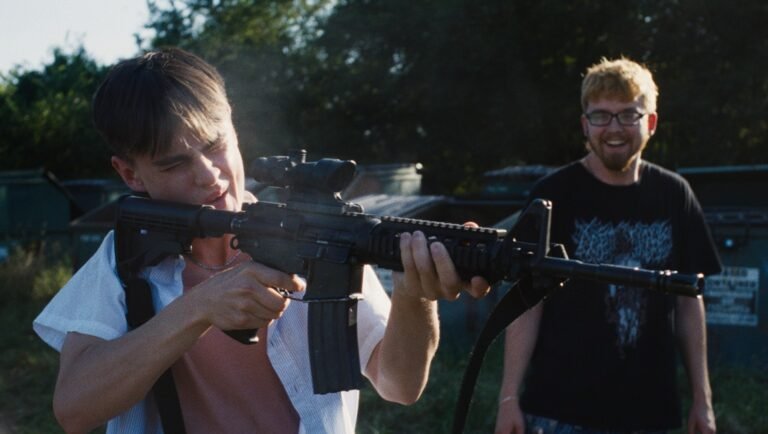
In Texas, Our Hero, Balthazar finds its footing as a buddy comedy for the new American nightmare. Balthy met the would-be shooter online as @deathdealer_16; IRL, he’s Solomon (Asa Butterfield), a moonfaced metalhead dork who pumps gas to pay his grandmother’s rent. Connecting the poles of either end of the American socioeconomic divide seems like a weighty endeavor, but Boyson resists the urge to load his movie with punditry. Instead, he finds Balthy and Solomon as they are: two desperately lonely kids in a country warped beyond recognition, acting out online in the wild hope that someone will notice.
Positioning David Hogg and Dylan Klebold stand-ins as a new-millennium Odd Couple is a provocation by default. Our Hero, Balthazar isn’t immune to taking edgelord barbs — Balthy fumbles a date when he tries to make a move while dark-web footage of a school shooting streams in the background — but Boyson’s movie is remarkably sober given its subject matter. Often, it’s pretty sweet. It takes Balthy a minute to catch on, but it’s clear from Solomon’s introduction that his threats to shoot up a school are mostly hot air. His cache of guns seems more a Texan prerequisite than a malicious arsenal, and while he does like to go shooting, he’s just as quick to rap the theme song of his favorite Nickelodeon cartoon.
Balthazar and Solomon, whose Biblical names feel more prank than parable, are bizarre reflections of each other through the Internet’s dark glass. Their pairing deliberately swerves past any grand statement, but while Our Hero, Balthazar doesn’t set out to diagnose kids these days, it suggests their unlikely friendship is a biproduct of helplessly longing loneliness. And it turns out that incels on either side of the political spectrum have more in common with each other than they might have thought. That Solomon shrugs off Balthy’s catfishing seems suspicious at first, until he reveals that he matched Balthy’s AI-mom erotica with screenshots of his own father’s penis. Solomon’s dad is a former porn star who skirts by these days hawking manosphere-branded testosterone supplements. He’s a far cry from Balthy’s socialite mother, but both kids are left aimless and bored beyond belief, abandoned to define themselves with little more than a 5G network.
A school-shooting premise demands that even a comedy as subversively buoyant as Our Hero, Balthazar should arrive at calamity. As Balthy and Solomon careen toward Chekhovian disaster, Balthazar doesn’t quite stumble, but its rhythm loses a bit of syncopation. The misfits one-up each other over hurdle after hurdle of performative nihilism until escalation becomes a means to its own end. To watch a movie so brazen flirt with rote plot points for the sake of reaching a discernable conclusion can challenge what makes Our Hero, Balthazar so exciting in the first place. It never quite loses its grip — it’s certainly never boring — but watching Solomon pump a disaffected Manhattanite full of designer drugs before teaching him how to use a gun sets a high watermark that Boyson’s movie can struggle to maintain.
For a good stretch of the 2010s, even the most seasoned auteurs seemed to throw up their hands when it came to smartphones. Within the past few years, that dam has finally broken: Eugene Kotlyarenko’s The Code embraces the hyperkinetic maximalism of the always on; Peter Vack’s www.RachelOrmont.com revels in the muck of burned-retina online discourse; Pascal Plante’s Red Rooms fashions one of the decade’s best thrillers out of the deepest corners of the dark web. The Internet canon is deliberately exhausting and exhilaratingly alive. These movies function like raw-nerve synapse bursts, risky provocations that, at their best, feel like inhaling the seconds between rolling thunder and bursts of lightning. It’s a budding genre within which Our Hero, Balthazar finds a welcome home: the buddy comedy has arrived, dead-eyed and lunatic, at the door of the Attention Economy. Can it borrow your phone?
DIRECTOR: Oscar Boyson; CAST: Jaeden Martell, Asa Butterfield, Jennifer Ehle, Noah Centineo, Chris Bauer; DISTRIBUTOR: Picturehouse; IN THEATERS: March 27; RUNTIME: 1 hr. 36 min.
Comments are closed.