
With most established classics of cinema, it only takes a little work to extrapolate what each sequence is meant to convey to the viewer, but Claire Denis’ Beau Travail is one of the most mysteriously elliptical of said classics. The broad strokes of the narrative arc are comprehensible enough, and doubly so if you have any familiarity with Herman Melvillle’s source novel Billy Budd, but the details from moment to moment can’t be pinned down and frequently involve Denis grafting disparate sources onto one another until they’re nearly unrecognizable — they shimmer like heat mirages and are just as vivid. It’s a fitting quality for a movie where Denis and cinematographer Agnés Godard frequently had to shoot completely blind and didn’t know what images they’d managed to shoot until substantially later in the production process, before Denis and her editor Nelly Quettier transfigured what they shot into something like a tone poem of power dynamics and elemental feelings. The team trudged through the salt and sand, were rewarded with music and dance, and conveyed that journey to their audience. They were aided by the presence of Denis Lavant as their lead Galoup, he of the body that expresses whatever his face cannot and thus a perfect match for this film’s thematic interests. He was provided a tattoo of a motto to make even the slightest motions of his chest more evocative of his character: sers la bonne cause et meurs.
“Masculinity” is the ultimate key word for any discussion of Beau Travail — there are very few women in the film despite a predominantly female crew, and so much of the film is as closed-off as you’d expect for a project about the French Foreign Legion and the military life it captures. Lavant’s Galoup lives a regimented life training troops in the sands of Djibouti, a location with echoes of Claire Denis’ childhood as the daughter of a French civil servant living in colonized West Africa. Her auteurist themes are notable enough to anyone who’s familiar with her biography and overall body of work (although Beau Travail, as her fifth feature, was only her second film to actually be set in Africa — it also nearly turned out to be a TV movie), but more curious is the presence of Michel Subor as Levant’s commander, Bruno Forestier. As the lead of Jean-Luc Godard’s Le Petit Soldat (1963), this makes Beau Travail both an unofficial sequel that somehow managed to outshine the original, and a suggestion of Denis’ childhood cinephilia becoming tied up with the disciplining authority figures of both patriarchy and colonialism. (She uses Neil Young’s song Safeway Cart, a song about both urban poverty and Jesus Christ, to further heighten the atmospherics and supply more elliptical connections between the themes of colonialism, sacrifice, and beauty.)
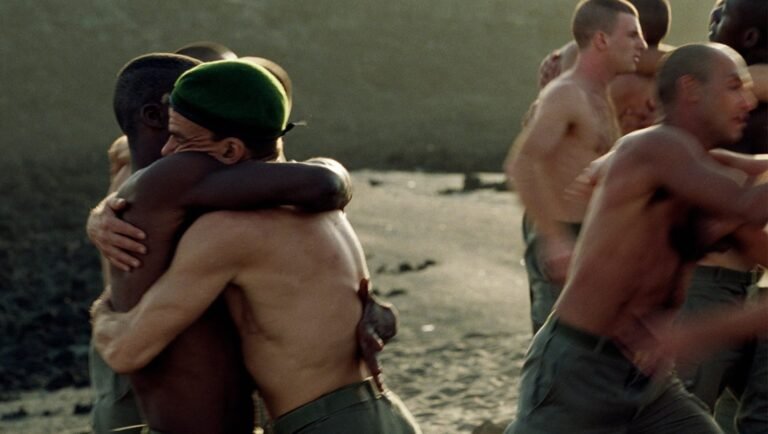
Galoup’s voiceover that sews together the flashbacks is frequently as close as the film comes to having a consistent dialogue, and verbal communication is largely limited to the most notoriously homoerotic sequences and the music that accompanies them — large groups of shirtless men engaging in military drills against the sun and sands of the desert locale, set to excerpts of Benjamin Britten’s opera of Billy Budd and choreographed by a ballet dancer in Bernardo Montet. (He was only given the Britten and Young to work with, and told to find nonprofessional dancers to work alongside actual Legionnaires.) One sequence of an exercise that would resemble tender embraces if they weren’t closer to virile collisions is perhaps as tender as the film can get when it comes to the bonds of men, even if their makeshift society does what would typically be women’s work by ironing clothes and peeling potatoes. In between these moments of living by codes, with Galoup perpetually above the men he manages and left disconnected, the men occasionally visit the disco and spend equally incommunicative time with their Djiboutian girlfriends. What few women are in the film form a slightly bemused group of Greek chorus-style witnesses to the oddities of these men, and get to directly acknowledge the guiding force of the camera in a way that the men can only do when they’re striking a group pose.
Grégoire Colin as the pretty new recruit Sentain is Galoup’s undoing, but he will never quite know why — Denis described the film as an exploration of what it means to be “a foreigner to oneself” alongside being a literal one. Everyone comes to a different moment of dawning awareness in Beau Travail that the film is ultimately about repressed homosexual longings (and then needs to start thinking about how those feelings interact with military power), but Galoup is not so lucky. What ultimately sparks the small narrative is Sentain becoming increasingly favored by Forestier after a daring rescue, which leads the jealous Galoup to provide him with a tampered compass and banish him to the desert on a phony mission. He nearly dies and is only rescued by the Djiboutian locals, and when the truth about the faulty compass comes out, Galoup is expelled from the Legion. He goes to Marseilles to dwell on the events of the film from memory, now left a man without a real home or connections to the world. After a whole film of Galoup only hinting at deeper passions that he’d never expressed before, Denis finally allowed him a proper exhalation with one of the most transcendent endings in cinema, but only after making his bed one last time for him to lie in. She directed Lavant to treat his improvised movements as “a dance between life and death,” but despite this weighty descriptor, it was initially conceived as a scene for the middle of the movie. (Beau Travail features a small hint of where the scene was originally meant to be when Galoup wears the same all-black outfit following what’s implied to be the morning after a clubbing night for the Legion, but Denis was able to seamlessly transfigure it into foreshadowing instead.) Whether Claire Denis saw the appropriate irony in Corona’s song Rhythm of the Night featuring vocals from a ghost singer who hid behind the group’s frontwoman is unknown, but she certainly grasped the escapist potency of Eurodance as a contrast to rigidity, and Lavant concludes the film with the most metaphysically startling “exit, stage right” ever conceived.
Comments are closed.