
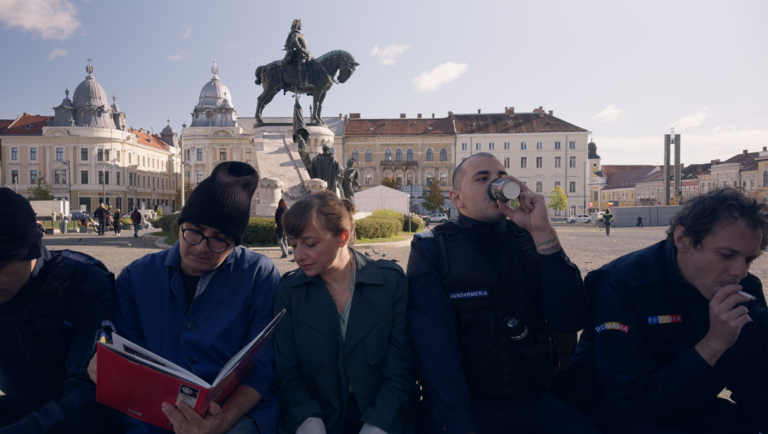
A man emerges from the forest, destitute. We follow him as he shambles through the streets, parks, hills, and graveyards of Cluj-Napoca. It’s his last day on earth. When Ion (Gabriel Spahiu) wakes up the next morning in his makeshift home — the boiler room of a building scheduled to be torn down, making way for a luxury hotel — the bailiff Orsolya (Eszter Tompa) is pleading with him to vacate the premises. She has placated the developers as long as she can, and if he fails to leave by choice, the gendarmes waiting outside will have to remove him by force.
They give Ion 20 minutes to pack up his things, and in that time, he manages to leverage his own weight against a radiator to strangle himself with some wire. Orsolya, understandably, is distraught. She spends the rest of Radu Jude’s latest provocation Kontinental ‘25 wracked with guilt, but not necessarily remorse.
Through a series of revealing encounters with her husband, her friend, her mother, her former student, and her priest, patterns of equivocation and self-delusion — frequently stoked by these fellow Transylvanians — emerge as she fights tooth and nail to preserve her self-image as a morally upstanding person.
Shot (beautifully) on an iPhone while production stalled for Dracula (2025), Kontinental ‘25 hits a wide range of pressure points in Romania’s shifting cultural, political, and edificial landscapes — exploring the gaps between feeling and action, and flagellation and reparation — through the lens of one well-meaning liberal coming apart at the seams.
Ahead of its limited release in the U.S., I spoke with Jude over Zoom.
Alexander Mooney: Architecture is a convergent point for the film’s commentary on housing crises, urban renewal, and the lasting impressions of European geopolitics. Can you talk about how it factored into the writing and shooting process?
Radu Jude: That element wasn’t there from the beginning [of the project] because it was an old idea that started from a news item, and then it developed little by little. I abandoned it a few times, got back to it, and actually, in the last 10 years, urban development [increasingly] became a big money industry, and in many cases something quite ugly — there’s a mix of corporate greediness with local political corruption and disregard of the law, a disrespect of the quality of buildings, disrespect of any ecological or urban standards of living. The quality of everything is a mess underneath the shiny advertisements for this [renewal]. So at some point, these two ideas converged — the one about morality, the topic of the film, and then I decided to place it in a space, in a specific city, in a specific moment, and you are right to point that making visible this chaos, and this ugliness, and this urban construction — which is also an urban destruction, the destruction of public spaces.
AM: Orsolya’s friend Dorina remarks that the buildings and the urban spaces recall those of Vienna and Budapest, rejecting the notion that Transylvania was always Romania’s. The line suggests that architecture and development can be critical to national identity, and in the final sequence you show how this sense of identity is in a constant state of gentrifying flux.
RJ: Yes, that’s also another issue here, since the history of Transylvania is a traumatic one — it belonged to Hungary for hundreds of years, and now it has belonged to Romania since the first world war. There’s always a lot of discussion about who was there first, kind of useless discussions because in the end, I believe in the status quo of the European Union that it’s a good thing that no countries can start asking others for territory, because as you know, the history of the world and of Europe as well was always very bloody, because of this demand for historical rights or whatever. This doesn’t exist anymore, according to the law, but the law is one thing and what people think is another.
So, there’s a lot of debate about this among Romanian nationalists, and also among Hungarian ethnics in Romania or Hungarian nationalists in Hungary. These discussions end up in absurd [territory] — the Romanian nationalist says, “look at this city, how beautiful, it is made by us,” and of course I’m like, “What do you mean made by you?” If you look at the architecture, which is larger than the scale of human life, then you notice that this architecture is not in the style of the rest of Romania. It’s in the style of Hungary or Austria. So, how could you say you were here? I wanted to point out how, indeed, architecture can be a witness, it can be proof of something more than just aesthetics.

AM: Notions of identity loom large here. Orsolya is scrambling to protect her own sense of self as a flawed yet essentially moral person, but for most of the movie she’s failing.
RJ: Part of the film has to do with words, and the connection, or lack of connection, between words and reality — how words are organizing our perspective on reality, our perspective on ourselves, our definition of events and how they can be used in ways which are not innocent at all. They might look innocent, but they are not innocent. This is why I think it’s a film — if I can be a bit pretentious — that is a staging of the words in the film. The film is staging the actors, of course, and the camera, but it’s staging the words and the expressions very carefully. Of course, in translation some things get lost, but I was very careful.
For instance, the main character is telling the same story over and over again about the suicide. In the tone and in the gestures, the way she’s telling the story, the words she uses, or the synonyms she uses in some cases, mean different things. Just a small example, when she says, “it was stinking of piss,” and another time she says “urine” — it’s the same word from a certain perspective, the same reality that it’s expressing, but the choice of word is not innocent, it expresses other things.
She’s always trying to find a way to redefine herself in light of the tragedy that happens around her, and in the end, with the help of a few people, she succeeds, I guess. She reframes that in her favor. It’s interesting, because in discussions about the film with other people, they’ve said, “this woman who’s having a deep moral crisis,” and I say, “she’s having a moral crisis or she’s pretending to have a deep moral crisis.” We’ll never know. I’m not saying she’s faking it completely, but there’s something “sweet” in engaging yourself in a kind of self-lacerating suffering which is not organized in a way that changes something.
I don’t know. I don’t want to be so judgmental about people, and about my characters in particular, but I feel that, intuitively, there should be something on the edge, something in between a real moral crisis and a crisis that is just a regular thing to have if you’re a good progressive person. There’s something trickier. The crisis of the character is in this gray area.
AM: She gets shunted toward a religious reckoning in the final stretch, and it’s deliberately not a very convincing one, and she’s reminded by the priest that Ion’s suicide was a sin. How does religion relate to the personal, political and national here?
RJ: I wanted the religious dimension because religion and the Christian Orthodox, after the 1989 revolution, has been more and more important and connected with the status quo of the state and of the values of the state. This happens everywhere, in a way. Religion and the state, which becomes like a state religion, is there to calm the situation down and keep the status quo. Even if it appears to change.
It’s weird, did you see that photo with Trump and like 20 people around him praying with their hands on one another or so something [laughs]. It’s crazy, and it’s the same thing — religion is helping them say, “God will help us kill this and that, and kill the ayatolah.” [Romania’s] religion was always connected to the state, including the fascist state, including the communist state — it was a national church that collaborated, always, with power. They even have an expression about that: “church-state symphony.”
Since our state today is somehow emphasizing a kind of neoliberal, pro-business perspective on things, it’s funny to see in church the priests trying to justify the system as it is. The priest’s arguments are ones that you can find in the Bible. It’s the arguments priests are using to tell someone, “you were doing your job, you didn’t do anything wrong, who are we to cast the first stone, suffering exists.” All these things are used to suppress, to keep any possible revolution out of reach.
Comments are closed.