
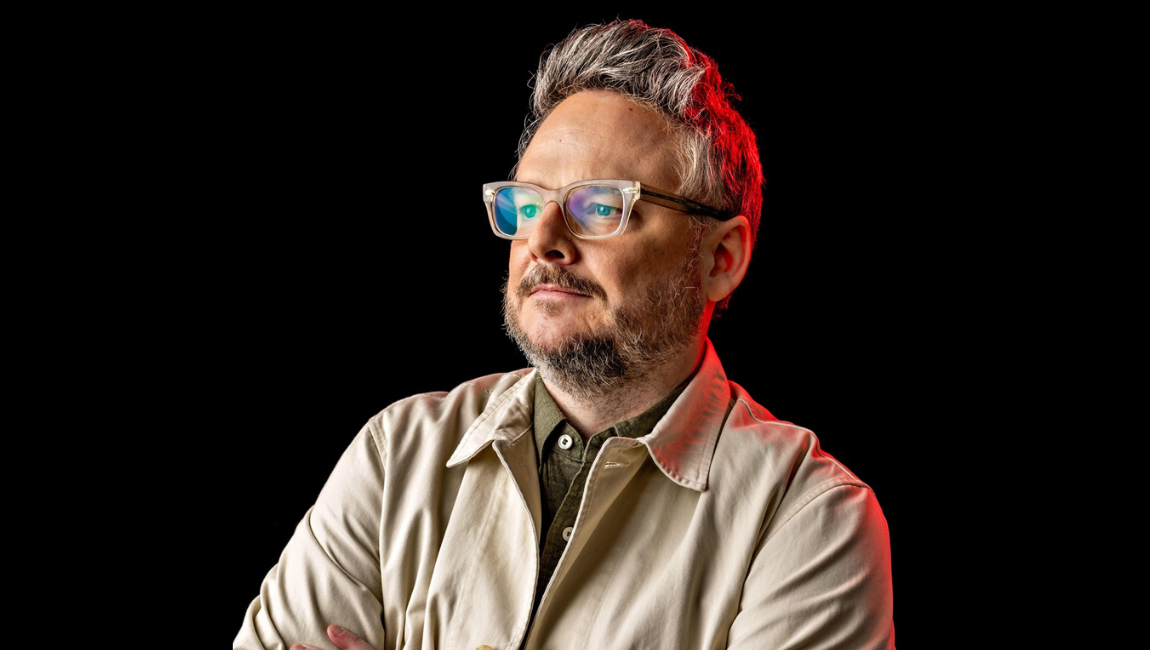
In the last decade or two, it often feels like action comedy speaks one language. You can blame Ryan Reynolds if you’d like, or maybe it goes further back to Joss Whedon. Whoever you want to throw the book at, it hardly matters. The point is that we’ve long been in a spate of a couple of “cool” guys pointing guns, getting into fights, and speaking in the same detached and ironic tone. One of the many ways BenDavid Grabinski’s latest, Mike & Nick & Nick & Alice, feels refreshing is in the earnest approach to its deeply strange, heartfelt humor.
To describe Mike & Nick & Nick & Alice in just a few words would be a fool’s errand. Perhaps as foolhardy as traveling back in time to save the partner you framed and had killed. Feeling guilty after doing that exact thing, mobster Nick (Vince Vaughn) travels through time to prevent his partner Mike (James Marsden) from being whacked. How he gets a time machine would be to spoil the very fun way this movie reveals its means of time travel, and why he wanted Mike gone in the first place would give away even more. Grabinski, through his own sense of off-kilter humor and sensibility, weaves a tale of love, friendship, and remorse by way of a time-traveling gangster comedy. Gilmore Girls riffs, a phenomenal Jimmy Tatro performance, and incredible set pieces pepper a film positioned like the first action comedy in many years to feel like its own thing.
This is due, in large part, to Grabinski’s pop culture references being more than just a simple “Hey! I got that!” Almost every single one plays into not only the fleshing out of his characters, but also underscoring or revealing some piece of information in his winding plot. Not content to only give his humor meaning and personality, he goes ahead and creates fights that feel so singular compared to the glut of boring, generic action we’ve seen in these kinds of comedies. Abandoning the fast-paced, blurry Raid-style fights that have polluted Western action, Mike & Nick & Alice gives its characters each a different means of pummeling their opponents. Marsden’s Mike is more lithe, more tactical, and zips around a room. Vaughn’s Nick is a burly, rumbling brute who fights like a guy who’s had one too many beers. It may seem like a small thing, but for the more action-literate, it stands out as a real choice made by a filmmaker taking the craft seriously. He’s not trying to illicit a “THIS RIPS!!!” from the crowd. His fights are baked into his script and layered with character detail.
I caught up with BenDavid after a screening at the Museum of the Moving Image. We talked about the film, building out those fights, what’s so special about James Marsden, and the perennially undersung Kirk Wong classic, The Big Hit.
Light spoilers follow.
Brandon Streussnig: I’m super into the action you pulled off in this one. You worked with longtime stunt choreographer Justin Yu, someone I know a little bit. What were some of the conversations you were having about how you wanted the action to look?
BenDavid Grabinski: Well, I didn’t want it to feel like anything that was on trend. There are some specific movies in the last couple of years that I’m not even talking shit about, just where they kind of are or are trying to be. They kind of feel like they’re trying a bit too much to find new ways to shoot action. I personally don’t think you can get much more exciting than a lot of my favorite classic Hong Kong action movies. I don’t think there’s anything that we needed to do that was new.
There is some stuff that’s really interesting to me, but I wanted it to be classically shot, and I wanted it to be wider. I didn’t want it to be so frenetic, so you don’t really know what’s going on. I thought that if everything had a consistent stylization to it, the different fights could have different tones to them because each of them has a different energy, either in terms of influence or in terms of just tone. Some of them are leaning into physical comedy. Some of them are very visceral and reference Heroic Bloodshed movies. They all have a different thing.
I think that if there’s a consistent visual approach, then you can have them feel like different kinds of dance numbers. I say this a lot, even if it’s not interesting, I think that all choreography is choreography, whether it’s a musical or it’s fighting. To me, the fight scenes are the same as if there were dance numbers in a musical, which is part of why I cast James Marsden. I knew he could do this even though he’s never done this type of action, because he’s clearly a guy who can learn choreography really well.
BS: I’ll come back to the action, but you brought up James Marsden, and I want to talk about him. I love how you cast him here as Mike. He’s such a great, versatile actor, but I don’t think we’ve ever seen him play, for lack of a better term, “cool” before. He’s like the traditional good-looking hero, similar to Cyclops but much less dorky. Tell me about casting him.
BDG: I just felt in my gut that like 70% of what the character has to do is stuff that’s kind of in his toolbox already. I thought that his commitment to it would work because I think that for Mike to be cool, he has to be a guy whose action feels precise and focused, like a tactical former mercenary-type, where he’s efficient instead of being show-offy. I wanted to feel like he enters a room and is assessing what’s going on and handling things and improvising as it goes along. Just very efficient. I thought that if he learned the choreography and behaved in that way, it would feel cool in an effortless way because he’s a little bit of a goofball in the movie when he’s not doing action.
They spend the whole movie calling him Quick Draw Mike, but he doesn’t fire a gun until the last 15 minutes of the movie. So, I thought if he nails that choreography at the end, it’s kind of a payoff for a runner because he spends the whole movie saying that he wants to get out and doesn’t want to do this stuff anymore. It goes back to Hairspray. I watched Hairspray on a plane, and he was so effortless and locked in on the dance sequences. It’s like, okay, just treat it the exact same way, and he did. He had dozens of sessions working with our fight team. He went and did tactical training several times on his days off in Winnipeg. He just kept working and working and working on it because we felt that if we nailed that, that is where the coolness comes from. So it’s just knowing that he was invested and knowing that that amount of work to him was appealing made me know it would work.
The thing about him is that he’s fearless in terms of trying anything. He’s a super nice guy who would always be like, “Oh, did you think that went well?” There’s no cockiness to him, but he’s very professional, and he’s the kind of guy who shows up and knows every word of something, knows what your intention is. He was game for everything. I just remember at one point, we were shooting on the rooftop of a hotel, and someone said, “Oh, he’s in the ballroom downstairs working with the fight guys.” It was his day off, and he was just going over and over some of the stuff from the finale again. Of anything in the movie, his bit at the end was what I had the shortest time to shoot. I was completely running out of time on the very last night of the shoot, and everything that happens when he goes in that room and starts shooting everybody was shot in the span of like four hours.
BS: Jesus, that’s insane considering what goes into it.
BDG: Yeah, it is insane, especially because there’s intentional lighting in the movie. This isn’t one of those movies where they’re like, “Oh, well, we just have 360 lighting, and we’re just going to shoot a bunch of stuff.” It’s stylized, but he knew it so well. We could just go piecemeal, shot by shot, and just try to go through it as efficiently as possible. He would get everything in like two takes, which is really impressive.
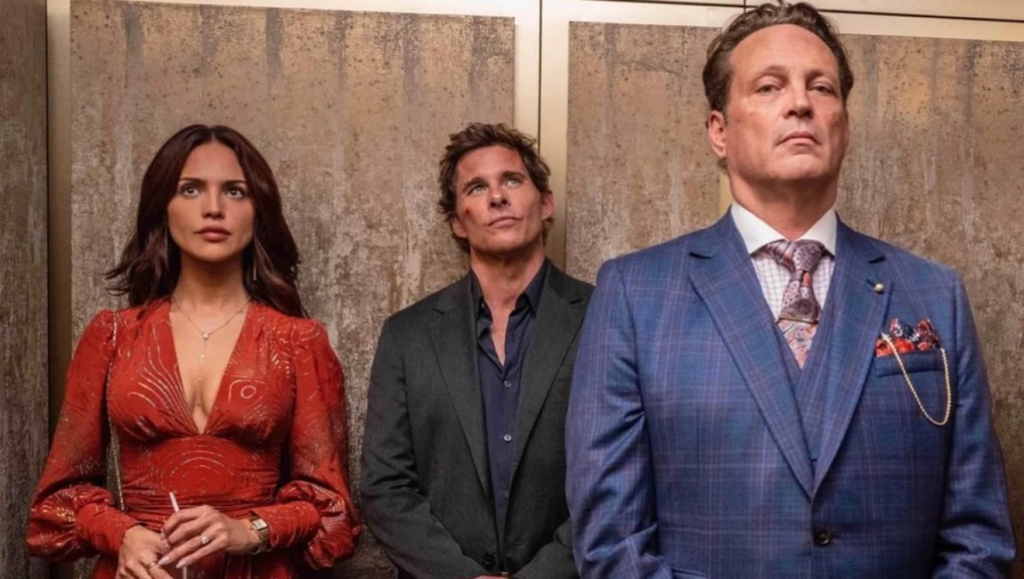
BS: Your action and fights feel like everyone is doing something a little different. You see many modern Western action films, and everyone is kind of just fighting exactly like their opponents. It’s so refreshing here because you have a smaller, scrappier guy like Marsden who’s more tactical, like you said. Then you have Vince Vaughn, who’s much bigger and whose fists land with bigger thuds. Were their fighting styles written into the script, or did you tailor that to their casting?
BDG: Well, it was always planned to me that Nick was more of a brawler and a bar fighter, and that it’s an unspoken backstory. I always felt that Mike is a guy who was in the military, then became a mercenary, then left that, and then somehow ended up working in the mob, and we find him at a point where he’s like, “How the fuck did I get here? I need to get out.”
Casting them was a plus because I think that the height disparity creates a fun difference between them when they’re fighting each other. Also, Vince is a guy who, if you’re looking up at him, you’re like, “Oh, fuck.” James is a guy who you might not expect to be as badass. It’s really fun too because when we did all our fight previs, we had a guy who was James’ height and a guy who was Vince’s height, so you can really see how it works, and we didn’t start that until we had the people cast. I do think that it does create this kind of weird, different energies between the two of them. It’s true that a lot of fights do feel like everyone’s just doing the same thing, or in your shootout, everyone is being the same type of gun guy.
That’s why I liked having Vince do the double gun thing, but then James not doing that. It just felt like if they were repetitive, when you’re cross-cutting between them, it would not be fun because you need to feel like when you’re seeing Nick’s action, that feels like a thing. Then, when you’re seeing Mike’s action, that feels like another thing. Otherwise, it’s just like the same, same, same, same, same. Especially if you had two Nicks doing the same thing, and then he’s also doing the same thing as Mike. It would become really boring. So with everything, whether it’s action or humor or drama, once you start casting people, you start trying to figure out how they can have different energies so the movie doesn’t become too repetitive.
The comedic scenes have many similar tones, but Jimmy Tatro and Vince Vaughn don’t have the same comedic energy. Neither does James. Keith David is his own kind of beast. Arturo [Castro] is his own thing, Lewis [Tan] is his own thing. That’s important too because they’re a bunch of idiots in a way that I find charming, but if they’re all dumb and they all have the same kind of delivery, you’re fucked. If they’re all efficient badasses in the same way, then it’s sort of the same thing.
BS: Speaking to that humor, our mutual friend and filmmaker Liam O’Donnell has this term that always rolls around my head when it comes to modern action comedies: Snark Mind Virus. It’s like they’re all plagued with the same bad humor that sounds the same coming out of everyone’s mouth. I think there’s a world wherein someone sees a trailer for this film and writes it off as being that kind of comedy. What I love, though, and maybe it’s unfair because I know you, but your humor is immediately your own. It’s so strange and earnest, it never feels like it’s making fun of the film. How do you strike that balance?
BDG: Well, I think when the movie is irreverent, there can be a danger in having your characters tell the audience that it’s stupid. The movie is sort of designed to be a pretty good balance of knowingly dumb but also smart, which I think also lets you kind of get away with the sweetness and the emotion that comes in later. If everyone was glib and they knew they were in a movie or were behaving as if they were better than the movie, to me, it kind of feels like you’re saying, “Well, this sucks.” I mean, there’s a weird balance of my tone, which I think is also just representative of me. I can be kind of deadpan and sarcastic, but I’m also pretty sentimental and kind of a softie because I love the romance stuff in the movie, and the emotion in it really comes from a real place. At the same time, I do like silly bullshit, and I like watching a bunch of lovable idiots get in over their heads on things. I think that part of it is just that, God bless them, a lot of people in this movie are stupid, but in a way that I find endearing.
The smartest guy gets shot in the opening of the movie. It was really stupid of him, though, to borrow money from the mob to build the time machine. It’s a weird thing to say about someone you wrote, but it’s like, I don’t know what the fuck that guy was thinking. I try to infuse stuff as much as I can with my own specificity because I think that’s what’ll make it not be like everything else you’ve seen. I’m sure some people will watch it and be like, oh, just another streaming action comedy. To that, I would say, regardless of whether you like the movie or not, I really don’t feel like I’ve seen this movie before. Someone might say that, but I’m like, respectfully, I don’t really know that I’ve seen an action comedy that begins with Ben Schwartz singing a song from Oliver & Company in a faux musical sequence. If that has happened before, maybe I didn’t see it, but I also watch a lot of movies, so it would be kind of weird if that had happened and I’d missed it.
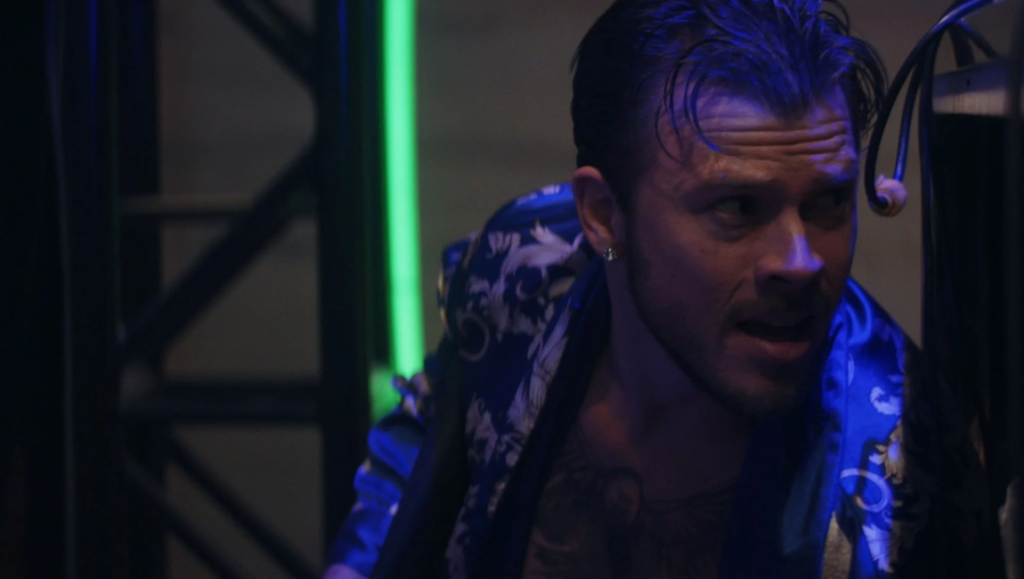
BS: To that point, and I say this as the highest of compliments, this feels like you were allowed to get away with every indulgence in the best way possible. It’s insane because this is, at the end of the day, a Disney film. You have the Gilmore Girls riffs, the theme from Blade, and you talked about the Billy Joel song from Oliver & Company. These all serve the story in fun, smart ways, but was there ever any pushback on any of your choices?
BDG: I would say 99% of the movie is exactly how I wanted it to be. There are a couple of tiny compromises that I can live with, or else I’d still be fighting about them today. I think the issue is that stuff that people might view as indulgent is all functional. The Gilmore Girls scene has a function, and if it’s not in the movie, the movie doesn’t make sense. If the opening isn’t there, it’s just a guy on a computer, and then he gets shot. It’s like the version of the movie where you remove that stuff that is objectively functionally not as good. The Blade song, if it’s not there, I’m just like, “So you just want the scene to be less cool?”
You’ve got to see Jimmy go through the house because it’s a functional scene where he’s establishing the geography for the final action. So he’ll walk through the hallway, moving to the Blade theme, and you see where the rooms are in relation to each other in terms of geography, and end up in the living room. So then, once the action scene happens, you’re not like, well, where is this? Where does this room lead to? You’ve already seen Jimmy do that. So if it’s not going to be the Blade thing, it just needs to be something else. It’s like having Dave Matthews in the strip club, that’s either funny to you or it’s not. If the strip club scene’s going to be there, do we want to have an interesting choice, or do we want to be generic? I think if you cut to the strip club and you’re just playing “Girls, Girls, Girls,” then it’s just a strip club scene. But if you cut to a strip club and we’re playing Dave Matthews, that’s a scene.
The thing about it is that everything in there that is very me and specific also has some function where if you pull it out, it’s kind of a Jenga thing that falls apart. I always have to be honest with myself about the movie, where I ask, “If I don’t do blank, what happens?” Stuff that may even feel kind of like shoe leather, it’s still functional. The combination of the writer brain and the director brain, or the pacing of the movie, is dictated by scenes feeling like they have a purpose, even if there’s humor to them or levity or kind of this irreverent thing. The Gilmore Girls scene has a narrative function because it leads to a big reveal. It also has a value of showing that these people love her so much, and that’s why they’ve watched this thing and have hot takes about it.
If I couldn’t defend any of my choices in a court of law, they wouldn’t be in the movie. So you kind of have to litigate your own movie way in advance, because when you’re sitting there being like, “I need to figure out how to get the money and time to shoot this thing,” you have think, “Is there a chance this is going to get cut out later? If it’s not, I’m wasting two days of my life doing it.” You have to bake in the necessity of your weirder choices.
I was 90% sure that in post, I was going to get in a bunch of fights about the opening, and then that never happened. Because it works. I’m not saying it’s going to be for everybody, but it has a propulsive energy, because it’s also the opening credits. We have a conscious understanding that opening credits have a kind of set piece-y thing to them. If that was happening and it wasn’t the opening credits, it would feel a little bit like a digression. You want to tell the audience that if you ever get really comfortable and feel like you know exactly what’s going to happen next, that’s not this kind of movie. So right out of the gate, you’re like, well, “I didn’t think this was going to happen. What do I think’s going to happen next? I give up. Let’s just go.”
BS: The thing I loved most about this is that it feels so of a piece with the films that Hong Kong directors made when they came to Hollywood. I’m thinking of stuff like Kirk Wong’s The Big Hit or Tsui Hark’s Double Team. I know you and I know these films, but I imagine many people will be catching this on Hulu and may have never seen this stuff. If you could give a small primer for folks who want to dig in more, what would it be?
BDG: It’s really funny you would say The Big Hit because I fucking love The Big Hit. I think Lou Diamond Phillips is so great in that movie. Bokeem Woodbine is so great in that movie. That tonally really is a little bit in the ballpark. I think Face/Off is a masterpiece, and I’m obviously as heavily influenced by John Woo as possible, especially the Better Tomorrow movies, as I think it is pretty transparent in the movie. But tonally, it is more in the ballpark of Knock Off or The Big Hit and stuff like that, where it’s kind of playful chaos. Those are definitely touchstones for me.
Tonight at Vidiots, I’ll be doing a Q&A and shooting a segment talking about the films that inspired this. The Big Hit is going to be one of them. I just want to recommend the things that maybe someone hasn’t watched already. That’s a very underseen movie somehow. If I were able to program a series at some repertory theater this week of movies that are kind of fun to me and sort of vaguely in the ballpark, that would be one of them. Knock Off would be one of them. I saw a print of Knock Off at New Bev a few years ago with a sold-out crowd, and it was one of my favorite experiences I’ve ever had in a theater.
Movies like Sexy Beast and time travel movies, but the action comedy stuff is very much either Hong Kong or when those directors came and then did their kind of weirder American movies. If Hard Target was funny, that would be my thing. Some of the action is funny, but to me, it’s sort of funny in a Jackie Chan way.
Comments are closed.