
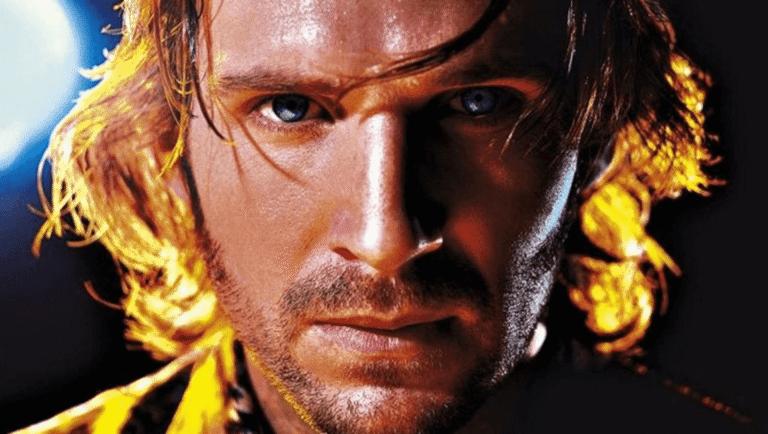
You ready? Yeah, boot it.
Strange Days should have launched Kathryn Bigelow’s career into the stratosphere. Having conquered land, sea, and air in 1991’s Point Break — a superlative action classic in its own right, accept no substitutes — the director’s fifth feature looked to the future, crafting a prophetic vision of a splintered world on the precipice of igniting into a blazing inferno. Adapting a screenplay co-written by ex-partner James Cameron — who also has a story and co-producer credit — Strange Days is an almost singularly angry film, drawing inspiration from the Rodney King Verdict and L.A. riots that followed, where tension and violence lurks around every corner, and the only respite to be found exists in state-of-the-art technology that can literally bottle up memories and share them as captured images for all to see. Guided by Bigelow’s muscular direction and unprecedented formal virtuosity, Strange Days felt like an easy layup to set the director’s trajectory on par with that of Cameron, who had already been dominating the filmmaking fold for a decade-plus. Instead, the film was met with a decidedly divisive critical response, it bombed spectacularly at the box office, and it would take another 14 years for Bigelow to see any sort of meaningful rebound — but rebounds don’t get much bigger than beating Jim Cameron at his own game, which is what happened when The Hurt Locker upset Avatar for Best Director and Best Picture wins at the 2010 Oscars. A few contemporaneous critics were on the right side of Strange Days‘ history from the jump — Roger Ebert famously gave it four stars, his highest consideration — but time has only grown kinder to Bigelow’s film, which has retained all of its firepower 30 years later, a harrowing reminder that nothing ever changes.
Set in the hostile futureworld of Los Angeles on the eve of Y2K, technical innovation has resulted in the development of SQUID (Superconducting Quantum Interference Device), a high-tech gadget that can connect to an individual’s cerebral cortex and effectively record not just their vision, but also their emotional and physical sensations onto a MiniDisc, which can then be sold and experienced by any wearer of another SQUID device. The capabilities and limitations of the technology are established right in the opening moments of the film, a visceral, kinetic thrill ride of a sequence that immediately grabs the viewer by the throat and does not let go, dictating the pace of the ensuing 150-minute runtime. During this sequence, three hapless armed robbers hold up a Chinese restaurant at gunpoint, before being frantically pursued by cops onto the roof of the building, where one ultimately falls to his death. Of course, since this is all observed as part of a SQUID playback, we experience the robbery from the point of view of one of the crooks, literally entering his eyes to become witness to a desperate situation growing increasingly worse, concluding in the unthinkable. Strange Days‘ opening is an absolute feat of logistical and technical accomplishment, aided by fluid Steadicam work (and a couple of seamless edits) to let the entire sequence play out as a single, compelling take.
The viewer of this SQUID recording is revealed to be Lenny Nero (Ralph Fiennes), an ex-LAPD officer-turned-infamous black market merchant of this particular product. Self-described as the “Santa Claus of the subconscious,” Lenny has no qualms about peddling his wares in this highly illegal operation, often conducting business out of back alleys and bathroom stalls to give paying customers what they want. You ask, he makes it happen. A high-octane crime spree, similar to the one depicted in the opening scene? You bet. Footage of an 18-year old girl taking a shower? Sure, why not. Footage of someone running on the beach, specially reserved for someone without the use of their legs? Lenny’s got you covered. With the year 2000 a mere couple of days away, the recent murder of influential rapper Jeriko One (Glenn Plummer) has transformed Los Angeles into a warzone, with streets consistently set ablaze and the city seeing a considerable increase in police activity, teetering the world over into a fascist rule. But even in this heightened state, capitalism is king, and Lenny’s always trying to score a quick buck, no matter how seedy his content might be. Yet despite this lucrative trade, Lenny remains perpetually unfulfilled, because his true desire is to reunite with Faith (Juliette Lewis), his ex-girlfriend and singer who’s now with Philo Gant (Michael Wincott), a powerful record mogul who represented the recently deceased Jeriko. The only real loyal companions in Lenny’s life are private dick Max (Tom Sizemore) and bodyguard/chauffeur Mace (Angela Bassett), whom Lenny met during his days as a beat cop. Meanwhile, two crooked police officers (Vincent D’Onofrio and William Fichtner) are running rampant on the other side of town, pursuing a terrified young woman (Brigitte Bako) for reasons as yet unknown.
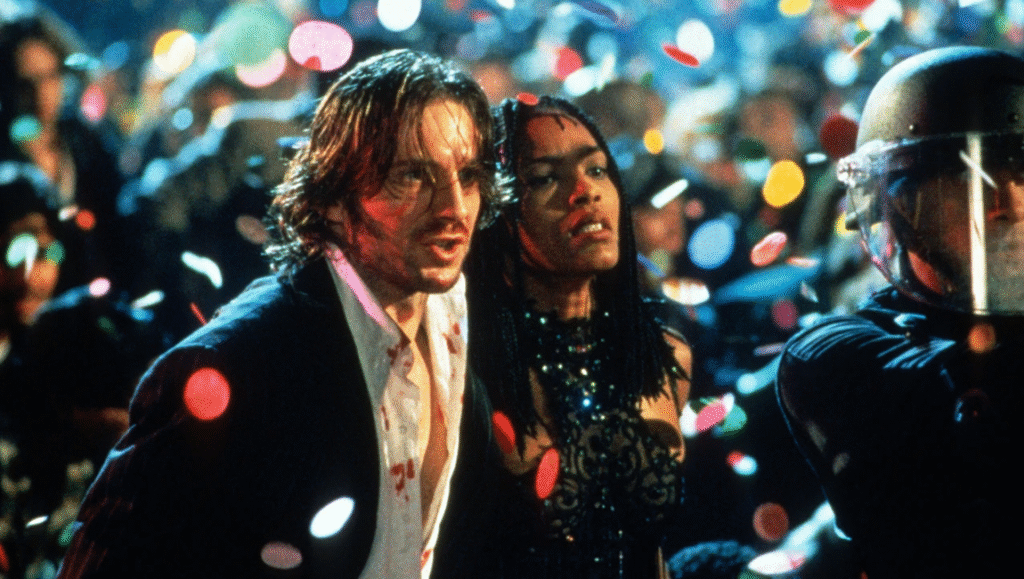
Utilizing very recent traumatic events as a narrative and thematic springboard, Strange Days taps into genuine real-life horrors to build out its simmering nightmare of a world. Streets are swarmed with protestors and armored law enforcement “keeping the peace,” an image that could almost be viewed as exaggerated in 1995 but is totally commonplace in modern times. One character casually mentions that fifth graders are shooting each other in schools, which would also sound unfathomable were it not such a tragic part of American reality (that Strange Days also pre-dates the Columbine massacre by four years only makes this throwaway line even more eerily prescient). The SQUID tapes offer the only real escape, delving into voyeurism as escapism, eliminating the ephemerality of memories in order to preserve them as entertainment (or, more pointedly, damning physical evidence of police corruption). Bigelow returns to the SQUID footage often, showcasing her dexterity behind the camera through these terrifically designed and orchestrated sequences, serving up perhaps the zenith of POV footage on film. The nature of Lenny’s business eventually dovetails with the police and true fate of Jeriko One, building toward a climax that sees Mace rescued by a horde of furious onlookers from a gang of cops in what feels like one of the most galvanizing set pieces committed to celluloid.
The cast, meanwhile, is tremendous in service of Bigelow’s technical achievement. Fiennes is pitch-perfect as the palpably sleazy Lenny, rocking cheap suits, fake Rolexes, and a gorgeous mane of hair. He’s a slimeball, but not an unlikable one, playing the part with just the right amount of charm and pathos so as to not make his profession incredibly off-putting. Fiennes is also a perfect contrast to Sizemore, who has seldom felt more grotesque on camera, fully living up here to his status as the resident dirtbag of the 1990s. Lewis gets her moment to shine in a showstopping moment to cover PJ Harvey’s “Hardly Wait,” while Wincott reminds us why he should have been a bigger star. D’Onofrio is also impressive as the hate-fueled cop who seems to solely subsist on rage. In other words, every in Strange Days is turning in high-water work. But who steals the show? Bow down to the indomitable force of resilience that is Bassett, whose steely veneer conceals a reservoir of passion, playing Mace as close to the vest until it’s time to unleash all hell. She’s utterly transcendent, ultimately becoming the heart and soul of Bigelow’s film.
In fairness, there are a few aspects of Strange Days arguably don’t stand up to scrutiny. Try as they might, Bigelow and co. failed to foresee the prevalence of the Internet and cloud-based storage, effectively wiping out the need for portable tapes and physical media players (the grungier aspects of the film’s soundtrack also did not linger long into the new century). For how ahead of its time it feels, the screenplay unfortunately isn’t immune to a Monologuing Villain, who handily recaps the entire film while our heroes are held at gunpoint. And even critics like Ebert, who originally showered the film in praise, recognized that the climactic re-appearance of the police commissioner reflects one of the more egregious uses of deus ex machina in film history. But a few quibbles aside, Strange Days remains Bigelow’s magnum opus and an absolute force to be reckoned with, the film’s various fiery threads coming together for a truly beautiful conclusion. And most memory of filmic flaws are almost certainly wiped away once we see the world survive the turn of the millennium, as Lenny and Mace share a most passionate kiss while “Fall in the Light” segues into “While the Earth Sleeps” on the soundtrack. Even amidst all the chaos, Strange Days still manages to find a glimmer of life-affirming hope. Let’s hope the rest of the world can follow suit.
Comments are closed.