
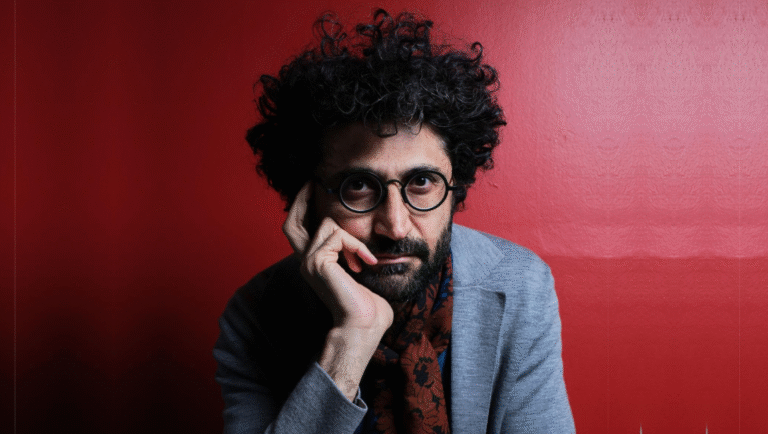
With his third feature film, The Things You Kill, Iranian-born filmmaker Alireza Khatami turns his perspicacious gaze away from the overtly political themes of Oblivion Verses (2017) and Terrestrial Verses (2023, co-directed by Ali Asgari). Instead, he is interrogating the inner workings of the family, and in particular the legacy of toxic masculinity handed down from father to son. It’s the story of Ali (Ekin Koç), an adjunct professor of literature, who has spent his life butting heads with his proud, intractable father (Ercan Kesal). Ali lived in the U.S. for 14 years, but has come back to his native Türkiye and is struggling with family problems, mostly pertaining to his disabled mother (Güliz Șirinyan) and the trouble he and his wife Hazar (Hazar Ergüçlü) are having conceiving a child.
After Ali’s mother dies in a fall, the protagonist undergoes a significant change. He is replaced by Reza (Erkan Kolçak Köstendil), a more ruthless version of himself. Aside from the spectator, no one in the film seems to notice, and this is perhaps Khatami’s most dramatic break with the relatively stable realism that characterized his previous films. In my conversation with Khatami, I learned that many aspects of The Things You Kill are autobiographical, which adds an intriguing intellectual twist to his formal gambit. Like certain other filmmakers — Fellini, Tarkovsky, Yvonne Rainer, not to mention Sophy Romvari with this year’s Blue Heron — Khatami’s interest in narrating his own experience leads not to diaristic directness, but a filmic exploration of the inherent instability of identity itself.
I spoke with Khatami on November 4, in anticipation of the film’s theatrical release on November 14.
Michael Sicinski: You’ve made feature films in Chile, Iran, and now Türkiye. And one of the things I noticed is that The Things You Kill is a very Freudian film in a lot of ways, and it seems like there’s a certain push and pull between what is, for lack of a better word, universal about family, specifically fathers and sons, and what is perhaps particular to Turkish culture. So I’m interested to know from your standpoint, what do you see as being factors in this film that are specific to Turkish culture that you couldn’t have made the same film elsewhere?
Alireza Khatami: The particularity of the film is actually a very small part of it, but it was necessary for making the dynamic of the story work. In Türkiye, families are way more connected. You have cousins, you have extended family, you know, a wedding is a 200-people affair, right? So, for this story to make sense, that was needed. I needed the cousin, I needed the sisters, I needed people to know that this extended family are fairly close. This may not have worked in the U.S., right? U.S. families are much smaller units.
MS: One thing that happens with the Ali character is that there’s the family dynamic, and how him leaving and going to the United States was seen as this significant rupture within the family structure. But then there’s also the conversation with his university department head, where he’s basically accusing Ali of abandoning his cultural patrimony, right? Like, why would he go and study literature in the U.S. versus in Türkiye? So, it seems like there are a lot of different braided thematic elements that all have to do the conflict between home and away.
AK: Yes, but also there is this colonial element to it as well. When the university professor is asking, why did you go to study literature in the U.S.? In this region, thinking is often taken to equal translation. Because in order to be considered the thinker, you have to think in the way that the West thinks. It’s a very Eurocentric way of reading that has been brought to these regions. And Ali is struggling with that. Even if he wants to understand that, in order to think, he has to learn that not every idea can be carried away exactly to another land. It has to first die, and then be resurrected. It has to go through an interpretation.
But the core of the film, I think, is that in today’s late-capitalist world, the structure is still patriarchy. You can be a well-educated woman in Switzerland, and you’re still getting paid less for equal work you do than your male counterparts, right? So that structure of patriarchy and how it subjects both men and women to its violence, I think it’s unfortunately a universal phenomenon today, right? We have seen it from the female perspective in a lot of films, rightfully so. But we have rarely looked at what patriarchy does to a man.
MS: One of the things that seems to carry through the film is that either in total, or maybe particularly with this kind of doppelgänger of Reza, that we are watching Ali struggle with what masculinity means. He’s got the low sperm count. You get the sense that his father resents his intellectual pursuits and maybe sees those as a more feminized kind of labor. So, again, it’s kind of the question of whether this is a fundamental Freudian element of overcoming the father versus becoming the father, or whether Ali is kind of finding that he’s hamstrung by patriarchy in a very particular kind of way.
AK: Both are valid reasons here. You know, we don’t have a masculinity that is grounded. Masculinity is in crisis always, right? And the very issue of it is the narrative. The narrative we tell ourselves, you know, we tell that from the earliest stage, that boys don’t cry. It’s a narrative that is handed to them.
Or all the achievement verbs we use are “go kill it,” right? It’s a very problematic way of building a narrative. And the story for me here is Ali’s narrative starts to crack as soon as the sisters start revealing their narrative. Through that crack Reza emerges. And Reza says, “I have an answer. I’ll hold this narrative for you. Simple.” The father is an issue, we kill him. Have to build a well? The water official needs to be bribed. He has easy answers for everything. But the more the female narratives emerge, the more Ali’s narrative collapses.
And in the process, you have to build a new narrative, right? A narrative that is not easy. As the sister says, sitting and preaching from afar is easy. It’s hard to live, to come and sit with the family narrative. Or when Ali’s wife asks him, “did your mom tell you bedtime stories?” No, because he didn’t like bedtime stories. He liked puzzles, right? It’s a mystery. It’s hard to hold life in your hand and live it. So for him to become a fully fleshed-out human being is to understand that the world needs much more complex stories. You know, he needs to move from that simple Freudian story. It was novel at one time, but nowadays, it’s too simple a story.
MS: I was reminded of the parable of the appointment with death in Samarra. Ali seems to have partly left Türkiye and went to the U.S. in order to avoid becoming his father. But inevitably, that process turned him very much into his father.
AK: Exactly. It was almost as if there was no escape, right? There is no escape. You cannot run away from yourself. And in a way that’s why people are asking, why did you leave? He doesn’t have an answer, all the way up to the confession scene. That’s when he finally puts everything together for himself. It connects things. The way he was subjected to violence as a childhood. How did he understand this resentment of his father? Finally, he’s able to find a complex narrative for himself.
MS: And when his aunt is in the hospital, there’s also the discussion of the scorpion bite from when his father was a kid, and how Ali was never told about this, because his father didn’t want him to think badly of his grandfather. So, there’s this entire chain of stories that are built on avoidance, right? And, then, in that final scene, he seems to no longer be capable of avoiding the trauma at the center of his story.
AK: Yeah. He finally has to face himself. And he’s building the courage to tell it. It was a very difficult scene in the sense that we didn’t know how to shoot it. This is the only scene I had no idea how to shoot. I wrote it very late in the scriptwriting process. And my producers were harsh. Nobody wanted to talk about this scene.
It’s very personal for me, based on what happened to me. So, everybody was kind of tiptoeing around it. And my actor kept asking me, how am I going to do it? I said, I have no idea how we’re going to do it. Then, I remembered a discussion we had on Primo Levi, who was a Holocaust survivor, and the way he writes is very prescriptive. There is no emotion in it. No, he is writing like he’s describing a normal scene. And that was the inspiration. I said, what if we do it that way? And I wanted the camera to be honest, be right in front of him, no tricks. We just sit there. But then as he moved forward a little bit, he went out of focus, and I couldn’t see his eyes. I was like, okay, that’s perfect. What if you lean forward, and we shoot it out of focus?
At the beginning, everybody was like, I’m not sure. My producers were panicking. But I thought that’s a dignified way to shoot the scene. First, we give him this dignity, this space where we don’t have to see his eyes. And at the same time, he goes to that space to find out, to connect the dots. And I’m not pushing the focus. He decides to lean forward. So, it was an ethical choice for me. But once he got it clear in his mind, then I pulled the focus. So, that scene was challenging, but also very rewarding for me. I was happy to protect his dignity, and give that clarity to him at the same time.
MS: Thinking about The Things You Kill versus your previous feature, Terrestrial Verses, one thing I noticed formally is that Terrestrial Verses is a series of modular vignettes that are looking at different cultural and bureaucratic problems around Iran from multiple angles. And it seems to me that there are just as many problems or discourses within The Things You Kill, but they’re braided together, not necessarily into a linear narrative, but a coherent narrative, as opposed to the modularity of the previous film. So I’m wondering maybe what prompted you to move in that direction of a more integrated style?
AK: I think the first two films I’ve made both resulted from my philosophical preoccupations. So, I’m writing with my head, right? So, I’m trying to think on that level, I’m trying to understand the point. With my third film, it’s the first time that I’m writing with my heart. I’m writing with my guts. You know, I don’t have an answer for these characters. I’m trying to navigate it. I’m trying to find out.
And also, I’m 45 years old now. I’m older. And I’ve learned that things are connected. You know, what we call intersectionality. One thing pretty much overlaps with another thing. It’s not as easy. Before I wrote looking forward — let me go and figure this out. But this is the first time I’m writing looking backward. I’ve gone through this. Let me see what I learned about myself.
So, in a way, I’m bringing myself to the table. And we don’t have easy answers for ourselves. It’s very easy to advise other people on what they should do. But when it comes to ourselves, there are many overlapping areas, complications. That overlap, actually, is the result of looking at your own image. What you see in the mirror isn’t what other people see.
MS: That ties back to the distinction between stories and puzzles, right? I guess one could make the argument that the modularity of Terrestrial Verses represents a kind of intellectual puzzle. Whereas that’s really not so much the case with the Things You Kill.
AK: No, no, it’s not. I think, again, that Terrestrial Verses was a work of thinking. Even though all the stories entail something very personal happening, there’s a distance. Here, I’m in it. This is pretty much based on my family. I’m not showing this film to my family still. I don’t want them to see it. Because even Mariam and Nastrin are my sisters’ actual names. There is dialogue in that film that they will recognize. So, in that sense, it’s a different film.

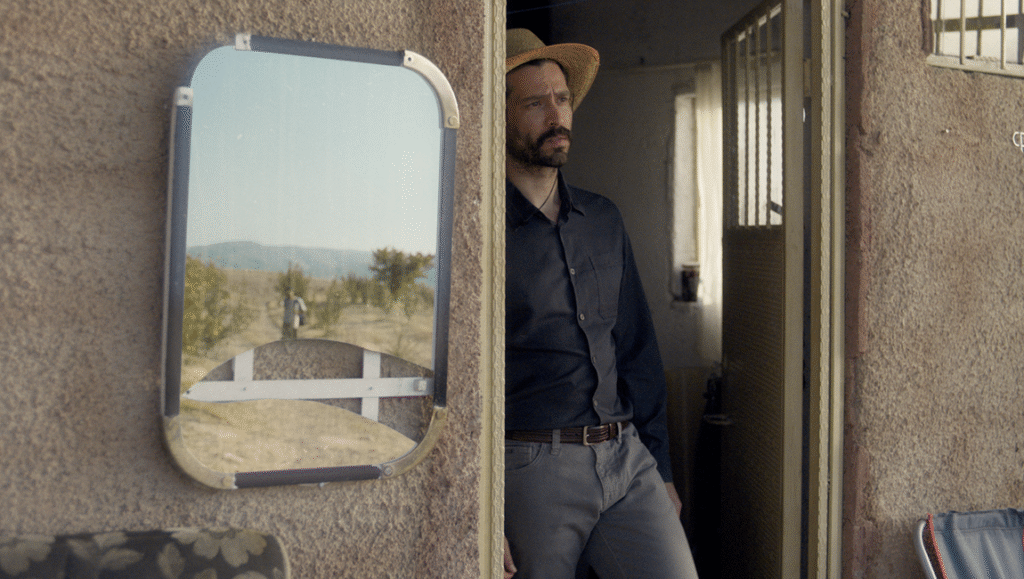
MS: I noticed this more clearly the second time I watched Things You Kill, that the switchover between Ali and Reza, as well as the switchback, have to do with this mirror on the wall of the cabin beside the garden. But even apart from that, I don’t know if people have compared this film to Buñuel, for example. But you have elements that seem like they’re truly surreal, in the sense that they are psychological or abstract, but they are presented with the verisimilitude of traditional realism. When Reza shows up, nobody asks who the hell are you? It’s a smooth transition, no one within the film sees the rupture, right? So, I guess I’m interested to maybe know what prompted you to orchestrate this in that way.
AK: Well, I mean, at heart I’m a cinephile. I love cinema, and I love taking it to places that it hasn’t been before, taking cinema to the edge. And in all the history of doppelgängers in film, you always see one imagining the other. And in some scene, the revelation happens, and we see a series of flashbacks that indicate, oh, this never existed, right? Fight Club, Tale of Two Sisters…
Buñuel is the only one who actually made that change because one of the actors died. You know, the actor died, so he had to replace him. For me, with the duality of this character, you have equal destructive force and agency, right? But what if I make them both real, bring in two different characters, you know, and go about it that way. Also, here in 2025, an audience, in my opinion, has the capacity to handle it. I don’t have to give them a lot of flashback, and I can say, no, let them deal with it. So, that’s something that is exhilarating for me. Let’s go to this place. Will it work?
Also, the way I played it is because I don’t want viewers to look at it like an allegory. So that’s why I played it so real. What if you read it literally? This is as real as it gets. This is not some obscure conversation that I have when I get high. This is my life. I live this every day. So, in that sense, I want it to be tangible. I want it to be real. And that moment right in the middle of the film, that 10-second shift, I love it when audiences are like, what the fuck happened? And I I knew that if I gave them half the film as a social realist drama, the audience will think, I know this movie. They come in, and once I pull the rug, it’s too late for them to walk out.
MS: Right, the switch happens exactly at the one-hour mark. I clocked it.
AK: I wanted it right in the middle, for the switch to happen, and then the audience has to fight their way back into the film. They have to struggle. What happened? Okay, let me go back. It’s that kind of Brechtian space there. Now you’re engaged, right? You want to watch this movie. This is part of the game. I think this is cinema today. What’s the point of medium shot, medium shot, medium shot, medium shot. And this is a story about how simple stories are dangerous. You know, simple narratives are dangerous. I always believe that stories come first, bombs are later. Bombs always follow the stories. Ink is spilled first, blood comes next, right? So, I didn’t want to make a simplistic, cohesive story that makes perfect sense. Everything is, you know, as the mother said, puzzles, mystery. Life is a mystery.
MS: Well, like you said, even within that shift, I think that a certain kind of filmgoer might think that they’ve got it dialed in, like, oh, Reza is like his bad side or his more actualized, forceful self. But that doesn’t really explain everything either. So, even if we assume a kind of modernist cinema, there are still things that don’t square with what even a cinephile viewer would expect.
AK: That’s because in life, always you can build a narrative, but something is always left out. Lacan calls it objet petit a. That thing that doesn’t fit completely. I learned that from Lynch. You can do a Lacanian, Freudian, Deleuzian, whatever reading you bring into Mulholland Drive. Something resists. That’s what makes the film watchable 20 years from now, 30 years from now. You cannot digest it completely. Something resists a full, easy comprehension.
MS: There’s a way to even relate this to Oblivion Verses in the sense that that is very much a film, I think, about the processes of history and the writing of history. When the main character, the mortician, decides that he’s going to re-identify this young girl’s body, it’s a kind of recognition that substitution can happen, that she can stand in for all of the unseen, unfound, disappeared victims. And then you put her in the ground. And then in some way, that story, that dangling history has been completed, the circle’s been squared in some sense.
That’s very different than how substitution works in The Things You Kill, I think. There, substitution is, like you said, that objet petit a, that ineffable excess that can’t be squared. As much as I appreciate Oblivion Verses, it feels like a film that kind of closes quite definitively.
AK: I never thought about it, actually. Now that you mentioned it, that’s true. It actually closes.
I mean, I’ve changed. That was my first feature. And I wasn’t brave enough, I guess. I hadn’t gone through as much life as I’ve done now. And making feature films, you tend tiptoe a little bit, you’re a little bit scared. I took a decent amount of risk in that one. But the heart of that one, it’s similar, in that it is also about finding a narrative. There we find a narrative that kind of completes, has a closure. Here we find a narrative that is incomplete. I like what you said, it’s ineffable, that element that doesn’t give in. It exists, and it is personal.
MS: Although you can’t make a clean distinction between the personal and the political, Oblivion Verses is very much about how official history is going to be written. It’s public, shared history. And so even if we know that it doesn’t ever really have closure, a closure has to be imposed in order for that meaning to be shared publicly. Whereas when we’re getting into the unconscious, we may crave that closure, but it doesn’t have the same kind of imperative.
AK: I mean, in Oblivion Verses, when they accept a fake identity for this new body, they know what they’ve done. They have agreed on a fake identity, they have agreed on a closure. They say, we decide to call this a closure. So there is an awareness of the narrative there. In The Things You Kill, there is also an awareness of a narrative, but here I like it more. Because, as you put it, there is an ineffable element. There is something that resists you.
MS: And I think that once the audience is aware of this shift or this split, it puts everything else into question in a way that’s very productive. We may accept Ali’s story about having been sexually assaulted as a kid. But in the back of our minds, we also know that he could be making that up in order to deal with this particular situation with his superior. Or his sperm count, obviously that’s something biological. But at the same time, there may be a kind of psychological element, an unwillingness to procreate. So even the most realistic aspects of the film can take on this sort of ambiguity in a way that I think is really fascinating.
AK: We no longer trust everything we see and hear. And actually, at the beginning when a student says the roots of the word tarjama or translation comes from the Arabic word to kill. That’s not true. It doesn’t come from that. At the end of the film, back in the classroom, Ali says, “let’s assume it’s true. What interpretation that would give us?” Some audiences will think that’s actually the root, but it’s not. That’s not the root of tarjama. So yes, Ali and the viewer are aware that now everything is under question.
MS: As to the question of false translation, you probably couldn’t have played that particular card if you were making a film in Arabic. I mean, the fact that it’s in Turkish means that you can perhaps assume that its audience is not necessarily going to know the Arabic root, whereas if you try to say that about the Turkish language, then everyone would immediately know that that’s not true.
So you’re introducing a kind of additional minority language, sort of like Deleuze talks about the minor literature that it’s not the dominant language. This lets you play fast and loose with it. Because I didn’t know that you were bluffing.
AK: No, I mean, that’s just being a bit mischievous, honestly. You know, sometimes I believe that I don’t have to know the answer. But I have to be willing to create a platform that sets up possibilities for interpretation. So if I myself am open to that objet petit a, that which is ineffable, if I learn to be comfortable in the presence of something I do not know, there is a smart audience that comes along and adds something to it. But if I claim that I know all the answers, then the movie dies very fast. One person comes along and explains it and then everybody says, okay.
MS: Right. I think that the history of cinema, even great cinema, is kind of rife with these films that are so meticulously constructed that they essentially answer their own questions. Like Michael Haneke’s films, right? Once you kind of figure out what he’s trying to say, every second of them is thesis-controlled, right? It kind of moves you to that conclusion, almost to the point that it’s a hermetic object that doesn’t really require a spectator.
AK: Once you solve the mystery, that’s done. The movie is finished. Come to think of it, the only movie from Haneke that I’ve watched more than once is Caché. Because some things are not explained. That’s a movie that I think is his best.
MS: Right. We never really know the exact origin of the videotapes.
AK: That’s a movie that I’m like, okay, that’s great film. But the rest of it, I’m always like, all right, I got it. Like Funny Games. I’ll give you a better example: Farhadi. Even when it pretends it’s open-ended, it’s not open-ended. Everything is clear.
MS: I admire Farhadi, but I’ve never really been sure that he needed cinema. He strikes me as a more kind of Ibsen-like dramatist.
AK: He is. I worked for him. I was his assistant. He comes from playwriting. This was his academic study. He worked in radio. He comes from that world. He wrote radio plays. And even today, if you just listen to a Farhad film, you get everything. You don’t have to watch it. Whereas I think films should explain through visuals. For him, it’s always verbal. And that also explains the success of the films in U.S. in particular, because they’re completely verbal. Everything has to be explained in words to make sure that audience are getting it in that sense.
MS: It’s interesting that he has been able to take that method and make films in Spain or France, that there’s a kind of portability of that classical structure that doesn’t necessarily demand a lot of cultural specificity.
AK: Because what he does, his true invention, is bringing the whodunnit to the family drama. You know, there is always somebody or something which has died, in all these films. You can pick any film. Somebody dies or something dies — honor dies, or an actual person. And then everybody has to ask whodunnit. So bringing that detective element to a family drama, it is true invention. That can go anywhere.
MS: Jumping off from Farhadi to Iran more generally, there’s a kind of critical cliché that I see a lot of in Western, and maybe especially American, film criticism, that is kind of brought to bear with a lot of, when addressing a lot of Iranian cinema, but also Chinese cinema, this idea that even though censorship is a bad thing, it makes artists more creative. Because you have to find new ways to say things that you can’t actually say. As someone who’s worked in Iran and elsewhere, and now you’re based in Canada, do you have any insight or feelings to that idea that, censorship leads to greater creativity somehow?
AK: No, no, no. I wholeheartedly disagree with that. I think the problem lies elsewhere. In American cinema, everything has to be explained in words. It’s a very verbal culture because it comes from a Puritan structure and a Puritan priest has to go on the altar and take the word and explain everything. The Puritans later founded the Ivy League, and this culture continues into today. So everything is very preachy. You have to say it in words.
Now, once cinema comes from a country where they cannot say it in the words, they have to use visuals to bypass the culture, they think this is more creative. I wholeheartedly disagree with that. Censorship does not make anybody more creative. Maybe more visuals, more ambiguity, but that’s about it. This is a mythology. Limitation gives more focused energy, for sure. But no, censorship is damaging. Censorship stops us from being radically honest with ourselves. And that’s why I didn’t make the film in Iran. When the censors asked me to take certain scenes out, I refused.
And also, I didn’t want to make, quote unquote, an “underground film.” I did that once because the structure of the film allowed me to do it. This one I wanted to be a rich, cinephile kind of movie. This movie is about things like how the opening and ending dream, you have dolly movement versus a handheld camera. Ali is always either on the dolly or static, and Reza is always handheld, up until the point of the killing. And then afterward, Ali becomes fluid. You can now go handheld to depict his world. These things were important. I didn’t want to just throw all of those options out because I had to make an underground movie.
And anyway, the foreign policies of Europe and the United States have always had an agenda to reward and spotlight movies that perpetuate the narrative of the Other they needed. Look at how the Nobel Peace Prize was given to [María Corina] Machado, a Venezuelan right-winger. That’s outrageous. And how many films we have seen from China, or movies that have been celebrated from Iran: which are good movies, really? Very few have pushed the boundaries of cinema. And those movies were not highly celebrated. Abbas Kiarostami’s Close-Up, that’s a film that only got praised later. And some of the masterpieces of Iranian cinema are still not that well-known in the West.
MS: Right, there’s a history that art historians discovered in the ’70s and ’80s, that the State Department and the CIA were promoting Abstract Expressionist painting as a way of saying, look how free we are! And the inverse of that is, look what these brave artists from oppressive countries are doing, despite all the limitations. So it’s always speaking back to the West’s purported democratic freedom.
AK: That is the West’s self-selected identity, right? To me, if the cinema of a country is under the spotlight and winning a lot of awards, I really worry about that nation being bombed very soon. Honestly, it has been like that, that soon they’re gonna bomb it. With the films that from that nation that are brought to circulate among the Western intelligentsia, there’s always a preferred narrative. There’s always an agenda which is, look at what we could do for Iran if we simply went and toppled their government, right? This idea that, you know, they’re crying out for liberation, right?
That’s why when you’re talking about the Iranian cinema, nobody talks about how that scene was beautifully executed through the lens and the mise en scène and the acting. It’s usually “brave” cinema. They are cinematic freedom fighters. I’m like, seriously?
MS: I think that Jafar Panahi is a great filmmaker, but I think that the way that he’s lionized can be very condescending, right? That it’s all about what he went through personally. That’s not to take anything away from that, but that’s not really the sum total of what the films are.
AK: Well, look at the new film, It Was Just an Accident. Or another movie I am interested in, Sirāt. Sirāt is a movie about a group of white people who go to a “brown country” looking for meaning. So you want Morocco without Moroccans. You want Islam without Muslims. All of this is just a casualty in your search for freedom. This is a movie that has been in Cannes competition, it just won the Chicago Film Festival’s best film award. It’s been selling tickets, and everybody talks about how it’s a masterpiece. And nobody talks about the fact that this is colonial filmmaking. In 2025. It’s outrageous. When I watched that, I could not believe my eyes. That in 2025, you still have to put up with this bullshit.
So this is the structure of the world we live in. It’s ultimately a colonial reality, you know, run by film festivals that were originated by colonial powers. The Venice Film Festival was set up by Mussolini. In response to that, the foreign ministry of France set up Cannes. And Berlin was set up by the American army in Germany. And now Toronto is being dominated by people who want to be Hollywood North. It’s all a disaster.
Comments are closed.