
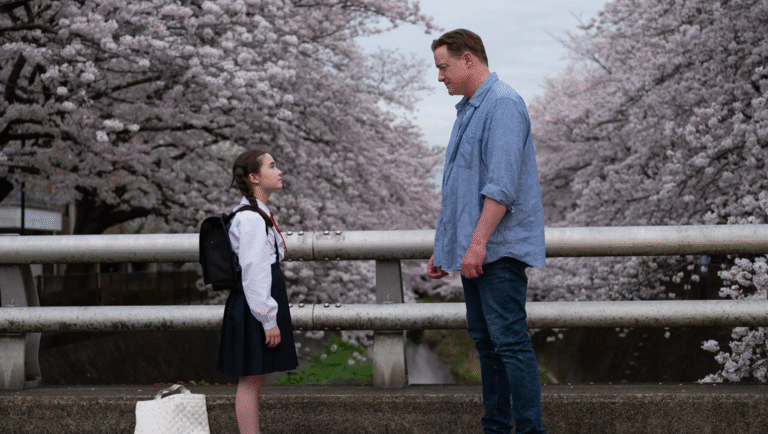
In Japan, where customs and a sturdy veneer of politeness greatly determine how people interact with one another, there is a strong emphasis on propriety, which comes with its ups and downs. Propriety stifles creative expression, suppressing much-needed raw emotion; it also sets out new paths of release for the emotionally suppressed, often with the tolerance and understanding that comes with social sanction. In Hikari’s Rental Family, her second feature after 2019’s 37 Seconds, these strands are laid over a deceptively cloying drama centered around the acts of manufacturing and performing emotion. Phillip (Brendan Fraser), a gaijin familiar with the Japanese language, has lived in Tokyo for the past seven years, shuttling to and from acting gigs where he fills in stock roles for a living. His personas are demeaning, largely confined to some variation of the token white American, while his personal life — peering from the outside into his solitary apartment — looks devoid of intimate, everyday connection.
A year before the pandemic, Werner Herzog’s Family Romance, LLC had fed its docufictional impulses into the narrative about a Japanese rental family service, profiling the relationship between a young girl and a man who, unbeknownst to her, had been paid to pose as her father. Truth and authenticity quickly became fuzzy concepts, complicating real and simulated feeling in a dizzying vortex of doubt and paralysis. With perhaps the traumatic isolation of COVID-19 in mind, Hikari’s own tender take on the subject displays a more upbeat disposition, following Phillip as he assumes a full-time position at Shinji’s (Takehiro Hira) company (straightforwardly titled “Rental Family”) to fill part-time roles in his various clients’ lives. This is by design: the individuals who make use of Rental Family’s services crave the presence of certain stock characters in their lives, for which Phillip’s gig experience comes in extra handy, but they don’t need him any more than a sex worker’s customer seeks true love from their encounter.
The choice of metaphor here is deliberate, because Rental Family does weigh in on the emotional stakes of the job and elicits a considerable response from both its providers and clients. Because his role-for-rent fundamentally operates within a business modality, Phillip finds it increasingly tough to separate the cynical detachment his presence demands from the purported social good it brings to people in need. Balking initially from the prospect of following through with a fake marriage to a secretly closeted young woman (Misato Morita), he gradually opens up to more encounters with a pool of varyingly distressed individuals, chief among whom are Hitomi (Shino Shinozaki), a single mother whose attempt to enroll her half-white daughter Mia (Shannon Gorman) into a prestigious middle school by enlisting Phillip to actively deceive her may be charitably interpreted as misguided, and Kikuo (Akira Emoto), an aging once-actor whose memory is fading and whose fame is almost all but forgotten. Naturally, one expects a dilemma: the better you are at genuinely connecting with them, the worse your performance outcomes tend to be.
Rental Family might strike the viewer upon first impression as a fatally whimsical travelogue of sorts, the kind to capture and exoticize a cultural curiosity for the benefit of easy sentimental wins. Yet it’s not entirely averse to the cynicism — or skepticism — the subject matter requires, as the decisions Phillip must come to are fraught with heavy finality, enunciated in the creases on his furrowed face but also in the film’s incessant focus on the persona he enacts in his private capacity. Anxious and sensitive to others more so than might befit the figure of an emotional surrogate, Phillip feeds off the catharsis he provides and slowly grows overwhelmingly attached (by the standards of his contract) to his dependents, along with his more reserved co-worker Aiko (Mari Yamamoto). Casting Fraser, himself an actor whose career had been stunted for the longest time and was only recently revitalized with his tour-de-force maximalism in The Whale, adds a smart dash of metatextual levity to the proceedings.
But unlike The Whale, which stupidly infantilized the prickly dynamic between Fraser’s hopeless addict father and his estranged daughter to milk pathos, Hikari and Stephen Blahut’s screenplay lays its ambitions out rather straightforwardly. Faced with a social problematic and the actual (and not imagined) remedies employed in response, Rental Family oils its narrative gears and smooths its motivational creases to better elucidate the heart of its interpersonal ties and obligations. Who needs whom more: the client demanding affection or the provider supplying it? The film’s maudlin beats, assisted by Jónsi’s high-on-life and quintessentially Hollywood-like soundtrack, are struck to the rhythmic hustle and bustle of Tokyo, glossed over in fast frames with little room for traditional contemplation. Yet in eschewing the critical tendency for incessant reflexivity, it also compensates with a host of two-way interactions between Phillip and Aiko on one hand and their patrons on the other. This is the film’s understated strength: by fleshing out the perpetual awkwardness between people, with locals endeavoring to speak English while the foreigner articulates flawlessly in their lingua franca, Rental Family keenly spotlights the mirth and frisson of human connection. For all the palatable cutesiness the film puts on frank display, it also earns it.
DIRECTOR: Hikari; CAST: Brendan Fraser, Shino Shinozaki, Takeshiro Hira, Mari Yamamoto, Ekira Emoto; DISTRIBUTOR: Searchlight Pictures; IN THEATERS: November 21; RUNTIME: 1 hr. 43 min.
Comments are closed.