

Now in its 36th edition, the Singapore International Film Festival (SGIFF) has taken on a most prominent role within the country’s cultural landscape, drawing younger and younger audiences among its wide demographic range to participate in an ongoing series of conversations centered around the world of cinema. Founded in 1987 as the SIFF, the festival underwent several rebrands and restructurings, its status as “Singapore’s leading independent arts event” having been ever so challenged during an interregnum of hiatus and uncertainty following the 2008 financial crisis. In its present form, SGIFF presents an outwardly formidable appearance of cinephilia and commercial savviness, spotlighting local and regional productions aplenty as it persists in the programming of events and bills both eminent and esoteric.
Yet its long-term footing is less secure. Having resided in Singapore most of my life and being a more-or-less regular attendee of the festival since 2017, I’ve seen the comings and goings of filmmakers, programmers, sidebars, and audiences; where new innovative strands of curation have no doubt been introduced every now and then, there remain anxieties surrounding the future of cinematic expression, anxieties both intensely specific to the national consciousness and seemingly generalized across borders. A new global mandate has arrived, as it tends to do every few years, proclaiming some form of death, some form of rebirth and resurgence, of the artistic experience. The pandemic transformed screen space from virtual sandboxes into entire simulacra of reality, just as how virtual spaces — the streaming platform, the unreality of artificial intelligence — have now stirred and stymied discussion on what and why cinema is in equal measure.
By virtue of its official (and in a way hegemonic) status as Singapore’s annual cinematic showcase, SGIFF has become a pertinent site to observe these developments as they play out, whether against or in line with the many daily wisdoms that mark our evolving socio-political consciousness. Several writers and publications have pitched in on this consciousness (not least the call-and-response publication Correspondence, co-founded by my friend and fellow InRO contributor Sasha Han), seeking to clarify, challenge, appreciate, and make sense of the multiple realities at hand: the programmer’s, the critic’s, the viewer(s)’, the margin(s)’, etc. InRO is proud to join the conversation amid these exciting and uncertain times, when the increasing accessibility to modes of filmic production renders programming responsibilities all the more precious and when a similar excess of discourse — necessary as it is for the egalitarian dream — also precipitates the desire for critical, measured, and open-ended response. We kick off our SGIFF coverage with a dispatch on the Singapore Panorama’s Short Film Programme, a section dedicated to showcasing the uniqueness and universality of Singaporean cinema in all its invigorating changes and continuities.
Divided among four sub-programmes, each organized around the tenuous and ever-slippery notion of theme, the Panorama’s short films express, for the most part, an admixture of curiosity, revelation, and playfulness, often blending textures and styles in a bid to advance the scope of creative representation. As this representation increasingly comes under strain by a host of factors (which are not solely economic), a collective yearning for renewal and reimagination takes root both in form and in narrative; there is, in short, no small element of speculative inquiry at work. Whether speculation is allowed to bloom unfettered hinges, then, on the inquiring angle in question and the stakes at play.
In Jun Chong’s Whisper of the Tranquil Water, opening Programme 2, an immigrant masseuse named Xiao Qing (Ma Zhen Yuan) gradually withdraws into the tedium of her job at a massage parlor, providing sexual services on the side to her clients. Little is seen of the outside world except in a scene toward the end; the four walls and percolating warm lights within constitute the boundaries of her world, to which she harbors little personal attachment. There would be little reason for doing so, seeing as her relationships remain transactional and the only expression of a bond is with Hui Hui (Peggy Zhang), an older colleague and — in all likelihood — competitor for her wages. DP Shyan Tan lenses the film with an oneiric feeling of suspension, reminiscent of the seedily kaleidoscopic interiors of many a Jia Zhangke feature.
When Xiao Qing receives a call from an anonymous man, it marks the start of a series of reveries for her. Her boss, Susan (Angeline Wee), vanishes off screen just as quickly, leaving her to occupy and pace the lengths of the parlor in the typically romanticized way heroines of their own world do. Chong pulls off Whisper’s visually intoxicating mise-en-scène with ease — the sumptuous reds adorned by the masseuses hold a feeling of feverish, passionate longing hitherto stifled — and makes of his Mandarin title “水月镜花” (loosely translated as “the rosy tint of glasses”) a distant and melancholic parable on the endless travails and disappointments that await his characters. Less successful, perhaps, is the film’s venture into oblique symbolism: blood pools on the floor, its origins ambiguous, while Whisper’s final shot leaves little to the imagination with its air of wistful inertia. It is interesting, though, to behold the twofold manipulation of the concept of tedium in the festival’s programme notes: we speak of “interrupt[ing]” someone’s tedium, breaking up their routine, but can we “fulfill” it the way someone actively longs to wear and be worn out?

The fringes are prone to these observations, likely because tedium and obsolescence co-exist most pertinently there. Tedium, both economic and cultural, catalyzes irreversible shifts in memory and preservation; Izzy Osman’s The Water is Blue in Tanjong Katong surveys just this phenomenon, here localized to the Malay community in Singapore. With the passing of P. Ramlee, the late Malaysian actor, singer, musician, composer, and filmmaker, an era of cultural renaissance comes to a close, lost to a generation who would come to grow up amid rapid industrialization without the sense of close-knit community. Osman juxtaposes the fading and derelict buildings of Tanjong Katong district, Singapore’s erstwhile site of multi-cultural heritage, with the impersonal sights and sounds of construction works in the present day, as old reels of Ramlee’s seminal works are overlaid onto the former establishments.
“When you conserve [something],” one of her subjects avers, “you’re not just fossilizing it.” This has, for the case of Ramlee, sadly proven false; having defined Malaysian cinema’s golden age in the post-war decades, his presence only dwindles with each successive generation. Water gently rebukes this charge by virtue of its existence as witness for the late actor’s persistent hold on collective memory, interviewing family members old and young to preserve and remember as best as it can. One could here take inspiration from Ramlee’s oft-memed quote in his 1961 comedy Seniman Bujang Lapok: “small-small don’t want to die; big-big then start to trouble others.” Such is fossilization’s tumorous nature; soon all that is left might be empty relics.
Reading J.G. Farrell’s The Singapore Grip (1978) incidentally over this festival period, I found myself drawn to the economy of rubber planting and exports that accompanied Singapore’s transition from British colony to Japanese-occupied territory and tormented the novel’s haughty if incompetent patriarch, Walter Blackett. This economy, stretching beyond bygone years and into our time, finds renewed relevance in Bart Seng Wen Long’s Emergencies, a variegated and altogether fascinating hybrid-memoir of the latex material from its plantation origins to its objects of homosexual desire. In line with the director’s broader project Rubber Dreams of Its Lifetime, which purports to explore the material “as a commodity fetish and a fetish commodity,” Emergencies traces a genealogy of rubber through both Marxist and queer lenses, undertaking its historical representations (through footage from a mix of older television films, rewound and repeated over one another) alongside the more contemporaneous testimony of a masked gimp.

Seng’s title reveals a flexibility through its plurality. There is, for one, the Malayan Emergency from 1948 to 1960, for which rubber was the commodity of interest and Communism its difficult custodian. Then there is “rubber fun,” which while intrinsically linked to practices of kink also has an instrumental concern, related to the practice of “stealthing” (or non-consensual removal, mid-coitus, of the contraceptive). Another emergency thus enters the fray, this time the specter of AIDS and its many socio-cultural stigmas. If Emergencies meaningfully weaves both dimensions of the ubiquitous substance into a solemn but no less sexually charged piece, Fadzli Jambari’s The Art of Cruising pales in comparison. At just under four minutes, the film doesn’t shy away from its explicit premise, combining hook-up messages with lonely images of Singapore’s nocturnal cruising spots — parks, public toilets, etc. — while a cool and caustic voiceover (William Thomas) declaims the paucity of safe queer spaces. Yet its message, charged though it may be, is undercut by the medium’s minor and uninspired register, hesitant to delve straight into the bowels of pleasure the way Ricardo Alves Jr.’s Amusement Park (2024) did but no less didactic in its talking points.
Against this paucity of Singapore’s spaces in general comes a disconcertingly earnest paean to negation in Pek Jia Hao and Ang Jia Jun’s As If to Nothing, its title borrowed from Craig Armstrong’s 2002 rock album. Pek and Ang recognize the ennui of dispossession, and have set out in harsh monochrome to enmesh their protagonist — an old carpenter (Phua Shao Kiat) whose bulbous nose flaunts its tragic pockmarks — in a ravishing nightmare, at times recalling both Tsai Ming-liang and Ahmad Bahrami. As If to Nothing follows this carpenter in a search for his missing cat, wandering through dust-filled streets and tenebrous gangster quarters. Virtually every corner of this alternate Singapore, set indeterminately anytime from the 1960s to the present day, has become unrecognizable and unsalvageable. As the oppressiveness peaks within the sweltering gloom of a bar, the ominous twangs of a set piece (“Purgatory Bliss”), helmed by local punk band Francis Frightful, come to intrude and sublimate an ever-present sense of futility. Walking on the tarmac next to gargantuan industrial lorries, the carpenter treads with no other purpose but to move where the future takes him, wherever this void may be.
If the films in Programme 2 documented the margins of respectable society, reconfiguring spaces otherwise lost or reduced to casual exploitation, those in Programme 3 flaunt an expressiveness that’s defiant and endearing both at once. Whimsy doesn’t come about much in an ecosystem taking its cue heavily from more developed and vaunted ones; that it does shine through (and organically for the most part) is a promising sign for Singapore’s dreamers. Dreaming and dying, the two conceptual poles of Nelson Yeo’s debut feature, derive from a Chinese idiom denigrating the life lived in drunken shadow, inebriated and overcome by sensation. With Durian, Durian, one of two shorts by Yeo at the festival this year, they reconnect in a trance-like non sequitur set under the titular tree. A man (Kelvin Ho) lies down in its shade, willing its prickly fruit to fall and end his mortal suffering. Soon a woman (Doreen Toh) joins him, inquiring about his prospects and awaiting a similar fate for herself. Lensed in Super 8 and opening with a pithy observation on Isaac Newton, Durian, Durian plays to the absurdity afforded both its premise and brief runtime: in the face of hopelessness, who’s to say suicide itself can’t be a joke?
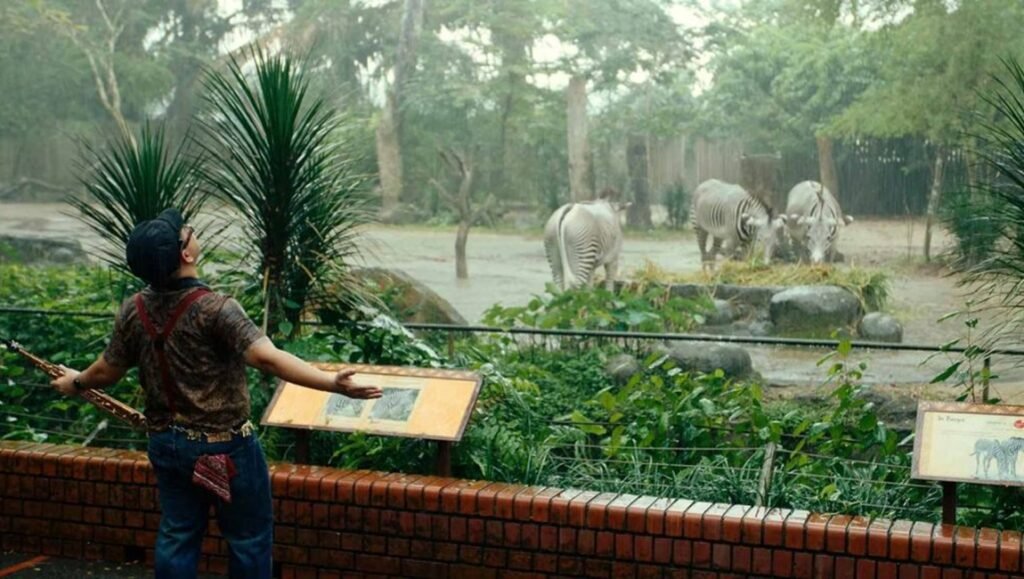
The joke pays off, somewhat, in Kew Lin’s delightfully springy Captive Audience, whose title can’t resist a double entendre. Starring Dave Tan as a hapless musician, the film offers a serenely paced demonstration of his unerring determination as he beefs with his agent (Gurmit Singh) over the commercial and artistic value of jazz fusion, for which he’d recently lost his gig at the zoo. The zoo’s general audience can’t exactly hum along to it, so he shifts his attention onto its permanent residents. As Captive Audience exploits their state of captivity — we see a troop of baboons parading their swollen asses, wandering around their enclosure to the music’s improvisational notes — to enforce a feeling of sensual captivation, one might read a slightly equivocal tune being sung here. How different are these prolapsed primates from us, we who cloister ourselves in the pursuit of our art by labelling it our nature and calling? With a number of local artistes cast in supporting roles (including Singh, Annette Lee, and Fauzli Azzhar), Lin’s film presents stubborn insouciance hand-in-hand with the system’s success stories, as if to both commend and lament the steadfast purity of those who play on, oblivious to those who listen.
An ocean away but no less comic in stature, Seth Cheong’s Singaporeans on the Kamo River runs through the city and prefecture of Kyoto, spotlighting the tiny individuals walking on and across the eponymous river’s embankment. Not much is heard save for the teeny diegetic sound of wind and waves; instead, Cheong leaves the bulk of interpretation to the subtitles, which imagine the dialogue of their interlocutors as distinctly Singaporean. A straight couple divvy up the itinerary — she to the scenic bamboo forest, he to a café to chill out. A lesbian one discuss doing long-distance. The flavor is unmistakable and self-aware: these are tourists in a land which imports more holidaying Singaporeans than it exports Japanese travelers the other way.
Shot as a one-take and very much in the improvisatory spirit of Hong Sang-soo, Singaporeans is formally compelling for an unlikely reason. It presents, to be sure, a cynical dig at the socioeconomic creatures who proudly define themselves by their creature comforts. A weakening yen against the Singapore dollar is sufficient ammunition for the spendthrift, who tick off cultural checkboxes in quintessentially touristic fashion and arguably visit the river only because TikTok told them to. But the acerbic tone of Cheong’s critique is watered down precisely because we cannot ascertain for sure if the onlookers are really not Singaporean. Supposing they were, the film would devolve into standard documentary, its ironizing force measured by the literal distance imposed between the camera and the crowd. Assuming they weren’t may be misguided altogether given the travel statistics. The state of liminal anonymity that ensues is what reinforces the foreignness of the scene and possibly reinscribes some of the traveler’s openness to experience refreshingly within.

Cheong’s other film in the selection, Dogma 65, moves in the opposite direction for better or worse, narrowing its conceptual ambitions into a candid if also labored narrative of the creative process. Two friends (Enze Kay and Daryl Cheong) sign up for a 48-hour short film challenge, hunkering down in one of their residential units — in the real-life 195 Pearl’s Hill Terrace, a “creative arts enclave” soon to be demolished — to work their imaginations. They receive a theme, float some ideas, and prepare to execute them. Except that both want to direct, and the guidelines insist on only one submission.
It suffices to say that Dogma 65’s highly metatextual gambit does work to the extent that it serves as a template to behold, scrutinize, and possibly take inspiration from. Cheong’s attempts at realism otherwise feel forced, lampooning the pretensions of the insufferable film bro but lending his own sequences a caricatural bent in the process. As the protagonists decide to shoot and screen both versions of an unexpectedly similar screenplay side by side, our film hints at a more radical version of the ethos and assumptions underpinning their hypothetical film movement, itself influenced by the seminal if short-lived Danish version. Would Vinterberg and von Trier, however, have filmed a manifesto and submitted an explicitly-titled “Director’s Cut” to festivals? That immediate sense of authenticity alone is commendable.
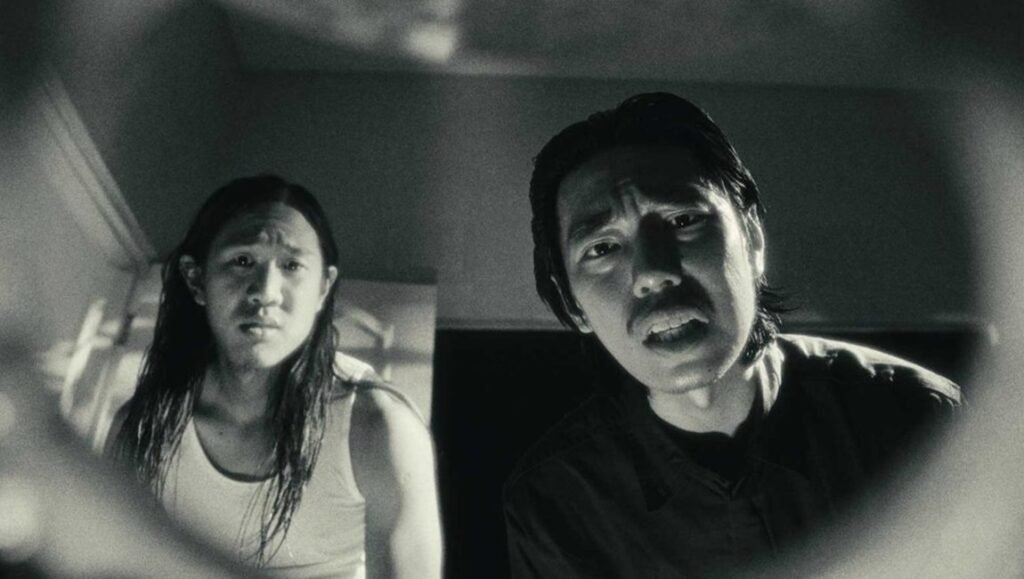
Authenticity isn’t usually paired with the horror genre, and neither does it quite get along with allegory. In Jake Low’s somewhat cryptic Manhole, a gnarly situation mandates a grisly, practical solution: while showering, Jayden (Lim Thean Yian) finds a man (Oliver Tan) in the circular drain, and calls the plumber (played by Low himself) to assist. The situation itself is outlandish, something straight from the Quentin Dupieux universe. (How does a man fit into a rat-sized manhole?) But the solutions proposed and eventually enacted have a parabolic ring to them, open to no end of dissection and identification. Between the haves and the have-nots, the oppressor and the oppressed, stands the mute spectator on neutral if shaky ground. Morality as allegory may not translate authentically, but it is — or should be — no less real.
Whereas Manhole’s interpretive breadth could be construed as slightness, a work like Christine Seow’s Two Travelling Aunties is unquestionably transparent, cleanly working in the documentary tradition to chart the vast and exuberant world into which its subjects enter. Susie, aged sixty, and Norah, five years her junior, have left Singapore for a nomadic existence abroad, traversing cities and continents in a camper van with a renewed lust for life. The duo have celebrated their fifth anniversary, a fact somehow elided in an article profiling them just last year, journeying deep into Colombia and the rest of the Americas on their savings and sense of adventure. With Seow positioning her film as both a travelogue and an accompanying account of the women, Two Travelling Aunties redeems them from the prevailing ageism surrounding their demographic and reclaims a vital freedom quashed in part by the absence of gay marriage laws in Singapore. “This world has lost its glory,” Susie belts out, determined to start a “brand new story” with Norah, defined not by Boyzone, but foremost through their burgeoning girlhood.
Has girlhood always been this simple, jejune matter of fact? Probably not, even before we pick apart the word and question its ontological precepts. Two other shorts, one each from Programmes 1 and 4, seek to rattle its conceptions or at least convey the discombobulating experiences particular to misplaced identity. With Full Month, director Ash Goh Hua revisits the familiar yet inexplicably foreign rituals of Singapore’s Chinese majority, among whose demographics counts the estranged Jing (Tess Pang), returning from New York to a family who’s made their disapproval of her lifestyle choices apparent enough. Although innocuous and generally conventional in the simmering tensions it articulates, Goh’s film poignantly accentuates the pain of separations — from childhood, from the past, from the sense of who one ought to be — with Jing’s grimacing visage torn between contempt for her ostensibly homophobic mother and comfort in the first-month celebrations for her baby niece. Full Month, much like Chong’s Whisper, is decked out in resplendent red, less a metaphor here of stifling passion than a mournful and almost taunting impression of connection forever denied.
The consummation of feeling and desire is, on the other hand, keenly realized in Marie Ee’s Rasa Sayang, albeit in frustratingly opaque ways. Adapted from Ee’s 2017 short story of the same name, Rasa Sayang accords being and girlhood a ghostly existence, with the folkloric pontianak serving as vessel for female subjugation and animality. For Mei (Simone Liu), a teenage schoolgirl physically fascinated with her classmate (Ember Ho), their tentative grazes reveal a palpable desire that refuses to culminate in more. “Kisses are reserved for boys,” which Mei takes to mean a reservation toward her very self; in response, a spectral lady (Athena Zecha) discloses her presence, whether from a banana tree in which her soul is trapped or from the sublimated recesses of the young girl’s mind. Although Ee imbues their narrative with a tantalizing simplicity of plot and affect, refusing all backstory beyond the almost archetypal markers of repressed Singaporean adolescence, Rasa Sayang bears only traces of its original literary vision. The acuteness of Mei’s declaration — “Nothing happened to me before you” — matches the cruel futility of her imagination, from which springs an unlimited if incomplete force of yearning.
 Rasa Sayang is nonetheless infinitely more thoughtful than Qi Yuwu’s Cendol, the unofficial spotlight film of the whole programme. Boasting a celebrity cast and a correspondingly banal script, Cendol is a Singapore-studio film par excellence: those less familiar with the political economy of Singaporean productions could conceive of it as an amalgamation of warm beige filters laid over cloying beats of melodrama, serenaded by the simpering defenders of nostalgia, family values, and blank contentment. The protagonist is Sarah (Sharon Au), a middle-aged Hong Kong-based interior designer who, like Full Month’s troubled daughter, heads back to Singapore in the hope of reconnecting with some vague idealized memory. Her mother (Goh Guat Kian) welcomes her by preparing her favorite dessert dish, the pandan-infused cendol, which unsurprisingly is swiftly expropriated as nostalgia’s metonymy.
Qi, himself no stranger to the acting world, pays little heed to the stilted over-exposition of his near-ecstatic film, which spends the good part of a half hour getting Sarah to reminisce over her ex (Darren Lim), elucidate time’s profundity with a customer (“the future will one day become the past”), and, of course, bump into said ex in a nauseating extravaganza of distilled and meaningless emotion. “Caught between feelings of family obligation and belonging,” the blurb for Programme 1 reads, “Singaporeans seek to reconcile their experiences of love and loss within the structure of home.” But what reconciliation is there in a woozily knitted patchwork of corporate shots that trawl through the same slop about how people and places change, and how self-flagellation ends with a homemade bowl? Cendol might just be better off as the raving depictions of a dementia patient’s fading mind.
Which, it so happens, isn’t too far from the purgatorial hellfire of Jon Keng and Ler Jiyuan’s The Spectre, whose phantasmagoric images open Programme 4 and are seared into a roving exhibit of stupefied, suspended animation. Shot in noisy DV and through the confines of a housing unit, the film details an anatomy of paralysis, its fraying perceptions mirroring the violent demise of a woman (Wendy Zhuo) in the house. Keng and Ler never depict the moment of death, and neither are its causes and consequences especially clear. Instead, The Spectre relishes its flickering images to expose the traumatic kernel of being, in a state of absolute detachment from the wider world. The woman hovers around different parts of the house, her face frozen in terror and grotesque mirth while traces of blood and strewn paraphernalia accompany the non-diegetic sounds of children or unseen family members laughing and slurping away. If the film fronts an intensely personal tribute to the horrors of depression, it also unmakes, perhaps subconsciously, the markers of happy socialization. Crammed into the confines of societal atomization and condemned to live it all out in perpetuity — this, not the fear of dying, is the Singaporean nightmare.
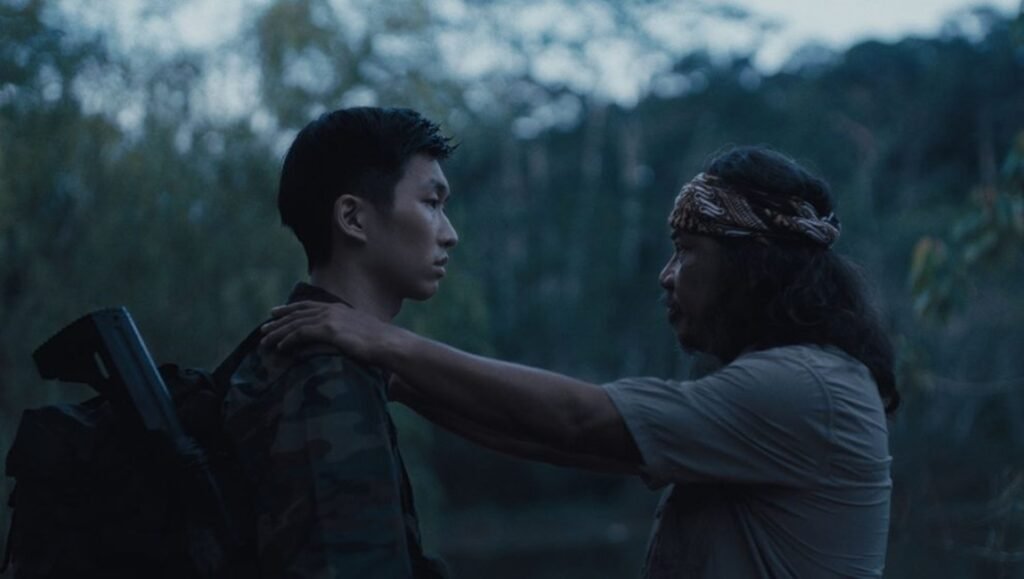
A more typical if no less universal Singaporean nightmare arrives in When the Cold Wind Blows — Keng’s other film in the programme — as the dreaded experience of national service. Compulsory (short of a valid exemption) for all male citizens and from one of whose marching songs is derived the film’s title, National Service (Singapore edition) has by way of cinematic representation an active army of signifiers: camouflaged uniforms, lush jungles, and the humid theatrics of masculine bravado. These signifiers form a conventional but effective thesis in the pantheon of Singaporean horror, borrowing liberally from the campfire tales told to fledgling recruits and bored soldiers alike. In the film’s tale, two young conscripts (played by Clement Yeo and Wayne Lim) on a navigation exercise get lost in the Bruneian wilderness, but not before following a local man back to his home, where his daughter awaits. The boys are horny; the girl hungry, and not in a way to their advantage.
Between apparitions both fantasized and hauntingly literal, When the Cold Wind Blows posits a restless commingling of desire with the incorporeal, as if to double down on the mystique of the desired object and its sequestering far from the articles of everyday life. Everyday life, however, pervades the valiant meditations of Zachary Yap’s Southwest Corner, whose comedic overtones arise from its deadpan and idiosyncratic register. While her 30-something son (Joseph Yeo) mopes about in his room all day, an elderly widow (Elsie Tan) rejuvenates herself and the house in a bid to summon a wife for him. Steeped in the belief in Chinese fengshui — or geomancy — and compelled by devotion to an unborn generation, the widow lights incense, dusts away the bad luck, and dances, her disgruntled nagging giving way to a quirky display of youthfulness once more. Perhaps the wind blows best through the southwest: while admittedly slight, the film eventually settles on a draught of bittersweet loneliness with one feminine energy and beauty replacing another, as is the inevitable order of things.
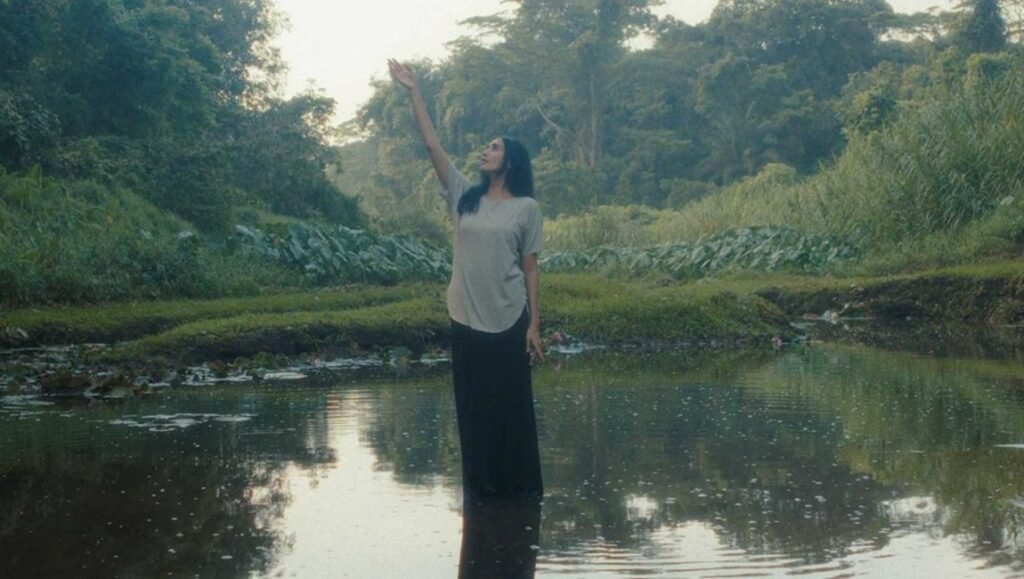
Programme 4’s remaining two films delve into the logic of dreams, a space held since time immemorial to be the feminine’s capricious and fluctuating domain. Of these, Azina Binte Abdul Nizar’s We Learn to Breathe in Distant Places attempts a demarcation of dream and reality that doesn’t quite succeed. As Mahia (Gurdev Kaur) comes to look for her missing son Ajeet (Raja Mohan), who disappeared out of the blue some months ago, she stumbles into the company of a forest spirit (Lim Shi-An) of some kind who offers to bring him back. More implicit than suggested by this synopsis, Nizar’s short hints at a separation of interior and exterior, from tensions between home and open spaces to the opposition of rational order with wild nature. Regrettably, it never quite develops them further, preferring to mine pathos with a languorous soufflé of emotive cues that cast sympathy onto every other facet of female experience. Distant places is a misplaced metaphor, when the dissociative maelstrom within often proves the nearest.
Perhaps a little more should be said about the last film. Having been given a “Not Allowed for All Ratings” (NAR) classification by the local censors for “inaccuracies in its portrayal of Islam which are objectionable and misleading” and effectively banned from public screening, Nurain Amin’s Proposals for the Interpretation of a Dream is fascinating in its own right, not least because it seamlessly weaves together theological supposition and a visually inventive language to undertake its speculative inquiry into the unconscious. Plagued by recurring dreams of an empty house, Safia (Amin) endeavors to decrypt its import and significance without succumbing to its all-encompassing logic. Surrounded by only a table and radio, and perched on a cozy wooden chair, she prays for deliverance, affirming her devotion to the second pillar of iman, or faith, in Islam. An angel is believed in; an angel therefore materializes, its divine unintelligibility duly projected onto a spartan two-dimensional screen and its holy words garbled in a grainy noise only audible to higher beings.
Ostensibly the offending bit in an otherwise unbelligerent film, the angel’s presence does not blaspheme against scriptural wisdom so much as it incites within Safia a confrontation with religious dogma. Specifically, the incommensurability between divine and mortal epistemologies is foregrounded as an impasse seeking redress, as encouraged and even enjoined by religious instruction. “Any dream, regardless of its meaning, that has resonated with you and has left you with either hope, wisdom, or insight” is considered a “message, or a piece of advice, sent from the One and Only.” When Safia consequently attempts to penetrate the lodge of mystery once more, this time with the help of a psychic (Virginie Carrillo), the world changes. Now definitively emplaced in the real environs of Paris, before the television set in her apartment, Safia surrenders to the psychic’s words, forgetting the weight of her body against the chair and entering a liminal state of leveled suspension. In this state paradise is glimpsed, even if briefly: a virtual medley of objects, icons, and vegetation as 3D animation, floating placidly against the idyll of the blue, blue sky.
Drawing a tentative line between religious and superstitious forms of interpretation, Proposals bears considerable stylistic resemblance to Bertrand Bonello’s The Beast, whose clairvoyant medium similarly facilitated a journey outside of space and time and into the many lives past. Yet there is something even more delectable than either its green-screened segments or its ruptured Lynchian impressions, which might have scared the censors into proscribing it: the speculative re-writing of historical memory. Amin gives us a proper physical house, located someplace by the palm trees and plantations of the Singaporean tropics and also in view of the equatorial sea. While she does so, we are made privy to two minor characters, appearing extremely briefly. One is an old Japanese man (Masato Masuura) in Paris who passes by her and asks for directions to the metro. Another is a young soldier (Sanshiro), also Japanese, materializing in the jungle by the house. “Do you like to climb trees?” the first man had asked. In the film’s spirit of oneirocriticism — dream interpretation — could we not avoid the traumatic implication, tethered to history, of a dream set way back during the island’s Japanese occupation? One imagines an alternative ending where the Japanese never left, and an alternate organization of race and religion instituted an alternate Malay heritage. Whether this is liberty or death, only the dreamer can decide.
Comments are closed.