

The Viennale and the Austrian Film Museum’s joint Jean Epstein retrospective makes a simple case: with Epstein, the sea edits. It splices, stretches, and scours his images; it is the pressure system under both the ornate studio phantasm of La Chute de la maison Usher (1928) and the coastal, workday textures of the Brittany films. At Viennale 63 (which ran October 16–28 earlier this year) and through the museum run (October 17–Nov 27), that idea became palpable in the room — across prints and restorations, and, for the silents, with live performance.
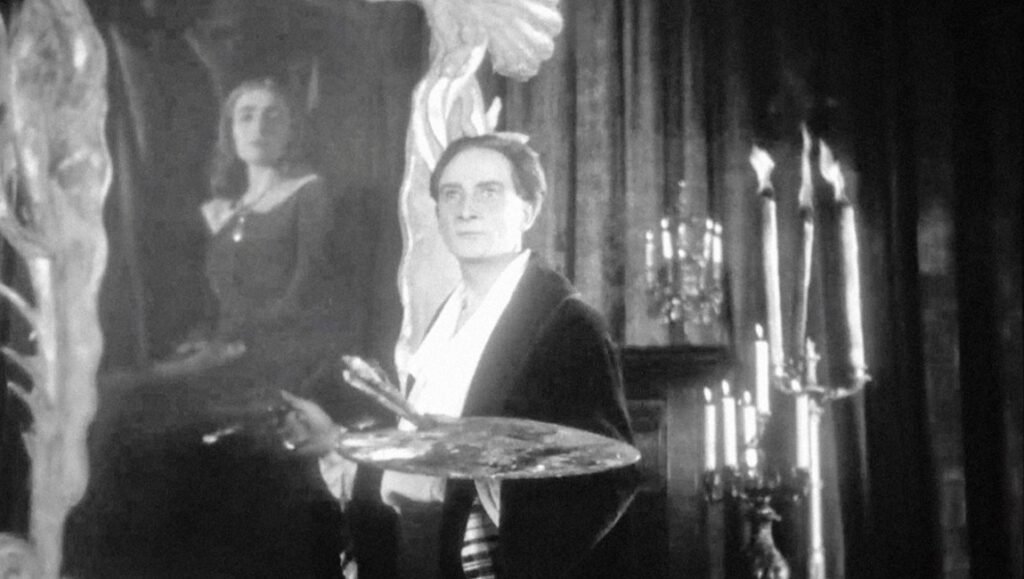
Usher opened the series at the Filmmuseum with duo drank — Ingrid Schmoliner and Alexander Kranabetter — on prepared piano, trumpet, and electronics. Their serrated attacks and long decays don’t “modernize” a classic so much as render audible a physics already inscribed in Epstein’s frames. Mesh, flame, and face seem fused into one trembling surface; windy corridors feel ventilated from inside the shot; even the slow-motion hammering of coffin nails acquires a new granularity. Epstein’s film keeps insisting on material processes — a painting that appears to siphon life from its subject; an ecstatic husband framed against a roaring fireplace; a world of wind, fire, and fabric act. The music merely makes those vectors legible.
Pivot to the Brittany cycle and the sea edits more literally. Epstein’s river- and sea-adjacent work — Mor’vran, la mer des corbeaux (1930), Les Berceaux (1931), L’Or des mers / Gold of the Seas (1931/33), Le Tempestaire (1947) — is often called proto-neorealist for its location shooting, non-actors, and documentary bleed. But what the Vienna program clarifies is continuity of syntax: intercut close-ups of tools, faces, and elements; defocused textures that make water an almost abstract field; deep-focus tableaux where foreground oars, ropes, and branches punctuate space like grammar. The films don’t contradict the studio stylization; they relocate the same grammar to different weather.
L’Or des mers states the quiet part out loud. Its opening disavows trickery —“no special effects, counterfeit images or actors” — even as the island community projects treasure into the surf, an economy of rumor and desire that turns belief into spectacle. The claim to plainness doesn’t cancel artifice; it relocates it into social hallucination. The sea, meanwhile, edits the village’s time: winds that never let plants grow “too tall,” a horizon that erases distinctions of class and distance.
Film Festival
If L’Or des mers shifts artifice onto the social, Le Tempestaire triangulates belief, proof, and the elements in a few lines of domestic dialogue. A door opens on its own. “It’s a bad omen,” the woman says. “Omens don’t exist — it’s the wind,” comes the materialist reply. The film then literalizes both positions: radio sets and lenses on one side; a storm-tamer who stares into a glass globe on the other. Epstein stages the argument as time: long stretches that turn surf into a slow-motion close-up of sound; the sea holding the cut. In this framing, the ocean is not backdrop; it is editor, metronome, and actor.
Even a counterpoint like Cœur fidèle (1923), a Marseille dockside melodrama, sits comfortably in this oceanic logic. The fairground sequence is famous for its centrifugal cutting, but what matters here is how the film grafts sea onto lovers, superimposing waves over bodies — an early declaration that Epstein’s close-ups are not just of faces but of weather. The later Brittany films will simply put those procedures outdoors, among nets, gulls, and radio hiss.
Which brings us back to Usher and to the series’ presentation choices. By nesting the festival slot within an extended Filmmuseum program, the curators let spectators test Epstein’s method across contexts: the same sequence read with different accompaniments, or on a scuffed print one night and a crisp restoration the next. Some evenings the grain makes sea-mist feel particulate; other nights edge definition invites you to parse horizon lines from lighthouse shafts and masts — the horizontal/vertical dialectic that structures so many Epstein frames. Either way, the sea edits: it sets pace, carves planes, animates objects.
The shorthand “avant-garde silent” never really fit. What Viennale 63 and the museum’s retrospective make plain is a continuous method across periods: faces, weather, and tools as co-equal agents; a cinema that tracks how matter moves. In one strand the wind bellows through a studio hallway; in another it rakes a Breton headland. The editor, in both, is the sea.
Comments are closed.