
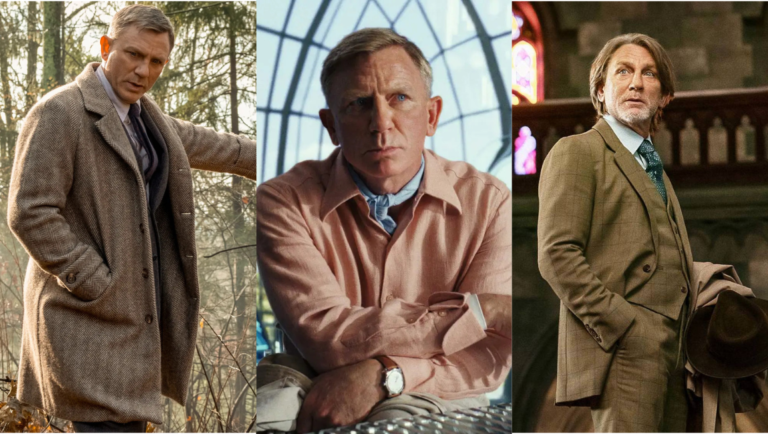
When you’re tucked into a cozy nook and crack open a whodunit, you know what to expect. The dead body in a locked room. The shrewd detective. The suspect list. An assortment of clues that double as puzzle pieces, some true and some false, exposing town secrets whether they’re related to the murder or not. Finally, a grand act of oratory theater, the summation, where that shrewd detective links each clue in a chain of causality that brings order to chaos, and justice to an immoral world.
These are the building blocks of the whodunit, and for a film genre as perennially beloved there’s surprisingly few that are truly great. We already know their names: The Thin Man, Laura, Gosford Park, and, if you’re hip to it, The Last of Sheila. There are others too, but many, like Clue, are satires and larks, as if to acknowledge the trickiness in playing them straight. The Knives Out series is the happy middle of those two polarities, as Rian Johnson, who has always shown love to a genre by deconstructing it, sends up some tropes while obeying others. But there, too, his films struggle with the core mystery elements even as they are so frequently delightful. The truth behind that tension is simple: whodunits are deceptively difficult to make into movies.
In fact, whodunits reveal interesting differences between fiction and film. When you read Agatha Christie and John Dickson Carr, their best novels have all the brainy pleasure of a Sunday afternoon spent assembling a 1,000 piece puzzle. They revel in the joy of hushed discoveries like the worst sort of gossip, like a slow reveal that a matronly neighbor had a dubious past. There ought to be a central lead of the ensemble, typically lovable, like Mary Debenham in Murder on the Orient Express. The crime is investigated by an eccentric yet cunning detective, a whodunit staple that can be partially traced to Auguste Dupin in Edgar Allen Poe’s The Murders in the Rue Morgue and Porfiry Petrovich in Fyodor Dostoyevsky’s Crime and Punishment, then giving birth to Sherlock Holmes, Hercule Poirot, Gideon Fell, Lieutenant Columbo, and Lisbeth Salander.
The best endings, like those in The Murder of Roger Ackroyd or The Hollow Man (both name-checked in the third Benoit Blanc mystery, Wake Up Dead Man), are like being allowed inside a magician’s trick, with the stagecraft behind the author’s sleight of hand brought to thrilling sequence. Whether it’s because you inadvertently invested in the killer or your heart breaks at a betrayal between family members, the reveals can be emotional, all the more so because it is a moral genre, with a sense of justified comeuppance on the evil-doer(s). Like a light in London fog, they bring a feeling of certainty to the grey unknown. For those reasons and others, whodunits are notoriously addictive; if you get a friend to read a great Christie, they go down like potato chips or, perhaps more appropriately, like tea biscuits — it’s unlikely you can stop at just one.
Compared to film, the written word has many advantages. On the most literal, physical level, there’s the benefit of scale; novels have more real estate. Death on the Nile can spend chapters building intricate suspects lists, detailing spindly family trees, and stack zagging backstories and hazy alibis, letting you assemble an evidence board in your mind’s eye. You can follow the the suspect list — the socialite, the aging author, the heiress, the doctor, the communist, the archeologist — as blood-shod datasets that not only bring you closer to the POV of the detective, but further envelop you into the lives of the cast of these characters. And with a wider range of clues in play, they each excite the “puzzle” aspect of the unfolding mystery.
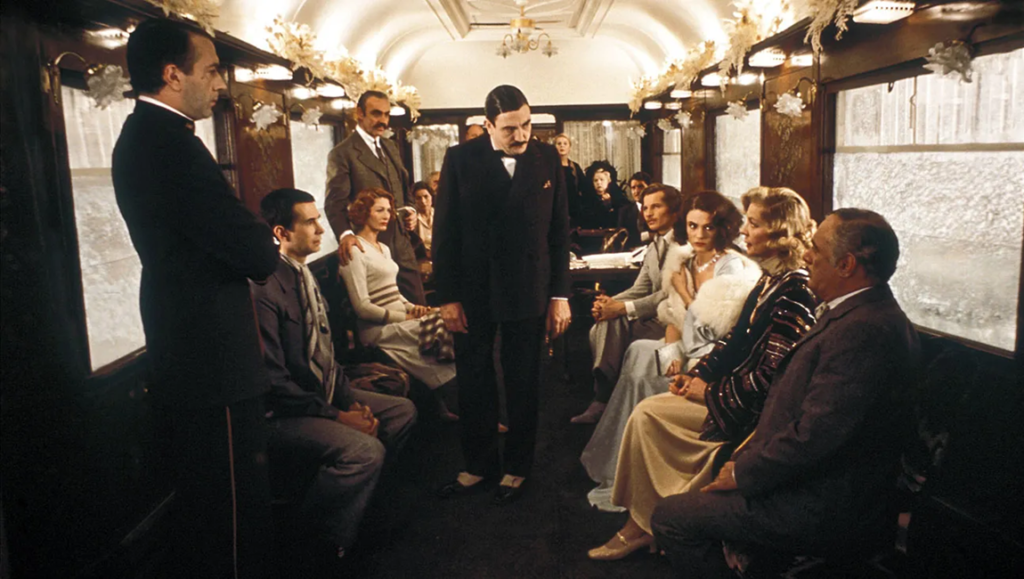
On film there’s the editor’s axiom “information is the enemy of emotion,” a reminder that cinema isn’t just a visual medium but an emotional one. But on the page, information can support drama. Murder on the Orient Express has a gaggle of 13 suspects, and Christie divides her page count between them to create a compelling sense of history, motive, opportunity, and moral character. Meanwhile, Sydney Lumet’s or Kenneth Branagh’s adaptation of Orient Express must rush through those finer details, and thus, one of Christie’s grandest reveals becomes all the less dazzling and profound. Or look at how Umberto Eco’s whodunit The Name of the Rose, famous for its torrents of historical detail, was hollowed out and simplified in the 1986 adaptation. It’s one reason The Da Vinci Code and Angels and Demons, written by Eco’s pop-fiction equivalent Dan Brown, have translated so poorly to the screen. On film, the story must typically pause to deliver raw information. In a smartly written novel, it’s all part of the flow.
As such, the film whodunit must economize. There’s no time to set up even five or six compelling suspects, so the film must settle for emphasizing two or three. As a result, the secrets of the mysteries tend to be easier to spot. If the script highlights one character more than the others, either in dialogue or with a bigger backstory, they probably did it. If one character is especially righteous, innocent or evil, they probably did it. If a film whodunit casts a more famous actor in a supporting role than the rest of the cast, they probably did it. Pages of text can intersperse suspicious behavior equally; on film, too often the filmmaker will inadvertently show their hand with an over-emphasis on key clues via close-ups, gags, and insert shots.
It’s the rare film whodunit to balance these elements. One diabolical gem is Henri-Gorges Clouzot’s The Murderer Lives at Number 21, which like Scream works both as a farce and a compelling mystery. There’s also Green for Danger, a favorite of Scorsese and recently praised by Johnson, a British World War II film where a bumbling but brilliant detective investigates the suspicious death of a patient on an operating table.
But there’s also the tricky business of what qualifies as a “whodunit” and what doesn’t. Take, for instance, David Fincher’s Seven, which is a murder mystery, but not, to this writer’s mind, a whodunit, while his adaptation of The Girl With The Dragon Tattoo is. (The latter checks the typical boxes with an eccentric detective, a “summation,” a clue-like suspect list, and sifting through information is a key focus, etc.). Debating the distinctions of subgenre can feel not only arbitrary but the worst kind of nerdy, like an exercise in cartography where the lines are fixed when they’ve always been open borders. The term “whodunit” was most likely first coined in a 1930 review by Donald Gordon in his review of the forgotten novel Half-Mast Murder, and while the classic tropes surely weren’t on his mind, they are still worthwhile to consider.
One of the earliest acclaimed “whodunits” was Alfred Hitchcock’s 1927 The Lodger. Yet, despite being the earliest Hitchcock to reveal his kinks, it’s not really a “whodunit” in the typical sense, which was a genre he despised. It’s not that a whodunit must obey these rules —Christie broke her own rules almost as often as she helped create them — but it can be irksome when the majority of murder mysteries, like Mystic River or Chinatown, are labeled as whodunits but do not follow the broad criteria. Just look at anything adapted from Raymond Chandler, whose pulpy focus was always more on mood, character, and style than plot.

As for the Knives Out films, they embody both the highs and lows of all film whodunits. Johnson’s Benoit Blanc mysteries are fast and funny, modernizing the genre for the 21st century. When someone drops dead, rather than a soldier back from the great war, we investigate Nazi kids masturbating in the bathroom, Elon Musk stand-ins, and reactionary streamers riding alt-right zeitgeist. He brings in recent events and pop culture just as Christie did — Hamilton, COVID, baseball — using those details to humanize his characters before killing one of them. They feature stacked casts who devour the sabertoothed dialogue, and half the fun comes in seeing Chris Evans shout “eat shit” at everyone he sees. To one degree or another, they’re all a blast.
They are also, in this writer’s opinion, terrible mysteries. The killers are obvious, guessable from the word go. Using the rubric above, they’re shamefully easy to spot. In Knives Out and Glass Onion, Evans’ Ransom and Edward Norton’s Miles are immediately and often labeled as exactly the morally bankrupt assholes they eventually turn out to be. Johnson opts for a double-twist by trying to initially discredit the obvious killer, just for it to be them anyway. The problem, however, is that it’s never credible that side characters like Meg (Katherine Langford) or Walt (Michael Shannon) killed Knives Out’s victim, Harlan (Christopher Plummer), in much the way it isn’t credible that Birdy (Kate Hudson) or Lionel (Leslie Odom Jr.) would’ve tried to kill Miles (as we’re initially led to believe was the intended victim) in Glass Onion.
In both films, the supporting cast is never afforded the development Christie and Carr gave to their suspicious characters, a point reinforced by how the characters all have, more or less, the same motive. They are parasitically reliant on the “victim” for money, but are never shown to have the low moral character capable of executing such a grizzly crime. And because the characters are never truly credible as potential killers, the films can’t fully work as functional puzzles. Blanc has no time to chase one lead only to hit a dead end, nor to then trace another to discover a red herring as he gets closer to the truth. Instead, despite Johnson’s claims that he wants to let his stories work dramatically, the characters mostly become delivery devices for gags and one-liners as you wait for Blanc to solve the mystery for you.
On the other hand, what Johnson excels at are structural games. For much of Knives Out, Marta seems the likeliest killer of Harlan, compelling you to be equally invested in Blanc catching the murderer and the murderer getting away with it. It’s a brilliant gambit, igniting a cognitive dissonance in the viewer’s loyalties — Columbo meets Crooked House. Johnson tries to repeat this in Glass Onion when it’s revealed that Janelle Monáe’s Andy isn’t Andy but her twin sister, flashing back to a murder in the past. These twisty narrative forms nail the puzzle box nature of whodunits, working as smokescreens for the simplicity of the mystery, the flattening of the suspect list, and the disappointing linearity of the reveal, always delivered with mellifluous gusto by Daniel Craig.
Wake Up Dead Man carries the cross of these same issues, but it’s also the best, and most cunning, Blanc mystery thus far. The first half is yet another clever Rian Johnson scheme, with an epistolary account of a conflicted priest (Josh O’Connor’s Father Jud) that uses assumptions of the genre against you. One aspect of the final reveal is obvious, while others are not. There are more clues run amok, Blanc falls through more narrative trapdoors, and a final revelation that plays fairly with regard to the early setup while still upping the ante. The suspects list might be the least interesting yet, but the director also has nearly perfected forcing the viewer to choose between a handful of likely culprits, and it’s all supported by a central arc, of a priest reckoning the sins within himself and those of humankind, that is surprisingly rich. In that sense, then, in the absence of strong central mysteries, Johnson’s hat trick sees him learning how to at least supplement them with an impressive sense of cinematic play rather than a wholly narrative one.
Comments are closed.