
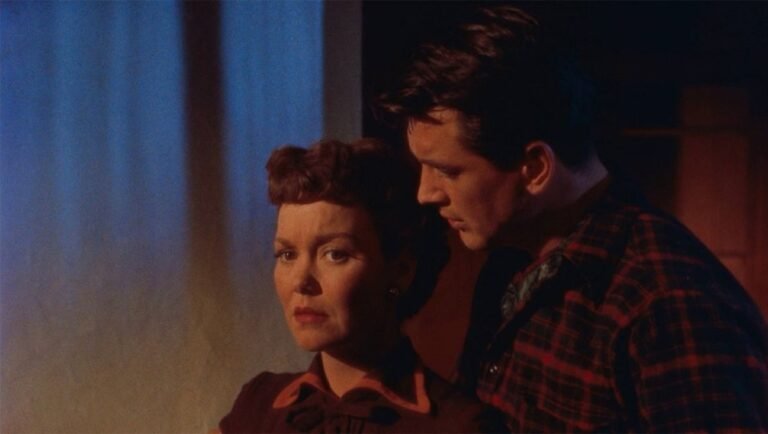
There’s little to say about Douglas Sirk’s All That Heaven Allows that hasn’t already been said. Like any great film, it’s animated by an internal lifeforce that wills it to stay open to interpretations and applications from audiences of any time period. Similarly, one person’s experience of the film produces a different effect on themselves than another’s. After several viewings over the course of one’s life, the surprises of All That Heaven Allows begin to reveal themselves outside of the film, rather than within it. What happens, for example, when you watch it just after your parents have gotten divorced? What comes from the sudden or overdue realization that one’s desires are incongruous to one’s life? For a film neither about nor even predicated on the subject, it’s hard not to feel, in the sober clarity of a few late-December nights, a swelling pride and wariness in suddenly coming closer, even if by just a few degrees, to a film that constantly negotiates its emotional proximity to its viewers.
A frightening case-in-point: the infamous Sirkian children. In this and other Sirk films — There’s Always Tomorrow the most potent example besides — they’re the stuff of nightmares. Few character types in Classic Hollywood pierce our collective bubble of self-perception as these mannered ghouls, whose air of propriety is merely a cover for unbridled selfishness and graceless snobbery. Early in All That Heaven Allows, the widowed Cary Scott (Jane Wyman) gets dressed for a date at the local country club. Her daughter, a psychology student home from college for the weekend, remarks on Cary’s romantic and sexual prospects now that she’s braving the outside world as a single woman. “When we reach a certain age, sex becomes incongruous,” she quotes Freud, matter-of-factly. The remark glides over Cary — in fact, she hasn’t heard a word of it; she was busy getting changed into a ravishing, low-cut red dress. She emerges from her closet to an appreciative whistle from her daughter, suddenly of the mind that widows shouldn’t be walled up alive in their husband’s homes like the victim of some ancient Egyptian custom.
The ambivalence Cary’s daughter expresses in regards to mature sexuality — she appreciates that Cary’s date for the country club, Harvey, acts his age, isn’t “an old goat” — sets the tone for the rest of the film, a melodrama spent at an almost constant waver, where the expressional force of symbols overpowers words. The famous orange and blue lighting motif Sirk achieved with cinematographer Rusell Metty is just one example. The tangerine glow emanating from the innards of Cary’s largely empty house promises her children’s perpetual return and the maintenance of her dead husband’s legacy; we’ll soon find out to what extreme degree the house already acts like an ancient crypt in thrall to her husband’s legacy. Outside, mediated by windows and doors, lies the cold blue of the unknown — at this point in the film still a threat instead of an opportunity. Together, these colors articulate what Cary doesn’t yet know, and what we begin to sense, about the imminent rift between her sexual desires and familial duties pried open by an unexpected romance with a man outside her social class.
It’s a terrible shock to find oneself, even if just for half a moment, in agreement with Cary’s prudish daughter. You smart at the shame soon enough, but that sudden identification has been made. No one can really prepare a child for their parents’ — perhaps especially their mother’s — sudden emancipation from responsibility to their partner. Whether precipitated by death or divorce, this separation ignites, in spite of the obvious change, a primal conviction toward a parent’s duty to entrench themselves in routine sameness that is, unsurprisingly, hard to shake. This isn’t to say oneself, or certainly Sirk, is against sex over a certain age, or that one can’t conceive of it happening at all. In fact, a clear and obvious reading of All That Heaven Allows, which at practically every turn skewers the conformist sexlessness of Cary’s upper-crust friends, reveals Sirk’s deeply held belief in the opposite. But a sudden closeness — especially closeness you didn’t expect to have — to All That Heaven Allows means confronting the fact that, for a brief moment, one sees where Cary’s daughter comes from, and oscillates, like her, between protection, embarrassment, and relief over her mother’s freedom.
What do we do with this shameful identification? One option is to rebuke it unequivocally. Cary’s sudden and willful romance with her gardener, Ron Kirby (Rock Hudson at his most uncannily beautiful, almost sculptural in his perfection), is our first signal to wrest ourselves from it. This isn’t a hardship. Ron’s Walden-esque existence, informed more by a spiritual embodiment of Thoreau’s writing than an intellectual understanding, is glorious. But it chafes against Cary’s. The friction starts to loosen her calcified devotion to the needs of others, a devotion made stale rather than noble in the country club air that suffocates her daily life. Cary’s reluctance toward the relationship, however, comes only after those outside of herself, namely her children and her friends, express disappointment, shock, and even repulsion.
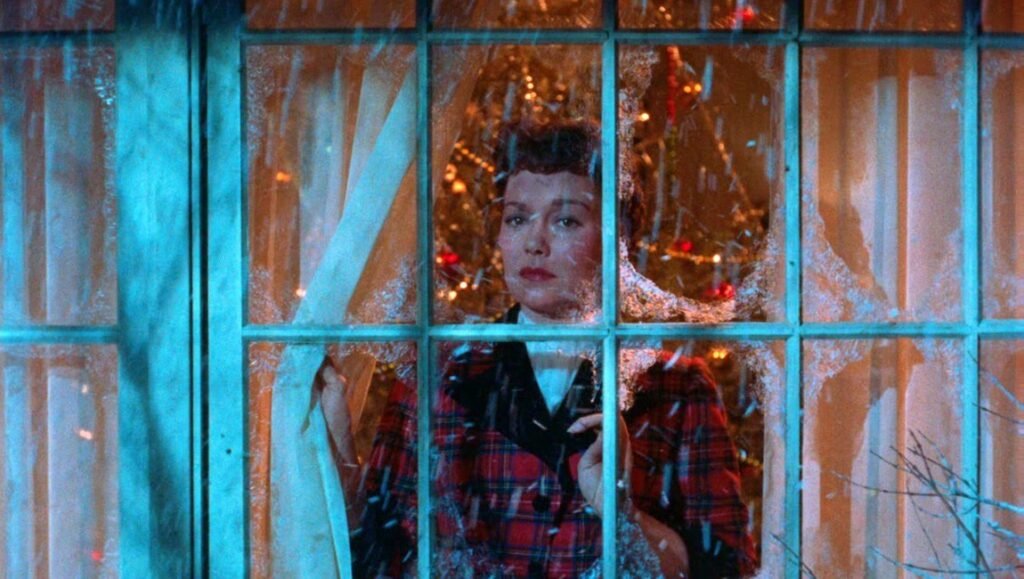
Sirk knows, despite the audience’s assumed identification with Cary’s stiff, upper class community values — material wealth, conformity, regulation — what they really want, frankly, is for a tall man in flannel to sweep them off their feet and renovate a dilapidated barn in proposal of marriage. It’s not a stretch to argue Cary considers her children, even her upturned-nose community at the Club, more as a part of herself than not. To support them means sacrificing a part of oneself for the sake of conformity. Accepting something for herself, then, is actually against her nature, a departure from herself. The tension between Cary’s desire to break free from, and her reluctance to give up, what has been her social safety net is the most concrete embodiment of Sirk’s rampant symbolism — the orange and the blue, the suburban and the pastoral. Cary’s choice, then, means redefining what the self means to her. While her act of rebellion still centers an inherently conservative social contract, its spirit, in this particular context, vibrates with the thrill of deviance.
This thrill affects men and women alike. If the Melodrama of Classic Hollywood was derided in its day as a genre solely catered toward women, then All That Heaven Allows is uniquely positioned to expand upon that assumption by offering (straight) male viewers the kind of fantasy usually illustrated solely for women. Ron’s friend Alida (Virginia Grey) tells Cary he embodies a kind of rebellion most men are afraid to undertake — to give up the perennial hustle for status to live more peacefully and deliberately. Ron’s choice, and that of Alida’s husband, Mick (Charles Drake), who learned everything about life from Ron, is derived from and for the self. But if Cary’s reluctance to commit her post-widowed life to Ron is borne of seemingly selfless concerns for her adult children, Ron’s devotion to himself should not then be considered selfish. Little details of his and his friends’ lives — as small as the party table assembled from individual pieces, to the party itself, a constellation of song, dance, and spontaneous camaraderie — are proof that a collection of individual pleasure-seekers can, paradoxically, enable a community of utter selflessness.
Cary’s longtime social circle, on the other hand, is structured around conditional acceptance, selfless acts craned toward selfish ends. The local gossip, Mona (Jacqueline deWit), sprinkles suspicions amongst their community under the guise of propriety, but are, in fact, meant to sow division between people she deems to have behaved improperly — Cary especially. Live and act in accordance to a set of unspoken rules, and you will be welcomed inside. Deviate, and brave the cold alone. When Cary’s best friend Sara invites her and Ron to her cocktail party, her intentions are honorable — “Maybe if people see him, maybe if they get to know him, they’ll accept him” — but they’re still conditional; Ron will only be accepted after walking through the door and proving himself, rather than be accepted automatically because he loves a member of their community. It’s a stark contrast to Ron’s party, where these social calculations simply don’t exist. If you’re there, you’re accepted; if you’re accepted, you’re there.
The opposing modes of being, as illustrated by these two milieux, hold a mirror to the calculations involved in navigating a parent’s newfound independence. It’s what Cary’s children navigate to varying degrees of success. Her daughter is the more enlightened and accepting, but is also unconsciously unfeeling; her son’s disapproval is more direct, unequivocal. Her children’s violent reaction to Ron’s social position and age confounds her. After initially accepting his marriage proposal, Cary breaks things off with Ron.
One doesn’t necessarily relate to the children’s wavering, at least to this wild degree, but there is something uncomfortably familiar in their reactions to learning their mother’s new partner is someone they hadn’t accounted for. With the marriage off the table, her son is suddenly back on side, happy to come visit for the weekend, happy to assuage her lonely singledom with a brand new television set. It’s not long after Cary’s prudish daughter announces her own engagement, and her son announces plans to sell the family home, that Cary stares down the prospect of a lonely future, cloaked in irony and dashed hopes, accompanied only by herself.
Sirk’s work constantly destabilizes a viewer’s assumptions about melodrama, and All That Heaven Allows is, perhaps, the best example. It distills the ironies of social choreography among a certain community, and places them in sharp relief to the crystal clear rationale of an idealized male hero/romantic figure. That Ron Kirby can function as both hero and lover is crucial to the impact All That Heaven Allows has had over the years, though it doesn’t appear to be remarked upon enough. There is a version of this film that doesn’t take the time to detail Ron’s philosophy of living, one which wouldn’t, on the surface, be wildly different. He might have still renovated the old barn for Cary. He might have still proposed just as quickly. But the essential juice would be missing. The film’s galvanizing energy is derived from the fact that Ron’s life not only destabilizes Cary, but destabilizes the viewer; it brings us closer to Cary’s experience by illuminating just how incongruous — to use a familiar word — she actually is to the life she’s been living.
Comments are closed.