
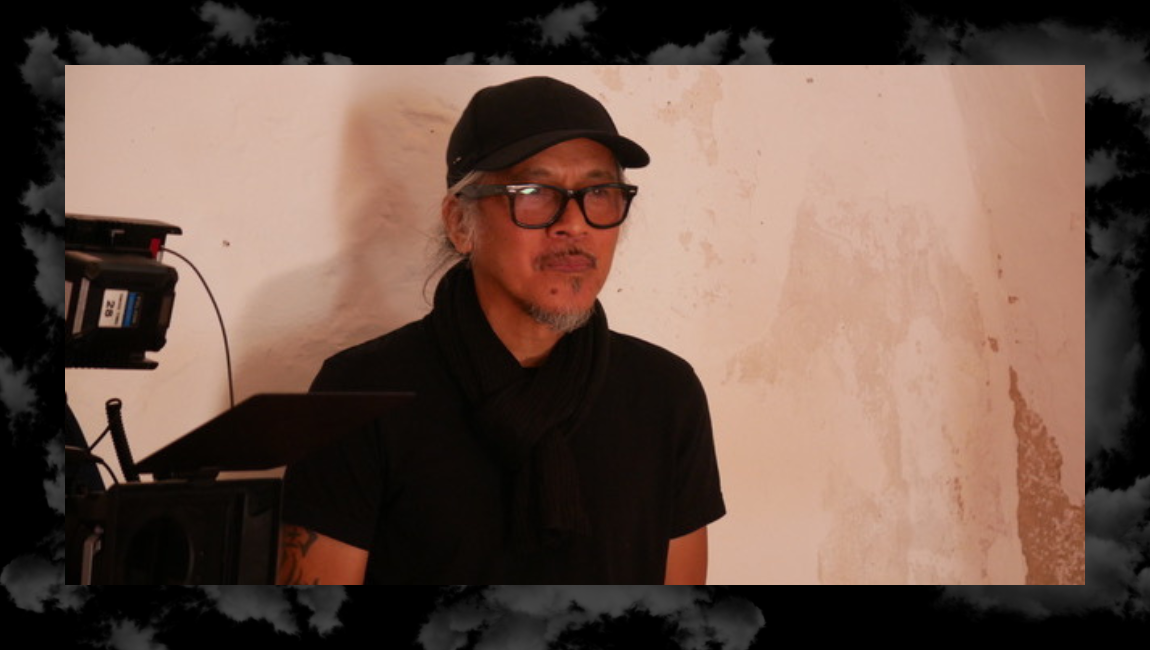
Lithuanian-French Jewish philosopher and Shoah survivor Emmanuel Levinas once opined that “the first word of the face is ‘Thou shalt not kill.’” The human face, or perhaps more creatively put, the act of seeing another and letting the emotions they wear on their faces penetrate us, touches something morally dormant resting within us. That’s the power of cinema. It’s an art that lets us meet, love, empathize, and mourn the faces of many. It’s a medium that can reshape the myths that sustain cultures when leveraged with a humanistic and subversive touch. This is also the story of the great Filipino director Lav Diaz’s career.
Diaz is best known as the Filipino custodian of “slow cinema” and the festival-favorite auteur behind titles like Norte, the End of History and Evolution of a Filipino Family. He usually rejects, or at least pushes back on, the “slow cinema” label simply because it is a label and he is an artist who prefers (and elects to make) boundaryless art. Elsewhere, in reference to the island where he grew up, he has claimed to be filming in “Mindanao time” or “Malay time,” an experience of time that runs counter to the standardized (and exported) fast-paced, capitalistic Western experience of the clock. His new film, Magellan, continues his decades-long experiment in “Malay time.” It is a selective biography of the final few years in the life of Portuguese explorer Ferdinand Magellan as he colonizes what are now Malaysia, Indonesia, and finally the Philippines, where he ends up being killed on the island of Cebu in 1521. While maintaining the long static shots and minimalistic soundtrack that have defined Diaz’s aesthetic over the years, Magellan also strays from the bulk of his filmography with its color photography and 4:3 aspect ratio. At just over two and a half hours, it’s also much shorter than his most famous “emancipated” works, which sometimes stretch past 11 hours.
I spoke with Diaz on the morning of January 3, several hours after the heinous American invasion and bombing of Venezuela. It was an altogether weird time to be thinking about the cinema. And if it were any other filmmaker, or any other interview, I might have considered cancelling; there are more important things in the world than talking about moving pictures. But Lav Diaz isn’t most filmmakers. He makes films with the intent to change the world. His moral clarity — unlike the president — is unimpeachable. And somehow, in some small way, maybe the thoughts he shares here can be part of his dream to build a better world. In other words, he is one of the very few filmmakers who it made sense to talk to in a moment like this.
I interviewed Diaz over Zoom on the occasion of Magellan’s North American release. Our conversation was free-flowing and touched on Donald Trump, anti-colonial filmmaking, his course-correcting depiction of Enrique of Malacca (a man enslaved by Magellan), his political reasoning for using translators while on the press circuit, the Wakwak connection between Norte and Magellan, and much more.
This interview was edited for clarity and concision.
Joshua Polanski: I saw Magellan for the first time at TIFF. In the Q&A after, you wasted no time drawing lines from the colonial past to the present as you repeated phrases like “Fuck Magellan, fuck Putin, fuck Duterte.” Today, we also woke up to the awful news of an American bombing of a sovereign country and the kidnapping of its head of state. Do you see Magellan in Donald Trump?
Lav Diaz: Yeah, [Nicolás] Maduro, man. My God. It’s the same. It’s happening again. The cycle continues. Imposing very arbitrary and premeditative things [excuses] like that. There was a plan. A very barbaric [plan], as well. It’s the same. It never changed.
JP: What does it mean to make anti-colonial cinema? What does anti-colonial cinema look like?
LD: Personally, it’s an obligation. I consider myself a cultural worker in my country. It’s a no-brainer to tackle history, to talk about colonialism and the different periods in our country’s struggle. It’s an obligation to talk about these issues, to disclose them. Magellan specifically is a big, big, big persona and a fixation to our culture. He has been a part of our culture forever. It’s an imposed responsibility to create a dialogue about this epoch in our country and in history.
JP: Walk me through the reasoning for casting a Latin American rather than a continental European in the role of Magellan. Was this a conscious decision from the start?
LD: We were casting and immediately the first person that we thought of was Gael García Bernal. It became a unanimous [decision] between Albert [Serra], me, and Joaquim Sapinho. When we were doing the initial incarnation of the work, when we [were thinking of the role] Magellan, somehow we all thought of Gael. And we also knew that Gael is not pure Caucasian. He’s half-indigenous. Half of his blood is Mayan-Aztec Mexican. He is half Native and half white. It could be a strange decision.
When we talked to Gael, he wanted to do it. He wanted to work [with me]. He is also a very knowledgeable man. He can talk forever about his country’s past, about their history, about Cortés coming to the country, Moctezuma, and even parallel histories like in Cuba and the Philippines. He is a very, very articulate man in terms of talking about history. He was the right choice. We made the right decision.
JP: Were there any specific works of his you saw that put him on your radar?
LD: I know his work: Y tu mamá también, Amores perros, the Che Guevara films [Fidel and The Motorcycle Diaries]. He’s also familiar with my work: he goes to festivals and he’s watching the films in Mexico. He’s a regular at FICUNAM [International Film Festival of the National Autonomous University of México]. We know each other’s work, so we connected with each other easily.

JP: I’m a complete outsider to Filipino history, but I’m curious about the person Enrique and his cultural importance in the Philippines and also Malaysia.
LD: Well, he’s a Malay. The Malay culture and the Malay race include the Philippines, Malaysia, and Indonesia. They call it the Malay Peninsula. We are all Malays. We look the same [and] our cultures are connected. Our languages are connected. Enrique is Enrique of Malacca. Malacca is an old city now in Malaysia, very close to Singapore. It was the first trading area in our region. Even before the Europeans came, Chinese traders, Indian traders, Arab traders, they were already there trading with the Malay.
Magellan saw Enrique for the first time when he went there in 1506. And then by 1509, he bought Enrique and brought him to Portugal and Spain. 10 years later, in 1519, they went back. They reached [Cebu] in 1521. That’s 12 years. The first circumnavigator of the world is not Magellan: it’s Enrique. Magellan died in Cebu, in the Philippines, so he never fulfilled the circumnavigation.
JP: I imagine the primary sources on him can’t be that abundant. Has he always been included in the Filipino story of Magellan? Does your account intentionally elevate him as a course-correction of sorts?
LD: If you watch European or American versions of Magellan, they don’t mention Enrique a lot. But he’s always there beside him from 1509 up to the very end. Enrique is always beside him, taking care of him, getting him food, washing his clothes. He’s the slave of Magellan.
As a Malay like Enrique, when we started talking about how we were going to do the film, [the producers] asked me, “How are you going to do it?” and I told them I needed to balance the perspective; it couldn’t be just the white man’s perspective. I need to have the voice of my culture there because Enrique is Malay just like us. We need to have a voice in the narrative. And I think Magellan, the film, did that.
JP: From Malay and Cebuano to Portuguese and Spanish, language and the act of translation are so important in the film. Enrique is at the center of this translation. His ethnicity, from my understanding, is contested by historians. Some say Malay, others Cebu. Your Enrique is almost a universal figure, in part through the languages he speaks. Can you say more about your thinking when crafting and representing the identity of Enrique?
LD: Of course, people are claiming that he’s Indonesian, he’s Malaysian, he’s Filipino. But if you talk about the pre-colonial era, then our language in the Malay Peninsula was still evolving. We understood each other. We can talk about the language of the North, the South, and the East, but they could understand each other. Even now, if you go to Indonesia and the Northern part of the Philippines, the language is so connected. The language in Malaysia and some parts of the [Philippines] are so connected. We still have those connections. Even our practices are all the same. We’re so connected. You can still find indigenous tribes in the country practicing the same old ways.
It’s valid that some Filipino historians claim that Enrique is a Filipino because he speaks Cebuano. Of course Enrique can understand Cebuano. And [then] Enrique is Indonesian, [so] of course, he can understand Bahasa Indonesia. And no, Enrique is from Malacca, [so] of course he speaks Bahasa Malaysia.
Remember that Enrique was already a slave at a very young age. He was traveling all over the peninsula with these Chinese traders and Malay traders enslaving him. He understands. That’s why Magellan was so clever. When he got to Malacca in 1506, he saw this young man — he was 14 — and he bought him because he knew Enrique was a polyglot. He could speak so many of the region’s dialects. Magellan knew he would need him when he went back. Magellan was clever to buy him because he could really use him in communicating with the Malay people. Getting Enrique was not just functional or for giving food or cleaning his clothes, but it was for the language, too.
JP: Speaking of translation, I’ve been following your press circuit with the film pretty closely. I’ve noticed you tend to use translators while in the West. Is this a political decision, or political message, in a small, linguistic way? [Note: this conversation took place entirely in English.]
LD: It’s a political decision and a linguistic message. I am more articulate in my own languages as well. I’m better off talking in Tagalog or in the language of the South [Ilokano and Illonggo] where I grew up, but I found it really annoying when translators or interpreters couldn’t translate my words well when I speak in Tagalog. It was a big decision for me when I decided, “Okay, I need a translator”: I want to speak in my sovereign tongue. Of course [it’s political]. Yeah, it’s part of the Magellan, anti-colonial story. I want to speak my own tongue.
But again, it’s hard to find good translators. I’m speaking to you in English now and I feel bad about it. I can articulate more in my own language. There are nuances, tones, or even words in the Malay language that you cannot really translate into English. Tagalog is a great language and when you translate it to English, you feel really limited. I’m not saying that English is not good. I love the English language. I love Shakespeare, the [classic] poets. It’s great. But at the same time, I have to respect my tongue as well, my sovereignty.

JP: Magellan is much more than just a Filipino story. It’s a story of Malaysia, Indonesia, Spain, and Portugal as well. Has the reception been the same or has it differed in these different places?
LD: The reception in the Philippines was great. There’s a little resistance as well. Most of these are accusations of revisionism because I questioned the existence of Lapulapu, supposedly the guy who killed Magellan. Nobody saw him and nobody really witnessed [the supposed crime]… It was not even a battle: it was a massacre. 60 against 2000. [But overall] the reception is quite good in the country.
Even in Indonesia, they like that we [Malay] have a voice now in this narrative. The Malay have a voice now, and they’re thankful for that. The resistance and the resentment is, again, with Lapulapu. I’m open to dialogue to talk about it because you can’t really prove it. There’s a big question about the existence of Lapulapu.
JP: Is some of the controversy with Lapulapu not just that you question the historicity, but also because you call him a Wakwak?
LD: If you create a narrative, if you create dramaturgy, it’s all about culture. The Wakwak is very much a part of our culture. If you’re familiar, it is our version of the vampire: blood-sucking, etc. With the Wakwak, it’s more [about] fetuses, the liver, pregnant women, dead bodies. If you create a narrative that’s within our culture, then you cannot escape those. I use the Wakwak as a concept or device to make it more Malay. It’s the way we talk, the way we see things.
JP: Is there a connection between Lapulapu being a Wakwak and the character Wakwak in Norte, the End of History?
LD: [Laughing] You remember Norte? Yeah, of course. I use Wakwak in Norte for that character because it’s such a menacing character, a bully, an imposing character, a bad leader. It’s all connected. You create an antagonist that’s really mean and use folklore, the legends, the myths of Filipinos. They’re connected. I was thinking of that Wakwak with the Wakwak in Magellan.
JP: Music is sneakily important in your films. I’m thinking of the band in The Halt, for example. You’re also in a rock band. I’m curious to know what music you have been listening to recently?
LD: I’m going back to The Beatles and Radiohead, some Pink Floyd. It’s always a constant. When I listen to music, it’s always The Beatles and the [Rolling] Stones. During the shoot of Magellan, I was listening to Bob Dylan and Tom Waits.
JP: What Dylan album or albums were you listening to?
LD: “Blood on the Tracks.” I’m also trying to open some novels that I couldn’t read before. There’s not much time to read a lot of good books. I just open a page and then there’s a good line here that really inspires me. A Virginia Woolf book or a new book.
JP: What have you read recently?
LD: A very recent new book by Kiran Desai called The Loneliness of Sonia and Sunny. It’s a great book. Also, Sad Tiger by Neige Sinno, a French writer. It’s so great. It’s about rape. And [I’m] trying to go back to The Magic Mountain [by Thomas Mann]. But there’s not much time, man. [Laughs].
JP: I know you believe in the power of cinema to change the world. Yann Martel, the Canadian author, thought the same with books, so he regularly sent books to Canadian Prime Minister Stephen Harper with a short explanation of why he was sending him the book. If you could show one person on this planet Magellan — knowing they would actually watch the whole thing — who would you show it to and why?
LD: Donald fucking Trump, maybe. Yeah, I don’t know. This guy is a moron in terms of history. He is [governing] with carelessness and madness. This is scary. Yeah, he needs to see Magellan.
But I know he won’t watch it. He’s going to be sleeping, he’s going to be yawning, and he’s going to run to Mar-a-Lago and have those parties again. He’s going to name all the streets in America “Trump.” Just like the Kennedy Center, all the streets will be “blah, blah, blah, Trump.” Maybe he will even rename the Strait of Magellan as the Strait of Magellan-Trump.
JP: What about back home? Who would you show it to back home in the Philippines?
LD: To the farmer next to where I live now. Every time I talk to him, he’s a very kind guy, but, at the same time, there’s a lot of ignorance. We need education. There’s a lot of resistance to the populist perspective. You can see their goodness, but at the same time, it’s very dark, very dark. You can see dread. You can see there is this abyss of ignorance that’s sinking them. And when we lose our kindness, we lose our souls.
So, maybe I’ll have him sit with Magellan one day. I’ve talked to him and shared all those things. I’ve shared the Marxist [reasoning] of why he’s that way now. Maybe a Magellan film can [open that door] and I can have a very Socratic dialogue with him. And maybe I can save him — or maybe he can save me as well.
JP: I hope he can see the film.
LD: Yeah.
JP: Do you have any updates on the fabled 9-hour cut?
LD: We’ll try to work on it maybe two or three years from now. It’s another film. It’s sui generis. This film and that film will be very different.
Comments are closed.