
Operation Al-Aqsa Flood, on October 7, 2023, opened the rhetorical floodgates on the wider population of the West’s awareness regarding the circumstances of the Israeli occupation and apartheid of Palestine. Such an operation, as has been cited by academics and even Israeli human rights activists, was an inevitable expression against the oppression of Palestinian livelihood by Israel, Gaza being widely considered the largest open-air prison in the world. Such a proclamation is determined via the acute surveillance and jurisdictional control Israel enforces on Gaza, their borders not only patrolled by IDF servicemen, but a buffer zone established within Gaza’s territory that furthers this pressurization, one which provokes a shoot-on-site response from the military if civilians approach (during 2018’s Great March of Return protests, dozens of Palestinians were killed or maimed by the activation of this policy against peaceful protest). The air above Gaza is monitored and controlled by Israel, alongside the Mediterranean seashore, where Palestinians would be shot at if they extended their fishing or recreational swimming into the sea more than 12 nautical miles. As of 2026, all wading into the sea is banned. At the Rafah border, regardless of Egyptian oversight, Israel ordered the crossing to be blocked in 2007. It’s impossible to understand these conditions, where 2.2 million were contained within these regimented constraints, and not consider the implications of apartheid infrastructure, which takes on a very economic and geopolitical reality in Gaza, where the majority of the population lived in poverty prior to the genocide. Operation Al-Aqsa Flood was a territorial reckoning of the militarized infrastructure built to control and stifle the Palestinian population of Gaza.
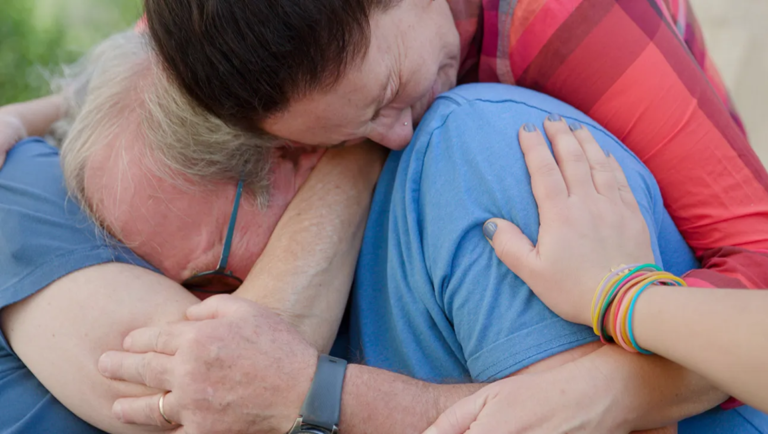
This reckoning killed 1,219 Israeli and international citizens, seeing over 200 people taken as hostages and brought back into the Gaza Strip. This is where Holding Liat begins, observing parents Yehuda and Chaya Beinin, comprehending the fact that their daughter, Liat, and her husband, Aviv, have been taken hostage during the attack. What unfurls is more or less a condensed, point-form relating of the events that transpired in order to advocate for Liat and Aviv’s return through prisoner exchange talks. The narrativity of the piece is flimsy, interested in the intimacy of the family’s relationship to these processes, and therefore leaves much of the timeline excised. Temporally, the film feels consistently in a rush, creating vacuous ellipses where there could instead be the witnessing of bureaucratic frustrations that each individual in the film routinely articulates as they await with bated breath their family member’s release. Simultaneously, it’s these frustrations and the tensions that mount in their elucidation that make up the substance of the work and its attempted moral reflections on the contexts that are outlined above. The film, however, is too liberalized to confront the contradictions that tear through the reality Yehuda, our protagonist, witnesses.
Yehuda and his family are tasked by the Israeli government to be a part of a convoy to the United States, advocating for political assistance in the processes being brokered between Qatar, Egypt, America, and Israel (it should be noted, Qatar was positioned as Hamas’ delegate by the United States, as part of the economic and military deals between the countries). Conveniently left out, however, is that America is in fact the kingmaker in this scenario, with these trips and meetings being ultimately a general practice of showmanship and Hasbara on the part of Israel. America has the deciding hand here, yet this dynamic of proxy states and geopolitical influence is certainly never a part of the film’s attempted analysis of these scenarios that humans fall victim to as pawns in the game of settler colonialism and imperial violence. Yehuda is a liberal man, often sequestered within his community due to his vocal opposition to the Netanyahu government, which he proclaims as the core issue in the contemporary Israel/Palestine dynamic. His liberalism blames religious extremism on both sides for perpetuating discord and societal breakdown. These views are supported by the ideological motivation for him, a New Jersey-born American citizen, to have committed Aliyah in the ‘70s with his family, hoping to build a Jewish democracy with socialist character within the many Kibbutzes being established across Palestine. Yehuda, it seems, still holds closely to this vision, blaming the rightward trajectory of national politics on its failed realization. Where this perspective becomes complicated, then, is in his travels to the U.S.
Arriving in America, the analysts and coordinators of the program he and his family are on find Yehuda’s discourse a bit too challenging. Don’t talk about politics to the politicians; talk about hostages. These are sentiments shared by his wife, Chaya, and his youngest grandson, Neta, whose views are more aligned with the militarized racism coursing through Israeli society as witnessed on social media, via Telegram and TikTok, as well as out of the mouths of countless Israeli politicians, documented by South Africa in their case against Israel at the ICC. With this marginalization of Yehuda, we watch as he and his family are paraded into the offices of republican Christian zionists, platformed on Fox and Friends, as well as brought to a rally where it’s made clear to Yehuda that Israeli nationalism and exceptionalism are more of a prevalent discourse than the desire to end the genocide (“war,” according to our subjects) and bring the hostages home. In the midst of this objectification of the family’s pain, the filmmakers veer into more intelligent territory, exploring their ideological dynamic as it relates to their history and relationship to Israel. It’s here that Yehuda’s brother, Joel, is given a brief featured section. Joel went with his family to Israel in the ‘70s but quickly discerned that the foundational promise of a socialist state through Kibbutznik proprietary was hollowed out decades earlier, and before them lay a colonial mirage. Joel quickly learned of the Palestinian villages razed to the ground and the populations killed or expelled, which gave room for these Jewish communities to come and build on top of. Retracing his steps back to America, Joel dedicated himself to anti-Zionist education, to understanding how these violent policies of dispossession, of disenfranchisement, could lead to the violence that has come down on his own family. The dialogue between Joel and Yehuda is short, filled with sympathy, but set in the silence of a family that cannot bridge ideological dissonances.
What follows is this general structure, brief focuses on other family members who don’t really have much to add to the discourse of the film, revealing these detours to be a method of narrativizing the family’s perspective on the hostage situation, timidly teasing a kind of ideological ambivalence — therefore liberalism — where questions of historical context are leaned into but not dissected: a knife gently caressing the dead frog’s belly; safe, curious, but in no way an agitation to the corpus. As the film concludes Yehuda’s arc with the return of Liat to her family, it observes him stretched across the schism between the two worlds he’s positioned himself within. Whether the liberal conservatism that courses through the Israeli protests against Netanyahu, where the subject of Palestinian self-determination becomes mired in accusations of Jewish self-hatred, or the Kahanist sympathies of Jewish supremacists, who court the families of hostages to tour them around politicians currently in vocal support of ICE agents’ jurisdiction to murder civilians who protest their abuse of power, Yehuda is stifled. In truth, one wonders if there was any attempt to direct Yehuda during the production of this film to the efforts of a group like Standing Together. Regardless, the film cannot configure a form to position this ideological conflict within. Holding Liat’s humanist tendencies aren’t interested in the human-manufactured machinations of colonial violence and its historically unwinding cycles of resistance against oppression and the oppression of resistance. Instead, it seeks to observe the quandary of humans stuck in the machine they are dedicated to maintaining. This is, of course, the liberal’s fallacy.
In the film’s coda, Liat guides a class of students around Yad Vashem (Israel’s Holocaust Memorial museum), describing the infrastructure of ghettoization that the Nazi’s implemented onto Europe’s Jewish population. It’s transparent to any viewer that director Brandon Kramer seeks to utilize this moment as a sick irony at the heart of Israeli society, in that they’ve built these exact same infrastructures, both as exist in Gaza as described above, but also in the West Bank, where occupation walls stretch vertically across nearly the whole length of Israel as to separate its faux Jewish majority from the Palestinian population it has ghettoized and made third-class citizens as part of its apartheid militarism. It’s with this, and so many other critics have made this observation, that Kramer and Liat both ponder the situation of Israel as one in dire need of change. However, the articulated change is not in any form systemic. Consistent throughout Holding Liat are attitudes that insist on the failed truth and reconciliation process currently stalled in Canada, normalizing coloniality, and refusing the concessions to revoke the misdeed of founding an ethnostate in another people’s land. The film, in its indirectness, provides the kind of sullen brood on the nation-state that is reserved for a crowd who chants “four more years” above the voices of protesters demanding the Democrats stop funding Israeli genocide. It sees a tragic contemporary made of historically contiguous violence and wonders what, pray tell, could be done? In a world where copious people have stood up to articulate these visions, where siblings of those killed and kidnapped during Al-Aqsa Flood stand firmly in anti-Zionist positions and dictate that Land Back be an internationalist motion toward peace, Kramer flimsily offers us a thought experiment, one where the suffering of Palestinians remains on the margins, leading so inevitably to this film’s awards ascension at the Berlinale in 2025 during a year where German and international arts workers called for a strike and boycott of the institution. While presenting a compelling profile of a family in ideological conflict, the film never pushes beyond its most immediate function, rendering it as little more than an interesting node in the liberal Zionist campaign to wrest the reins of Zionism from those it has always belonged to.
DIRECTOR: Brandon Kramer; DISTRIBUTOR: The Film Collaborative; IN THEATERS: January 9; RUNTIME: 1 hr. 37 min.
Comments are closed.