
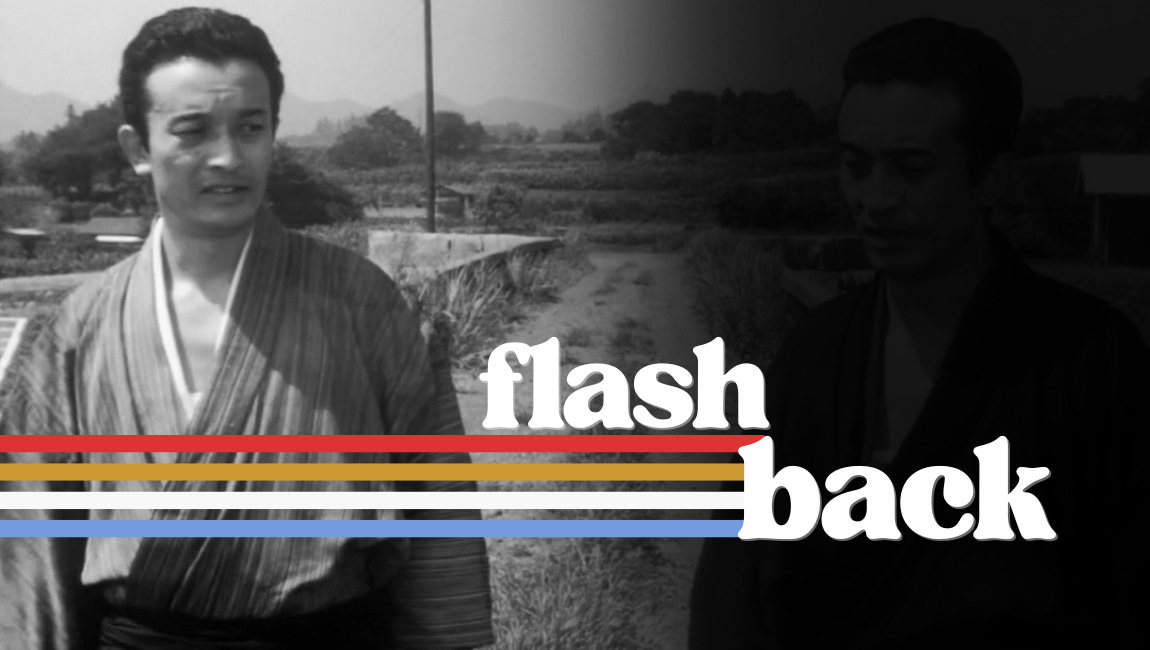
Nowadays remembered as the independent producer of the heavy-hitters of the Japanese New Wave — Nagisa Ōshima; Shohei Imamura, Yoshishige Yoshida; Shuji Terayama; all of them, really — Japan’s Art Theatre Guild first began as a distributor for foreign films in 1961. Then, they branched into film criticism, publishing their own journal (Art Theatre) on the European and American films they distributed. They even owned a small art theater, Nichigeki Bunka Gekijō, in Tokyo. But “independent” as we understand it in America they were not. The major studios still distributed nearly every film made in Japan, and one of the biggest, Toho, was the main financier of ATG. Roland Domenig’s Midnight Eye article on ATG describes it as an experimental laboratory for Toho, as it could incubate and test out talent who could then make their way into directing the genre films of the major studios, or at least garnering attention from overseas. Far from pure noblesse oblige or the European model of doling out government funds for cultural capital, Toho saw ATG as an actually profitable investment, though the returns were a bit more abstract and long-term than any film financiers would like today. There’s never been anything else quite like it, as even contemporary American “independent” subsidiary studios are much larger and much more conservative. ATG was genuinely radical by comparison, even if it had corporate backing and structural support.
Since the start of the new year, I’ve been slowly watching these early films from Art Theatre Guild to get a sense of their transition period from works of arthouse-influenced political dissidents who grew up in the postwar studio system to the kinds of youth-driven works we associate with ATG today (what might be unfairly, at least in this context, be called “post-68” radical films like Shuji Terayama’s 1971 Throw Away Your Books, Rally in the Streets). Kazuo Kuroki’s Evil Spirits of Japan, featuring a sense of profound grief and regret in the postwar political world but also featuring a guy who plays electric guitar onscreen every 20 minutes, feels like the bridge.
In it, Kei Sato plays Murase, a yakuza bodyguard hired by the Kito family as they prepare for a turf war with the bigger Tenchi family. He also plays Ochiai, an unimpressive prefecture detective hired by the local cops to do research on the Kito family and their history. And boy does he ever: as Murase finds a hungover Ochiai in the bed of a not-quite-sex-worker who mistook Ochiai for Murase because, of course, they look exactly the same. Murase offers a strange proposition: switch identities with him while they’re both in town. Now Ochiai can freely gather as much dirt on the Kito family as he likes by asking direct questions, while Murase uses his newfound detective credentials to do his own investigation into a fateful night in which a left-wing student activist group’s assault on a prominent landowner went awry. This setup could easily be turned into an excuse to plot out some tense undercover scenes that would eventually explode into a climactic shootout, and that could also be a very good movie, but instead, Kuroki lets both investigations go smoothly, as each Sato explores more of the cultural, personal, and political rubble of the postwar Japanese landscape still not quite cleared. They’re linked by a young girl who represents both sex and something ineffable for them; the climax of the movie is no shootout but an admission to her that they’ve blurred their pasts to the point of indistinguishability. Someone who looks like Murase and Ochiai belonged to that radical student group that night; they got away and they started over; they easily could have become a detective; they easily could have become yakuza. The final shot is powerful if a bit on-the-nose: a sword planted in a ruined wasteland, the rising sun illuminating the blade from behind.
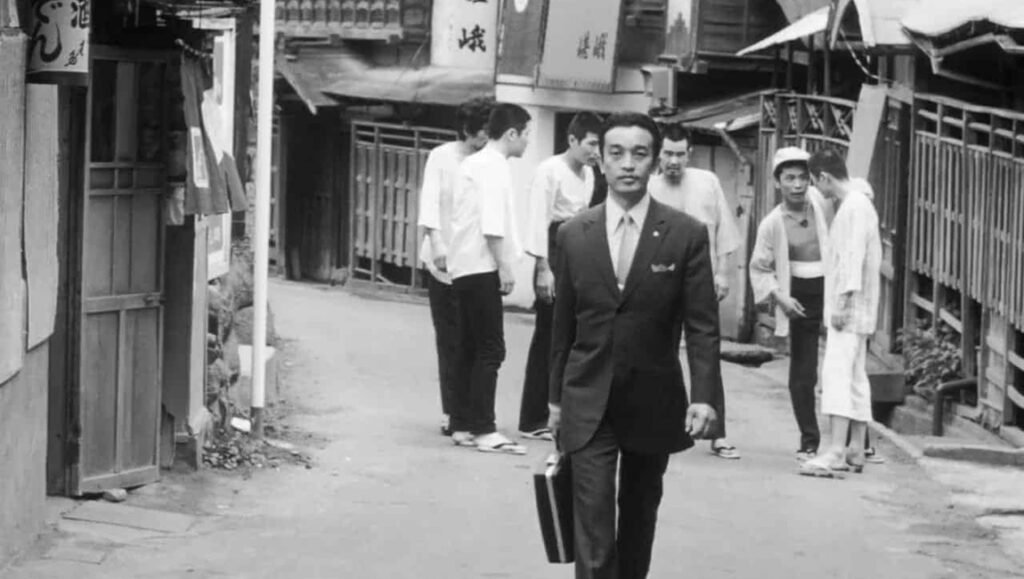
This is a bit more reflective than the many calls-to-arms to typify some of the later ATG titles, yet it’s more brazenly political than some of the films that cribbed Antonioni’s approach to postwar meandering (like Yoshida’s Farewell to the Summer Light). Director Kuroki himself had joined a Marxist student movement, and, though he didn’t kill anyone like our Murase/Ochiai, later became reflective of being caught up in a movement that advocated a kind of justice that could include terrorism as a means. But while “reflective” can sometimes imply a condescension of the wise and old to the young and loud, Kuroki’s films are judgment-free and even accepting of youth culture and the developing New Wave aesthetic signifiers: very little sync-sound, a hyper-mobile camera capturing “verité” moments, and stark nudity.
Evil often returns to a hippie-bard playing his electric guitar on the Kito roof, out in the red-light district’s streets, or even alone on a mud-filled construction site. His guitar is never plugged in, but he doesn’t seem to mind. In one scene, a small crowd of children gather to listen to his playing a pun-filled dirty song that suddenly switches to puns about corrupt Japanese officials, and the adults in the audience seem none-too-pleased. While I couldn’t confirm this production detail, it seems obvious that this was a small “happening” and shot with real locals — at one point our bard even calls the attention of the crowd to the director as the camera swirls around these small, curious faces before returning to our bearded balladeer. In the narrative of the film, the bard is just supposed to be a degenerate ruffian who fell into the Kito family’s circle, but structurally, he acts much like a chorus, a holy fool, or a god, interrupting the action of the film to comment on the futile efforts of our detective/yakuza. That Kuroki makes such a youth-culture figure (clearly a proto-punk) the wizened one of the bunch reveals another layer of complexity in this film about a much-too-directed youth who becomes an aimless adult.
Though credit for this story of Japan’s establishment and criminal elements becoming ever-blurred could also go to Yoshiyuki Fukuda, the film’s screenwriter whose short list of credits also include the celebrated 1973 anime Belladonna of Sadness (other members of the crew who’d become celebrated later include Oshima’s sound guy Tetsuo Yasuda and director Nobuhiko Obayashi, here working as a composer). But this was not a film riddled with what would become ATG mainstays; most members of the crew made little else or channeled their radical tendencies into mainstream-ish productions, like Fukuda and Belladonna. Kuroki himself would make a few more features with the Guild, but his quieter style and vaguer sense of political responsibility would make his name less memorable than those like Oshima and Terayama, whose subversive images always stirred fashionable bouts of controversy. By looking into his somber works, we can discover another side of ATG — one that recorded both the ebbs and the flows of Japan’s radical political movements and sought to understand them before jumping back in.
Comments are closed.