
The unknowables that inform the maintenance and dissolution of familial relationships are, for Hylnur Pálmason, generative. Fittingly, then, his new film, The Love That Remains, begins with a partial image of destruction. The roof of a dilapidated seaside hangar suddenly uncouples from its foundations, hovers and sways under its own force, suspended from some unseen point in the air. The moment poses a question: how do you locate a cause when you can only see its effect?
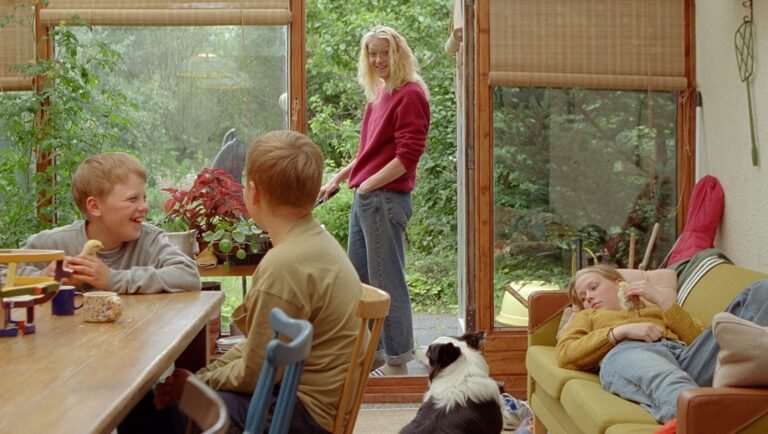
For the rest of the film, we watch Anna (Saga Garðarsdóttir) and Maggi (Sverrir Gudnason), an independent artist and listless fisherman, respectively, navigate the seemingly ideal post-divorce scenario. Peaceful dinners, backyard basketball, and excursions in nature appear to be the standard routine of a family unit making a success of what could be deemed a failure. But the same question that troubled the opening shot persists: what cause is being hidden from us?
Pálmason’s previous feature, Godland, was an historio-religious epic, following a devout Danish priest on a mission to spread the gospel to the people of Iceland. Pálmason’s scope in The Love That Remains is not historical, but there is, nonetheless, a grand sweep. In Godland, images of death permeated moments of spiritual sublimity; for example, a decomposing horse (Pálmason’s father’s own), filmed from above and depicted in jarring cuts across time and seasons. Now, Pálmason’s practice of synthesis between the real and imagined is extended to the motif of a large dummy tied to a wooden stake, which Anna and Maggi’s kids, teenage daughter Ída and twins son Grímur and Þorgils (played, unsurprisingly, by Pálmason’s own children), construct over the span of a year, dress up in armor, and shoot with arrows. Both the dummy and the horse serve to remind the viewer of death and life as a continuum, and that artistic creation is inextricable from biological reality.
In The Love That Remains, Pálmason weaves together a series of scenes that very clearly illustrate the passage of time, but splinter off and jump around according to a unique internal rhythm. But if these vignettes form a tapestry, then its threads are frayed. Pálmason’s refusal to contextualize Anna and Maggi’s divorce — a line here or there flashing upon deep resentment are our only crumbs — has the effect of throwing this collection of present moments into a kind of disarray. This isn’t to say they unfold chaotically, but they make time feel slippery. As discrete chunks of time, they flatly deny the viewer’s innate desire to connect one event to another, forcing any instance of interpretation to occur on the terms of the images, and only as they appear.
The terms of their appearance are another destabilizing tool. The film operates mostly in a realist register, but has deliberate pockets of atmosphere from which surreality and humor bursts forth. A simple mushroom foraged on a day trip represents nothing more than itself, until the mushroom is ripped open, its spongy innards exposed, and the sound is cranked for maximum texture. Suddenly, as we’re thrust inside Maggi’s lonely state of mind, that mushroom becomes the soft, pillowy manifestation of his pent-up sexual desires and Anna’s withholding yet playful sexuality, which we witness on the family’s nature excursion. So, too, does the family rooster, of which Anna asks Maggi to dispose, morph from a minor nuisance into a nightmarish terror after he decides, out of a frustrated impulse, to pummel it to death with a rock.
In some ways, Anna and Maggi are an unremarkable screen couple. Their intrinsic contrasts — artistic ambition against professional aimlessness, parental laxity versus impatience — are pleasantly familiar, though Pálmason can’t help but to, eventually, adopt Maggi’s position in the story instead of Anna’s. Gunnarson, for his part, avoids playing Maggi like a stereotypical sad divorcee. No simple sad sack, his quiet disposition is pulled taut across himself; constantly uncomfortable, he’s a man approaching his capacity to make the most of a bad situation. His handsome face plays against his early-middle-age beer belly; comprising two halves, the lover and the divorcee, they seem to entice and repulse Anna, herself increasingly frustrated, in equal measure, by the fits and starts of her elemental artistic practice (an isolated visit from a self-centered Swedish art curator is more absurdly comical than professionally useful) and the stubborn, enduring attachment she feels toward Maggi.
It’s difficult to end a film without a story. Thankfully, Pálmason does his best to return to the beginning, aware that questions about Anna and Maggi’s split still peck away at the viewer. The answer, if there is one, has already revealed itself in the form of Maggi’s drifting detachment. Alienated by Anna and his children, his days on the fishing boat are all-the-more filled with resentment. In an act of desperation, he jumps ship near the shore and starts to float. Directionless, he cries out a pathetic song: “Maggi the coward.” Elsewhere, one of the twins is shot with an arrow, and the knight in shining armor comes to life. The coward slips into self-pitying irrelevance, fated to lust after figments of imagination, and survive on the crumbs of a dissatisfying reality.
DIRECTOR: Hylnur Pálmason; CAST: Saga Garðarsdóttir, Sverrir Gudnason, Ída Mekkín Hlynsdóttir, Þorgils Hlynsson; DISTRIBUTOR: Janus Films; IN THEATERS: January 30; RUNTIME: 1 hr. 49 min.
Comments are closed.