
Three Austrian documentaries from the past two years turn their gaze to the racially marginalized of the small mountain country. The oldest of the three, Favoriten (2024), follows a school class from second to fourth grade in the biggest elementary school in Vienna. It derives its name from the so-called “workers’ district,” Favoriten, in the south of the city, and known more colloquially as the Turks’ district. A great variety of ethnicities live there, as it happens, and its vibrancy is immediately felt. Yet it also receives the most ire from those not living there. The district is divided into the more affluent Oberlaa area and the inner Favoriten area, which is so thoroughly sealed with cement that any patches of grass are entirely by accident. Favoriten keeps itself to a grey and yellow-tinged color palette throughout, to the degree that even St. Stephen’s, the venerable church and perennial tourist favorite, looks a little like an administrative building here with its ochre tint.
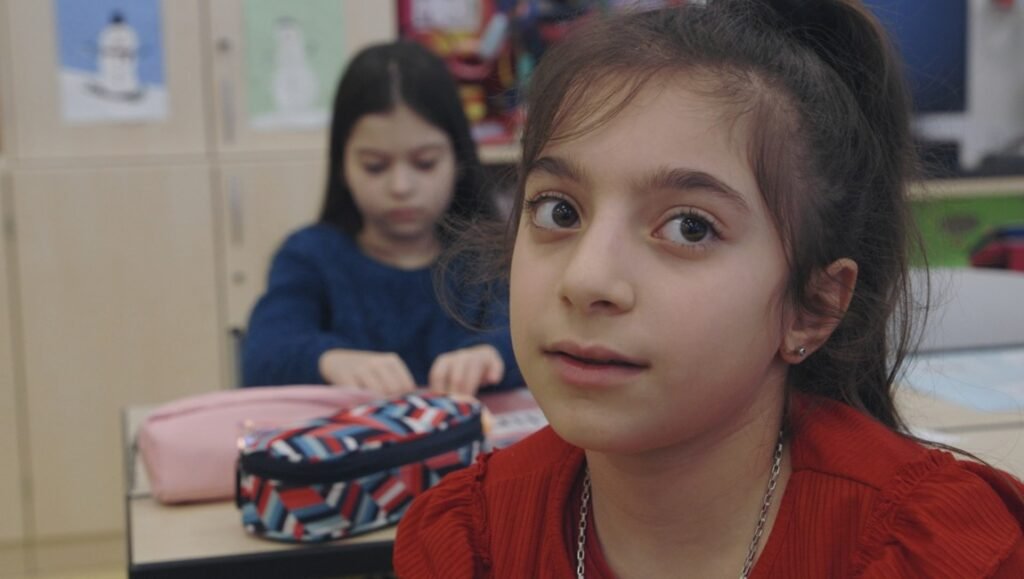
Over the course of three years, director Ruth Beckermann follows these ethnic Turkish, Albanian, Serbian, Syrian, Romanian, and Chechen children with their ethnic Turkish teacher Ilkay Idiskut. Beckermann provides little commentary; Beckermann keeps her focus on the children as they wrestle through math questions, attempt their first sentences in German, and resolve their first inner-classroom conflicts. The scope of Favoriten, then, isn’t about being Austrian or not, or what that entails. That question is obsolete to Beckermann; these kids have already been born and will presumably live their lives here. The dramatic question guiding much of Favoriten, and an increasingly worried-looking Idiskut, is instead how the state prepares for this new generation of Viennese children. Not very much, as it turns out: early on, the school principal informs the teachers of missing social workers (“secondary school is more important”) and second language support (the teacher being on maternity leave). Whatever improvement these kids receive through the year seems entirely the result of Idiskut’s will. The parents — workers who speak little to no German, wives either at home or cleaning other buildings, and too busy to care for their children — know this; they shower Idiskut with chocolate and flowers at the close of the year. The lack of German puts the children in the unenviable position of translating for their parents. Favoriten goes to great lengths to leave nearly everything uncommented upon and commonplace, and succeeds at it for the most part, marking this the only distinctly immigrant part of the whole film.
From the start, Idiskut seems unflappable and totally in control as she watches the children with crossed arms and permanently arched eyebrows. Fights don’t bother her. The strange things the pupils say that usually begin with “My parents said” — the bespectacled Nerjiss says, for instance, “if you wear makeup, you will be taken away” — and are met with an “Okay…” or “Aha.” She is friendly but not comfortable, firm but not dictatorial. This image later softens over the semesters to reveal a woman in over her head with mounting school pressure and an eventual pregnancy reveal, both of which come to a head when the class turns out to bully the new kid, Liemar, who cannot speak a lick of German. Beckermann focuses on Liemar’s teary face here and not on Idiskut, who chides the class she’s come to love; the hurt in her voice is palpable. The silence feels thick as the camera asks the viewer to empathize with the young student.
A few other characters emerge from the movie, such as Beit, whose comment to Idiskut’s anti-violence message is, “I think it’s okay if there’s violence,” a point on which he’s adamant. There’s Melissa, who may be terrible at math but proves herself with the camcorder, a homework exercise from Beckermann. The bright Majeda, meanwhile, is totally fed up with the Turks around her and the boys that annoy her. And then there’s Nerjiss herself, who may have flubbed a little when recounting a violent scene with Dani and Danilo. Boys are already interested in genitals and harassing girls; the girls, meanwhile, are more concerned with making a career for themselves and living life. This is the genius stroke of Favoriten: depicting an average childhood with average memories — many of these moments had a mirror in my own life, despite being two decades older than these kids and the only Turkish girl in my elementary school in my year, with the other Turks all being boys. The kids are no different because they can speak other languages. Due to little support — Turkish classes are costly and not immediately available — this is a generation that mangles both German and Turkish, and manages to make do in their immediate society.
Toward the end of the film, Favoriten becomes bolder in its political questions, most of which concern religion. The Muslim children discuss Ramadan, and when one kid mentions fasting, Beckermann, in a rare intrusion, asks, “Why?” His answer? “Because you’re good multiplies by seventy when you fast.” Later, the Muslim children visit the only mosque in Vienna with a minaret (in Neue Donau, north of Vienna) and listen to the imam with rapture. They are more at odds when the entire class visits St. Stephen’s church, where priest Toni Faber declares that St. Stephen’s belongs to every Austrian (even these kids), before asking Idiskut if there are any Catholic children in her class. She pauses, thinks, and answers, “I don’t think so,” then seems to realize that there are indeed no Catholic students and laughs. Faber isn’t deterred and asserts again: St. Stephen’s belongs to all the Viennese. The children view this with either distant interest or outright apathy, though the camera is specifically focused on pupil Alper as he talks about one McDonalds offering a menu at a higher price (€5.70) than the one he’s used to (€5.00). Both Majeda and Hafsa have the same observations: their religious institutions have depictions of people, but the mosque does not. Elsewhere, girls disagree on who birthed them, their mothers or God. The movie doesn’t remark on this, cutting away as if simply declaring the matter done, with an “Aha” or “Okay…”
The Viennese “Integrationsmonitor” — a dataset of the local population that documents active immigrants according citizenship and background, as well as their Austria-born children — only began to ascertain the percentage of residents with an “immigration background” (“Wiener mit Migrationshintergrund”) beginning in 2008, where it was listed at 35% with a population of roughly 1.7 million; that number has increased to nearly half of the Viennese population in 2023 (49.67%), with the city overall housing nearly 2 million residents. Part of this increase is explained by an immigration wave starting in 2015, when refugees from war-torn Syria arrived in Austria; another wave came when Ukrainian refugees began arriving following the Russian invasion. Still other factors include an increased birth rate among immigrant women and an aging ethnic majority, but the website of Vienna marks this salient point: “immigration was — and remains — an urban phenomenon,” linking to a study published in 2022 on this matter.
How to account for it? What to make of it? The right-wing party FPÖ has been clear about this: “Ausländer raus” (“immigrants out”). Appearing as small, triangular-shaped advertisements along the boardwalk, the party attempted to make poetry out of it in their 2006 election campaign: “Daham statt Islam” (best translated as “ham not Islam”); “Pummerin statt Muezzin” (Pummerin is the bell of St. Stephen’s Church); “Abendland in Christenhand” (occident in Christ’s hand). Seeing these advertisements on the boardwalk on my way to school makes up some of my earliest memories growing up in suburban Vienna, far away from the arch buildings and gregarious cultural programme that the city offers past the Danube. When somebody feels bold enough to shout “Fuck off back home” to your mother in the middle of the street, you very quickly internalize what the city thinks of you and yours.
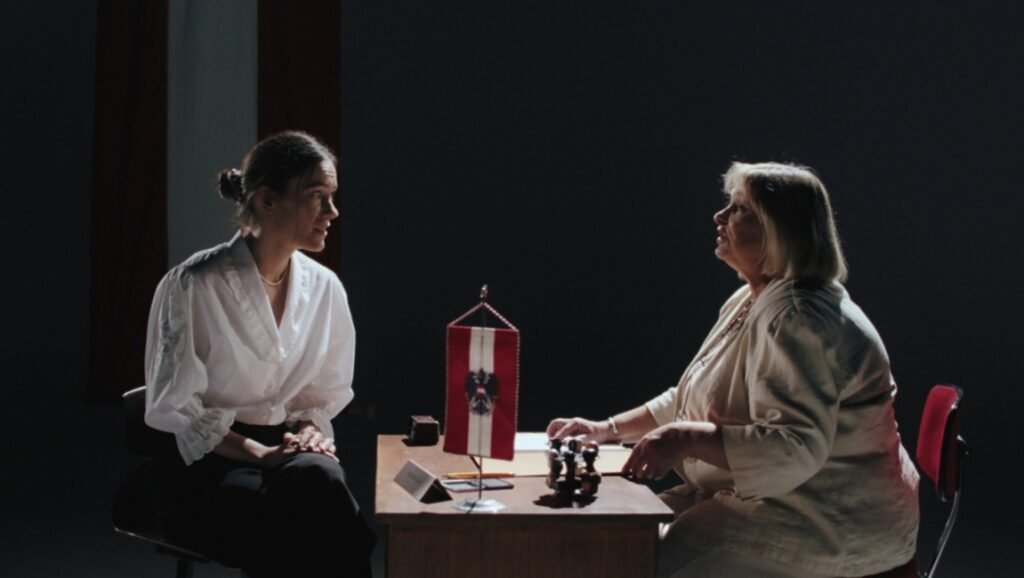
But one need not turn to the Nazi-adjacent to find out what the rest of the Austrian parliament thinks of those not ethnically Austrian; amidst 738,886 immigrants (a not-insignificant 36% of Vienna), working and living here but unable to vote for any parliament, the current ruling party and center-right ÖVP declares the Austrian citizenship as “the final step of integration,” not “something that can be automated” upon birth, in a crass difference from a country like the United States, which operates by birthright. Not everybody is supposed to get the well-valued Austrian passport, hence why the process — which can take over two years even with newborns! — has been made more difficult since. Filmmaker Olga Kosanović, born in 1995 in Korneuburg (Lower Austria) and growing up all her life in Austria, has been denied citizenship once before. The reason? She has been out of the country for “too long” — 58 days to be exact. These include summers in her ethnic Serbia and an Erasmus in Europe; average trips — including education abroad! — now become slights against the validation of one’s Austrian-ness. Having previously appeared on television to discuss this matter, she received an online comment on a daily newspaper’s forum about it: “Just because a cat gives birth in the Spanish Riding school, that doesn’t make them Lipizzan.”
One thing that rankles and befuddles in the same breath is the ease with which people manage to be xenophobic and racist, seemingly finding no faulty logic in it. This commenter here is immediately clear on what Austrians are — and what non-Austrians cannot ever hope to be. But is the case so clear-cut? What is a “real Austrian” anyway? How do we define belonging, and what makes one part of something? The comment wounds Kosanović so much that she dedicated not just the name of her 2025 documentary (Far From Being Lipizzans), but most of its formal conceit to this anonymous commenter, which frequently appears as insert shots of her attempting to write an answer to them online. She reads part of her rejection letter (11 pages strong) aloud as she runs stairs up and down — those thick, depressing pieces of slab so crucial to Austrian culture — and hurries with mounting documents and binders as she tries to be a good enough Austrian citizen. She plays a fictional form of Snakes and Ladders, where every card drawn denotes a struggle. One reads, “Congratulations! You completed your higher education in Germany! Unfortunately, this means you have spent too much time abroad and are not eligible for Austrian citizenship!”
Much of Lipizzans is an essayistic response and an attempt to destroy racism with facts and logic. She questions immigration lawyers and immigration experts on the matter, who affirm that Austria has the strictest immigration process behind only the United Arab Emirates and Saudi Arabia. She affirms further that this restrictive form of identity makes no sense in an urban setting, where multiple identities can and have to coexist, and that dangling the citizenship like a carrot is less effective than it really seems and only leads to hostility. She finds it strange that millionaires get Austrian citizenship as a gift if they simply buy property, but she — a teacher who lives here and pays taxes — does not. She spends time in Austrian heritage museums and immigration centers, with her grandmother in Serbia, in a fictional Serbian-Austrian household, debating who should get citizenship (as it is not merely arduous but also costly). She even goes out of her way to confirm that Lipizzans, despite being an Austrian symbol, are bred in Slovenia and have been claimed on the Slovenian €2 design. Amidst the neutral colors of much of the movie, she sprinkles in bits of monochrome animation of a typical Austrian family of two who are bored to death by this topic, and a retro TV show format that treats the place of birth like a bingo that decides a child’s fate on arbitrary positions. But her best move is inviting numerous interview subjects, from ethnic Austrians to young diasporan kids — including her own brother — on what being Austrian even means. And again, one finds several ethnic Austrians — all past a certain age, so certain of their Austrian-ness, and the non-Austrian-ness of “them Syrians” — quite unsure when Kosanovic probes further than a standard reply of “know German and be Christian.”
Why does Kosanović want the citizenship? Why does Kosanović feel like giving up Serbian citizenship is a betrayal of where she’s from? Her slender face is frequently stern, and her voice is somewhere between informative and mildly outraged. She has practical reasons for the citizenship: she wants to be able to vote and decide her future; she lives here, and a citizenship is, if nothing else, a mark thereof. Lipizzans is the kind of film that makes the porousness of national identity — not just Austrian, but in general — clear by highlighting the arduousness of all the steps involved to achieve it. In one section, she watches a soccer match with her grandmother; it is Croatia vs. Russia. Her grandmother asks her if “’they’re’ winning,” surprising Kosanović by meaning Russia, not Croatia. The explanation: “At least [they’re] the same religion.” (Russia and Serbia are Orthodox; Croatia is Catholic.) You can always find a way to belong to whatever circle you draw in the sand. Kosanović imagines her second citizen application as concluded not just with a handshake and a certificate, but a new kind of Austrian identity: one where a davul/tupan troupe greets her. The camera zooms out in a warm yellow glow and lets the confetti rain. It was unclear at the time of the filming if she would ever receive approval. She dances either way.
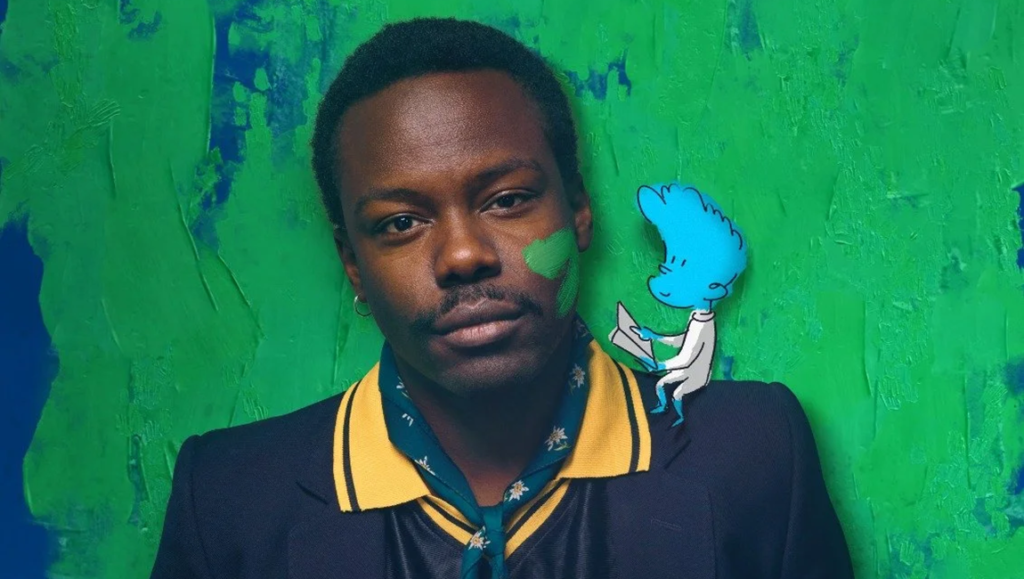
The question of citizenship doesn’t concern Tanzanian-Austrian Mwita Mawaro. Despite a decent enough childhood in Salzburg, he’s been questioned on his Austrianness simply by the color of his skin. Mawaro, who would go on to front indie rock group At Pavillon, finds himself confronted with his identity and the racism of the country. Blue – A Black European Tale, as an English title, isn’t half as interesting as the original German: Austroschwarz (“Austrian Black”). Over 100 minutes, Mataro and co-director Helmut Karner weave in autobiography, vlog, and a theatrical staging of the fictional “Greenland” with the help of a papier-mâché mountain, rivers, and houses full of green potatoes, in which a blue potato family must always dip their skin green to pass alongside the rest of the green potato families. BlueKid, the youngest of this Blue potato community, wants to defeat the big evil at the top of the mountain, a big elderly Green potato. Double consciousness, having to pass: these are not new concepts by any means, excavated with eloquence and sharpness from W.E.B. Du Bois and James Baldwin many decades ago. Still, those writers came from the other side of the pond, and this is continental Europe, where there are far fewer Black people, and therefore exists far more of an exoticized, stereotyped blend of anti-Black racism.
Austroschwarz’s one strength and draw is that it is perhaps more emotional about these things than Kosanovic’s film. It upsets its own treatise on racism — literally halting a staged scene where Mawaro acts as a right-wing nationalist and speaks ill of white people, flipping the stereotype on its head. A voiceover informs that this was supposed to be a great cathartic scene, but ultimately winds up derailed by Mawaro’s own diagnosis of bipolar disorder. Mawaro records these with a camcorder and tries to find community, other Black Austrians, to ameliorate the pain and trauma, not make sense of it exactly, but to belong somewhere, somehow. And unlike Kosanovic, who majored in film in Hamburg, Mawaro’s dilettante approach — coming from a professional background as a musician — gives the work a loose energy that occasionally causes the 100-minute runtime to feel longer. It’s a coming-of-age work, a filmic künstlerroman, an ascertaining of Austrian racism, a eulogy of Black refugee Marcus Omofuma, an evisceration of right-wing politician Jörg Haider (who died in 2008), and a probing of identity all at once — to say nothing of the Greenland plot, which is interwoven throughout. It is no doubt an overwhelming art that Mawaro has produced, but also a highly personal one.
And it works in part due to Mawaro putting himself front and center, as well as the sincerity with which he both wants to explore himself and the world around him. His is an unguarded way of filmmaking, loose and open, and it leads to an emotional resonance for those who live in Austria long enough to recognize its myriad ways of othering people. It’s a balm to finally have somebody who records, unguarded and with all the earnestness they can muster, on how taxing racism is. The disappointment of demanding better and never getting it; the allure of inflicting them the exact same violence — verbal, in his case; the perennial sadness: why does it have to be this way? The constant question, despite the rationalizing, despite all the knowledge available to the non-white and marginalized, always remains the same: I didn’t choose to be this way, so why are you?
Austria is a diverse country, he notes at the end of his production, five years in the making, and he is glad of it. And whiteness, the way he takes it, is the straight line that he, in an inspired nod to architect Friedensreich Hundertwasser, rejects for himself — that he considers rejected by nature itself. Meanwhile, the fantasy of the Greenland kids reveals an imagination far beyond the simple platitudes of heavy-handed racism metaphors. In their minds, these potatoes are part of fantasy only; suddenly, aliens are in it and brainwashed potatoes, and maybe they were all differently colored and had to change to green due to the big bad? Thanks to a growing diversity in schools and the younger generations, kids do not have to go through what Mawaro did — or at least not to the same extent. They are free to imagine Greenland as whatever they want it to be, as something totally alien to them.
Theirs — by any number of hyphenated Austrians with a diaspora background, symbolically concentrated in Favoriten — is a multiplying, multi-faceted kaleidoscope of a culture. Taken together, it eclipses the ethnic Austrian culture in Vienna, and has for a while; so much so that it was hitherto disregarded by the Austrian media, and the parliament by extension. By minimizing it as an “immigrant” or “youth” thing — the latter was how the media painted environmental efforts by students, many of them ethnic Austrian — the conservatives can keep lording over an entire class. All these films are federally funded by Austria, and it remains to be seen how much the country will continue to invest in these stories amidst severe budget deficiencies. But one thing is for certain: whether they document it or not, whether they want it or not, Vienna will remain a haven for immigrants. The right-wing can assert otherwise until it until its blue in the face; the citizenship process can become the hardest in the world. It doesn’t matter because Vienna is different, Vienna keeps being different, and it is an irreversible progress. The parliament would do well to embrace it.
Comments are closed.