
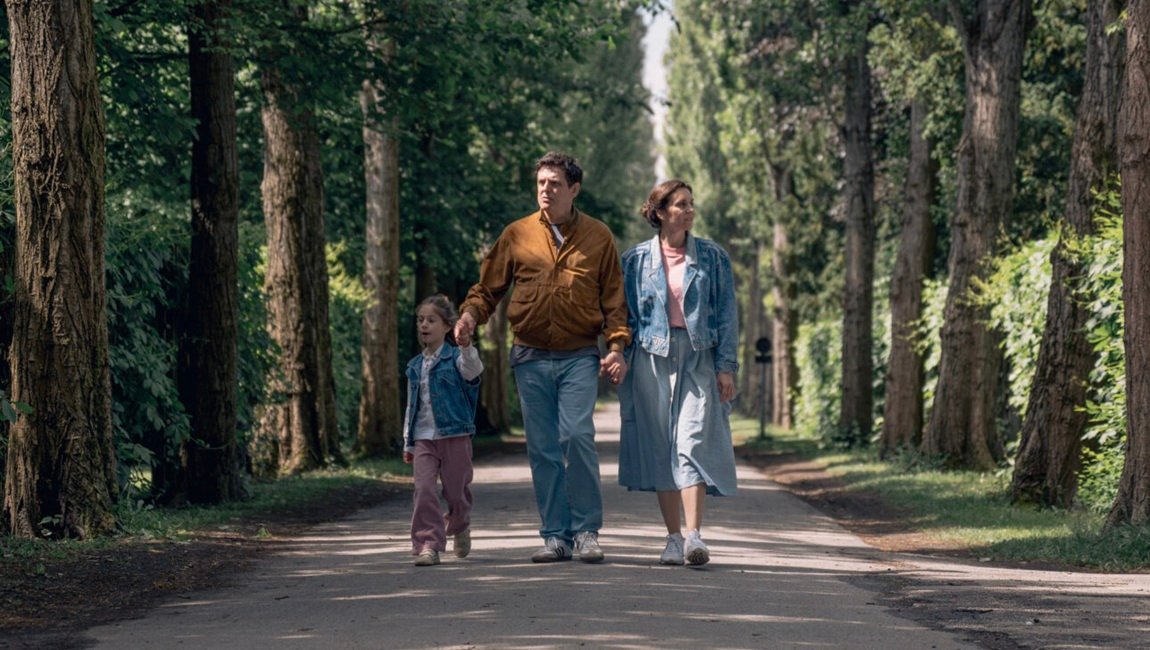
After a long career as an actress, Marijana Janković stepped behind the camera to tell the story on her own terms. Her debut feature Home, premiering at the 2026 edition of IFFR, offers a narrative built with familiar materials, yet shaped with a quiet precision that feels newly intimate. Resisting a migration story that is told through spectacle or political drama, the film focuses on the quiet architecture of family life.
Inspired by the director’s own life, Home portrays a family from Yugoslavia who decide to move to Denmark. Forced to make a difficult decision, the parents leave the two older brothers behind for an uncertain amount of time. Taking only their daughter, the six-year-old Maja, they begin their journey to the land of Hans Christian Andersen.
“Dreaming doesn’t cost anything,” says the father of the family. From that moment on, the film quietly begins to ask what the price for a better life is. In that fairytale Denmark, things turn out to be no easier than back home. From visa manipulations to language barriers, life continues to be defined by barriers, sacrifices, and hardships.
Telling the Story From the Inside
When I asked Marijana Janković what made her shift from actor to director, she didn’t answer it as a question of ambition. It arrived more like a missing shape: something she kept not seeing, until the absence itself became unbearable. “In cinema, you always look for something you recognize,” she said, “and I never saw something in Denmark where I could look myself in the mirror, something that was telling my story.”
Meticulously approving “every millimeter” of the process while serving as the writer, director, and actress (she plays an older Maja), Janković held the film’s texture at the level of lived detail and tactile realism. “I know the smell, I know the colors, I know the feeling,” she explains. Feeling responsible for telling an immigrant story without reducing it to victimhood or criminality, she turns to familial interiority as her lens and crafts a story recognizable regardless of country of origin. “Families are hardcore sometimes,” Janković says jokingly. But precisely in this openness to the tension and imperfection, Home earns empathy without instructing it.
Some moments rooted in Balkan culture may slip past viewers unfamiliar with it, but that, too, is intentional. Not focused on “entertaining” in a conventional sense, the director aimed to make the viewers question, think, and understand the story through “the heart rather than the brain.” Yugoslav wars are deliberately excluded as a governing explanation, but presented as pressure, as absence, as the shape of a life lived between places. “When you put politics in a movie, I always experience that it takes over in a way because it’s such a big theme,” she says. Being quietly everywhere in the film, it never eclipses the family’s interior weather.
 The Interior Life of Migration
 The Interior Life of Migration
The director utilizes the emotional weight of that interior through the contrast of spaces between the two worlds. Yugoslavia appears on the screen as a lush and open landscape, while Denmark is presented through confined, almost claustrophobic spaces. A kitchen becomes the site of a negotiation no one names. A hallway holds the afterimage of an argument that didn’t fully happen. A classroom becomes another place where the child learns the new rules before she has the vocabulary to describe them.
Janković describes it bluntly: “their soul down there was free,” and then, in Denmark, their life resembles “a small jail.” Keeping in tension the idea of home as a space both suffocating and protective, the film captures how quickly that interiorization becomes habitual. A family can learn to keep itself together by smoothing over visible rupture and by compressing its feelings inward, resulting in a practiced silence.
“That silence tells me more than words,” says Janković. “Sometimes in life, you kind of put yourself and your family in a situation where you suddenly don’t have anything to say, but everybody knows.” Home treats this quiet not as an absence of dialogue but as its own form of speech, one that carries the weight of what cannot be made legible in a new language, or in any language at all.
The Quiet Labor of Holding Everything Together
Silence in Home is not neutral. It settles unevenly within the family, especially borne by the women. When I asked Janković about the rare but tender moments in which Maja is alone with her mother, most painfully in the abortion scene, she didn’t hesitate. She answered with a sentence that feels like the film’s hidden engine: “I really believe that we are the quiet heroes.” The mother “is not saying much,” she tells me, “but she’s actually the one who’s making, like, the wheel go around.”
It’s a form of agency that does not announce itself as such: the labor of holding a family together through compromise and endurance that cannot be spoken without breaking something. Even the mother’s fragility arrives through restraint; what she passes on is not explanation, but method. “This is our secret,” she says to Maja. This generational handover, an inheritance delivered as silence, makes the intimate almost indistinguishable from the burdensome.
And yet Home never treats this burden as solitary. Again and again, Janković returns to the family not as a set of individuals, but as a unit under pressure. Speaking about the child’s silence, she describes it as something active: each time Maja helps the family “to succeed,” “for her, it’s like scoring a goal. It’s like being a team.” In that image, love becomes coordination. Parents doing this for the child; the child doing this for them. If the film is tender, it is because it refuses to romanticize that teamwork, and instead observes what it costs.
Through tenderness and care, both in the film’s form and substance, Janković manages to open up a question of belonging and lets the viewer carry that question out of the cinema. For her, home remains hard to outline. She pauses, and then says: “When I lie in my bed and my little daughter, who is three, crawls in next to me, I always say, ‘okay, this is home.'” After a longer pause, she adds, “So, probably home is not a place. It must be when you are together with your family; wherever you are, that must be home.” Accordingly, Home leaves the viewer with a strong feeling that belonging is not secured by geography or legality, but negotiated daily through care, compromise, and the fragile choreography of staying together.
Comments are closed.