
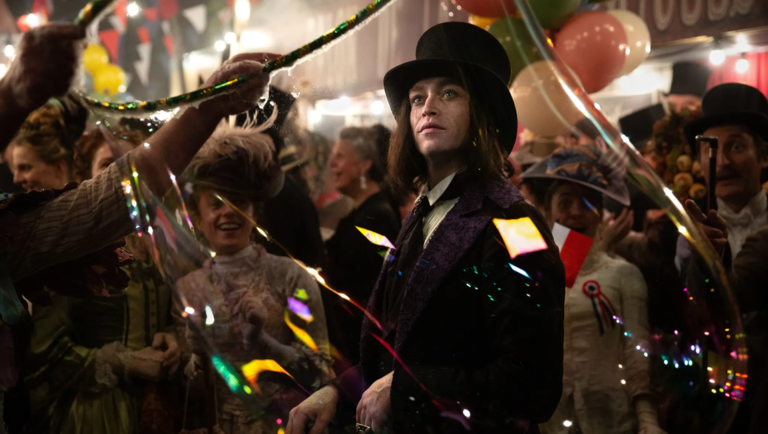
Luc Besson, famed French director of Léon: The Professional and The Fifth Element, returns from making the relatively obscure June and John (2025) to release the highest-grossing French film of last year, Dracula. Subtitled A Love Tale in some territories, Besson’s Dracula is puerile and flamboyant. It has old-school pomp, is — as a production — fairly comfortable in its ridiculous garb, and it’s surface reality is a little brittle.
Caleb Landry Jones stars, and in his makeup, costume, and performance lands somewhere in between the Nosferatu of Bill Skarsgård and Gary Oldman in Bram Stoker’s Dracula. He maybe even boasts a little Bela Lugosi in his turn here, with an accent that’s milky but sharp. Put more straightforwardly: he’s magnificent, exotic, sultry, and scary. Jones has always been an eccentric performer, and it serves him well here, his off-center appeal showing clearly through thick makeup. Zoë Bleu, meanwhile, is Mina, the woman who once, 400 years before, was Prince Vlad’s wife, Elisabeta. Hers is a visage from another age. Her throat accentuated, she holds up, at first, under Vlad’s daring, withering gaze. Is this a face from a Medieval painting, or “iPhone face,” reframed? There’s a silent trepidation swirling beneath her painted surface, as well as a deep melancholy beneath her darkened eyes. An clear attention to immaculate costuming and emphatic makeup elevates Dracula to a Gothic fantasy, but credit shouldn’t be withheld from the performers beneath the decorative sheen, who carry this all through with relish. One recognizes the awesome power of performers who buy in fully to such a lavish, lascivious sort of production.
Still, Besson’s Dracula isn’t for everybody; and certainly not those preferring the dusty, brutal realism of Robert Eggers’ Nosferatu. It may feel closer, in aesthetic, to Francis Ford Coppola’s Gothic phantasmagoria, but it’s less artful in execution, and more forthright with its intentions. Dracula is an absurd, blood-boiling melodrama, one wherein Count Dracula brews a perfumed tincture which attracts women, feasts on the debauched courts of 18th century Europe, and cares for nothing else but his darling Elisabeta. And across the film’s runtime, we find ourselves enmeshed in Jones’ captivating performance, a thumping, swelling score by Danny Elfman, and a plot which hurdles forward with little regard for patient pleasantries.
Working alongside cinematographer Colin Wandersman, who collaborated with the director on Dogman (2023), Besson finds dramatic images; visceral, striking, Baroque, and violent images, pulsing with operatic, Wagnerian excess. Elizabeta’s long train of sky blue tulle flowing out behind her galloping white horse; the painted colors of Zoë Bleu’s face, her lush costume, the white of the snow, bright blood against the bare, cold sky; elsewhere, that same sky dark with smoke, Vlad and his army raising impaled heads over the flame crested ridge line — these are the compositions that take shape within Besson’s frames. The use of widescreen here also demonstrates a careful attention to craft; objects in their right place, proportion, figures cornered by scale. Guillermo Del Toro’s Frankenstein should have looked like this. And Elfman’s score — classical, romantic — offers considerable support in established the film’s chosen aesthetic. The composer, famous to most viewers for his work with Tim Burton, ports over some of that familiar, mischievous trickery to Dracula, utilizing, for instance, an ancient music box and a host of choral arrangements.
Narratively, Besson’s take on the material uses the classic trope of the “vampire investigator,” only here the traditional role of Van Helsing is instead taken up by Christoph Waltz as a furtive, assured priest, while Guillaume de Tonquédec pitches in as a bumbling, honest doctor. These agents of modern medical science and religion are brought together to investigate something beyond their understanding. This approach also functions to upset the the typical structure of a Dracula story — with Harker in Dracula’s castle and Mina in his sights — by placing an emphasis on this priest’s perspective, his goal in sight. This lends the proceedings a new wrinkle; alongside Dracula’s quest — in fact, running counter to it — is his damnation, and his salvation.
Vlad finds Mina in Paris on the eve of France’s centennial celebration (we are by this time set in the late 19th century). We follow their leering, yearning romance through a bustling carnival replete with sideshow oddities, and we almost find ourselves rooting for them, for their dangerous attraction — eternal love — as the priest, the doctor, and the Romanian army come storming at their castle walls. In executing this, Besson keeps to a gluttonous pace, never pausing long enough to even digest exposition. Instead, we’re whisked on to the next foible as soon as one seems to end, and without any reverence for historical or geographical accuracy, the travel between Paris and the Carpathian Mountains is all but instantaneous. And so, in the end, what’s become clear is that Besson understands precisely how the narrative of a melodramatic romp should progress, its beats accelerated so that the climax is upon us almost from the beginning. All the viewer need do is submit to spectacle.
DIRECTOR: Luc Besson; CAST: Caleb Landry Jones, Christopher Waltz, Zoë Bleu, Matilda De Angelis; DISTRIBUTOR: Vertical; IN THEATERS: February 6; RUNTIME: 2 hr. 9 min.
Comments are closed.