
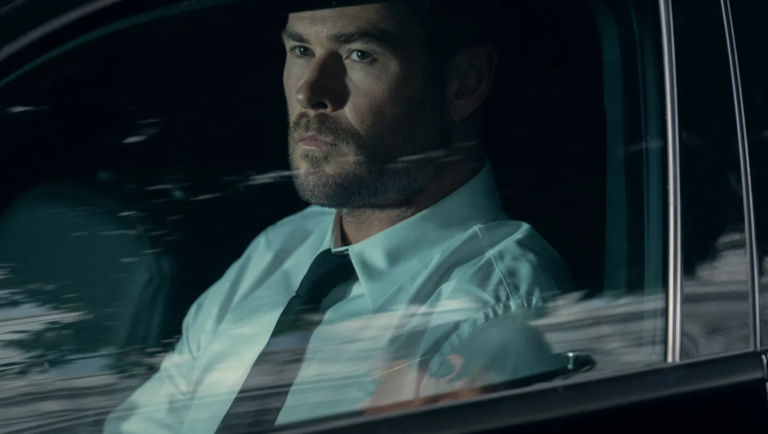
The title of Bart Layton’s Crime 101 is a play on the film’s plot primarily transpiring on and around the 101 Freeway — a major interstate highway that runs nearly the entire length of California and most notably through downtown Los Angeles — but it’s also inadvertently damning of the film’s ambitions. Ostensibly an insider’s account of a string of high-end, armed robberies perpetuated by a meticulous professional thief (Chris Hemsworth), the film’s approach to the nuts and bolts of criminality is, in actuality, glancing and derivative to a fault. The film unwittingly plays much like an introductory course: lightly touching on familiar tropes and conventions while eliding any sort of probing specificity. Instead, the film’s “riding shotgun” immediacy is subsumed by an endless sprawl of supporting characters and branching storylines that takes the subject far afield, presenting its subject from a 360 degree perspective. Crime 101 perpetually expands outward, drawing into its web cops, facilitators, competing criminal outfits, victims, co-conspirators, insurance companies, and blinkered significant others. Layton is attempting to ribbon daring armed robberies and high-speed chases through the streets of L.A. into a dense tapestry of class, gender politics, lasting emotional trauma, and upward mobility, wearing its influences loudly on its sleeve, but, then, that’s something of a double-edged sword. After all, we already have Heat at home.
Hemsworth plays Mike Davis, an Angelino (the Australian actor using the same rumbly, nondescript accent he employs whenever he plays an American) in business for himself, orchestrating daring robberies of jewelry couriers up and down the 101. Introduced getting ready for his next job by combing out errant hairs and removing dead skin from his body with an emery board (as not to leave any physical evidence that will tie him to the crime scene), Mike is a monastic, consummate professional, relying upon a network of informants and surreptitiously gathered intelligence to catch his victims by surprise. Mike takes as much pride in skillfully evading the attention of the police (personified by Mark Ruffalo’s dogged Detective Lubesnick, with the actor fully in his post-divorce, rumpled Columbo magnificence) as he does never having to resort to physical violence. But after his most recent job goes sideways — relative to his own exacting standards, anyway — Mike develops cold feet about pulling off his next heist, leading his fence, Money (Nick Nolte, the 85-year-old actor’s speaking voice recalling a rusty razor blade dragged across corrugated metal), to bring in a wildcard to ensure the job gets done one way or another: Barry Keoghan’s Ormon, a peroxide street punk on a motorcycle who possess no such qualms and relishes the chance to get his hands dirty.
On the down-low, Mike sets his sights on the proverbial one final score: a robbery of a diamond courier from Antwerp carrying millions in valuable stones being purchased in an all-cash transaction by a slimy billionaire (Tate Donovan). That requires flipping the billionaire’s insurance broker, Sharon (Halle Berry), whose company is underwriting the diamonds in addition to overseeing their transport to America. Mike preys upon Sharon’s feelings of marginalization by the boy’s club at her firm; denied being made partner, her slimy boss makes no bones about her “advanced” age limiting her professional prospects while threatening that she should be more appreciative of what she’s got. Might Sharon be willing to break bad if Mike is willing to cut her in on a multi-million dollar payout? And then there’s Mike’s new girlfriend, Maya (Monica Barbaro, Oscar-nominated last year for A Complete Unknown), who’s desperate to burrow beneath the surface and get to know the real him; a hardscrabble past of poverty and kicking around foster homes that Mike closely guards, shutting down every time the subject comes up.
At a leisurely 140 minutes, Crime 101 is stranded in no man’s land. Its discursiveness is a liability, drawing our attention in half a dozen underserved directions — subplots involving a diamond merchant played by Payman Maadi being investigated for enabling in his own robbery and Lubesnick getting strong-armed into going along with a shady officer-involved shooting are given disproportionate prominence, only to be abandoned without an actual resolution — while lending the film a real sense of bloat. It’s as though an entire season of television were being ruthlessly compressed to feature-length with numerous narrative strands left dangling (one imagines a fulsome deleted scenes section awaits). At the same time, the film is cursory, with a pat touch as it relates to insight on taking down scores and the police work involved in stopping them. Most of Mike’s diligence and research is consigned to offscreen or waved off by the screenplay (seemingly 75% of the character’s prep work is paying a twenty-something to hack into his targets’ emails and social media accounts). For all of his caution — after Mike spots Ormon camped outside his home, he relocates to a brand-new beachfront apartment, available on a few hour’s notice — Mike’s big plan is to simply approach Sharon in public and hope she doesn’t take his proposition of “want to rip off your employer?” directly to the police. When Mike confronts Ormon, who’s been tailing him for weeks, he does so next to the beer cooler in a convenience store in plain view of customers who presumably made a note of all the yelling and gun-brandishing. At the same time, the film treats the LAPD as a collection of quota-chasing incompetents and middle managers looking to close cases with little regard for whether they’ve even arrested the right person (Lubesnick is labeled a professional irritant and crank whose hunches are barely humored by police brass). In other words, we’re constantly being told of the characters’ hypercompetence while the film provides scant actual evidence of it.
Layton (American Animals) is an able mimic, and in Crime 101 he steals from the best. Beyond the aforementioned Heat, the film draws considerable thematic and visual inspiration from Thief and the similarly L.A.-set Collateral, but in truth the entire film could be couched as Michael Mann cosplay. Hemsworth’s character favors antiseptic, modernist domiciles that overlook the Pacific Ocean, and his primary hobby seems to be staring out pensively at the Los Angeles skyline (Erik Wilson’s low-light, digital photography makes exceptional use of depth of field, lending the city an uncanny quality as though it stretches on into infinity). But there’s none of the stylistic grandiosity nor still-waters-run-deep emotions of Mann’s best films, to say nothing of an intractable governing philosophy worth grappling with. Everything here is recognizable yet fundamentally empty; the film cherry-picks images or familiar motifs that evoke more distinct works and uses them as a psychological shortcut to evoke more singular pieces of filmmaking. There are bits and pieces here that self-consciously call to mind Walter Hill’s The Driver or Peter Yates’ Bullitt (the latter name-checked in the dialogue) that might elicit an involuntary smile, but mostly Crime 101 is coasting on the fumes of other, better, films.
Perhaps the most forgiving framing of Crime 101 is that it’s actually an ensemble character piece. The one upside to how flabby the film is comes in its allowance of quieter scenes perpendicular to the plot and digressions that most films in the genre would lack the patience for. As an example, the film is touchingly invested in the Ruffalo character’s midlife crisis — spurred on by the dissolution of his marriage — which finds Lubesnick moving to an apartment by the beach with his cat and taking yoga classes (in an unspoken touch, the character signals his willingness to turn over a new leaf by shaving off his hideous-looking handlebar mustache). Likewise, it’s genuinely commendable how committed the film is to dramatizing the travails of Berry’s fifty-something Sharon, who both recognizes the role her beauty plays in furthering her career — allowing herself to be used as a lure with a plunging neckline to get whales to sign up for lucrative policies — and acknowledges hers is a dwindling resource (theoretically, anyway; Berry’s agelessness is almost working against the vulnerability of the character). The character’s dramatic apex has little to do with her role in Mike’s scheme, but rather finds her finally working up the nerve to call out the rank hypocrisy and exploitation at her workplace.
Alas, there remains a Chris Hemsworth-sized void at the film’s center which proves to be insurmountable. Mike is meant to be mysterious, emotionless and unknowable — also possibly on the spectrum: we’re oft-reminded that the character has difficulty making eye contact and making emotional connections with other people, in addition to being a stickler for familiar routines — which Hemsworth interprets by playing the role as sentient plywood. Barbaro does a herculean job of trying to humanize her costar in their scenes together, playing up her character’s gregariousness and bracing honesty — the character offers up a pointed critique of Los Angeles while slow dancing with Mike to a Bruce Springsteen song — but Hemsworth never keys in on his character’s interiority. There’s no tragedy to Mike’s self-imposed isolation or compelling itch being scratched by his obsession. When asked, point blank, what motivates him, Mike bluntly replies: “money.” Honest, perhaps, but that lack of introspection is unfortunately of a piece with the rest of the film.
DIRECTOR: Bart Layton; CAST: Chris Hemsworth, Mark Ruffalo, Halle Berry, Barry Keoghan; DISTRIBUTOR: Amazon MGM Studios; IN THEATERS: February 13; RUNTIME: 2 hr. 19 min.
Comments are closed.