
In “Wuthering Heights” — as Emerald Fennell sees it — death and ecstasy rest on the head of the same pin. Its opening credits are set to what sounds like someone groaning in pleasure on a squeaking bed; it’s soon revealed to be the last gasps of a hanged man. Heaving chests are match cut to flayed pigs; one bare back might be scarred from a whip, another from a suffocating bodice. Snails drip secretions down windowpanes, egg yolks run through fingers and soak into bedsheets, toothy fish sit trapped in gelatin molds like amber encasements. If this is what a romance looks like, then love hurts.
Emily Brontë’s landmark novel seems a natural fit for Emerald Fennell: Wuthering Heights is gothic, brooding, and defiantly horny. Fennell has fashioned herself something of a cultural lightning rod over the course of her brief career. Her debut, 2020’s Promising Young Woman, offered a cockeyed rape-revenge in the cooling embers of the #MeToo movement; with Saltburn, Fennell took a spin at a class-conscious Talented Mr. Ripley for the TikTok generation. Both films enjoyed firecracker acclaim before combusting under the scrutiny of their own brittle commentaries. “Wuthering Heights” trades the thematic aspirations of Fennell’s first two films for the animal id of teenage lust, but removing oneself from the discourse du jour doesn’t guarantee immunity from controversy.
Like the Brontë adaptations before it, “Wuthering Heights” hones its focus on the novel’s first half, omitting the haunted children of the novel’s lovers in favor of a more concise, but no less burdened, love story. Fennell pares the story further, axing pivotal characters like Hindley and extending the life of Mr. Earnshaw to cover his absence. That leaves us with Catherine, who we meet as a young girl (played, at first, by Charlotte Mellington), gawking with glee at the hanged man of the movie’s cold open. Catherine is raised in the chilly estate of Wuthering Heights by her father (Mr. Earnshaw, Martin Clunes), a temperamental drinker who throws his family on its ear when he brings home a street urchin (as a boy, Owen Cooper) he’d found during a visit to Yorkshire. The boy has no name; Catherine decides to call him Heathcliff, after her dead brother. The children become fast and fiery friends.
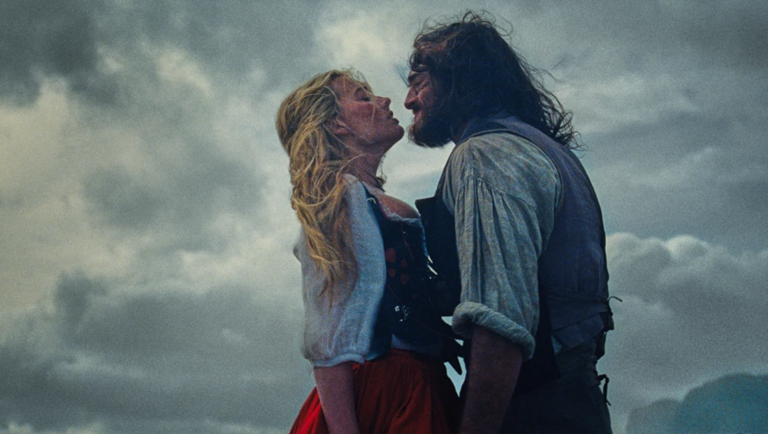
The bulk of “Wuthering Heights” simmers in the adult lives of Catherine and Heathcliff, played by Margot Robbie and Jacob Elordi, who burn feverish after decades of not-quite-requited love. Fennell has always suggested an allergy to subtext, and she embosses in gold what Brontë otherwise leaves between the lines. Catherine masturbates on the edge of a cliff before Heathcliff licks her fingers clean; from the rafters of a barn, she watches servants fashion BDSM getups from horse bridles. “Wuthering Heights” is flush with enough bawdy provocations to send Victorian diehards to the fainting couch. But Brontë herself was no prude, and giving the softcore treatment to a book that christened an outcrop of phallic ledges “Penistone Crags” isn’t quite the stretch some might make it seem. At times, Fennell’s movie can even seem chaste. Robbie and Elordi are two of the more arresting presences booked in modern major movies, and while their chemistry is formidable, it can occasionally crest plasticine; their dalliance is steamy but never threatens scandal. Fennell, both within the film and in the press, has made it no secret that she didn’t embark on a faithful adaptation, but the restraint she shows around Catherine and Heathcliff’s affair betrays an unsure footing.
To be fair, there’s little happiness to be found in the love of the Earnshaws. In Giovanni’s Room, James Baldwin likens the lack of agency in love to a ship chained to a sea floor: “People can’t, unhappily, invent their mooring posts, their lovers and friends, any more than they can invent their parents.” Heathcliff haunts Catherine’s heart like a polyp, their love persisting like a stain on hardwood. Their spectral obligations toward each other are challenged further by the arrival of Edgar Linton (Shazad Latif). Linton moves into the nearby Thrushcross Grange with his bookish, dolls-and-ribbons–obsessed sister, Isabella (Alison Oliver), and quickly swoons for Catherine. Her heart belongs to Heathcliff, but Mr. Earnshaw has drunk away their fortune, and their union would leave the couple destitute. When the wealthy, amiable Linton proposes, Catherine accepts and consigns to a life within a gilded cage. Heathcliff, in turn, gives way to cold cruelty.
Fennell’s reputation raised eyebrows when she was announced at the helm of a beloved Victorian story, and the director deliberately styles the film’s title in quotation marks, serving as both wink and warning to Brontë purists who might hope to see the classic rendered with reverence. Most of Fennell’s concessions are designed either to streamline the movie’s narrative or to provoke its audience, and the latter inclination often comes by way of giddy anachronisms. The Oscar-winning Jacqueline Durran seems bent on proving her costume work with Robbie in Barbie was a dry run: each of Catherine’s staggering gowns — here a dress blossoming with blood-red roses, there a number made of flowing, club-classic latex — outdoes the last, and runs in smug contempt of the period. The strings of a traditional score courtesy of Anthony Willis weave in and through an original album from Charli XCX, whose bowel-shaking bass synths pop with enough force to loose the limestones from Wuthering Heights’ decaying walls.
But the most glaring diversion comes via Jacob Elordi’s casting. Heathcliff, in Brontë’s book, is described as “dark-skinned… a gypsy in aspect,” and later, as a “lascar,” a contemporaneous slight toward South Asians. The designations are ambiguous enough to set a precedent for Heathcliff’s onscreen portrayals to fall nearly exclusively to white actors (a trend from which Andrea Arnold’s 2012 adaptation notably deviates). For Fennell, the blowback from whitewashing was both swift and something the director seems to have anticipated — she hedges her culpability with colorblind casting across the film’s more minor characters. As Nelly, the Earnshaws’ watchful housekeeper (and one of literature’s more totemically fickle narrators), Hong Chau easily nabs the movie’s MVP title, and Shazad Latif’s Linton is so convincingly docile that he almost sells papering Catherine’s room with her skin tone (down to the freckles and veins) as endearing. In Elordi’s shadow, though, both performances buckle under the weight of tokenization.
Characteristically (t)horny, Fennell’s “Wuthering Heights” stands as a work that could encourage either navel-gazing think pieces or quick, casual dismissal, depending on the weather. The adaptation is easily her strongest work — for all its missteps, there’s a marked freedom Fennell enjoys outside the obligation to ante into the cultural conversation. Brontë’s book is a text best enjoyed at 13, bound and gagged by an infatuation that borders sickness, and if Fennell’s adaptation runs flagrant of the beats of its source, it remains spiritually devoted to the sort of love that wrecks your future. Both Promising Young Woman and Saltburn hum with a restlessness that seemed to suggest Fennell was circling ideas she couldn’t quite nail down. With “Wuthering Heights,” for better and for worse, she’s finally arrived.
DIRECTOR: Emerald Fennell; CAST: Jacob Elordi, Margot Robbie, Hong Chau, Shazad Latif; DISTRIBUTOR: Warner Bros. Pictures; IN THEATERS: February 13; RUNTIME: 2 hr. 16 min.
Comments are closed.