
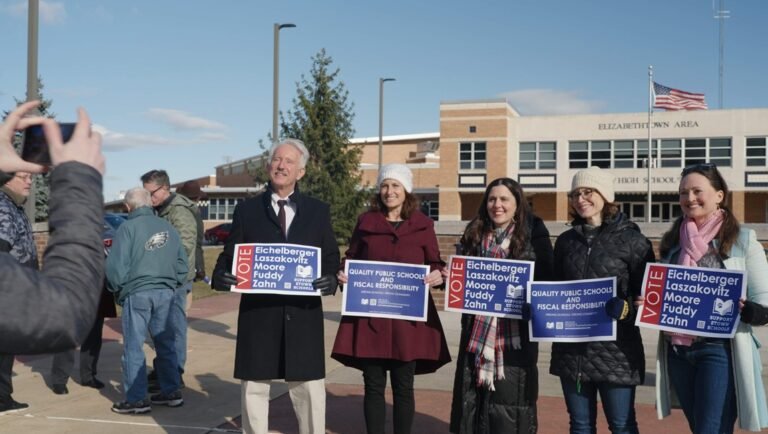
School board elections, in the best of times, are non-ideological affairs, with local communities electing representatives to prioritize the effective administration and financial management of their local public schools. Documentarian Auberi Edler did not visit Elizabethtown, Pennsylvania, in the best of times. In her documentary An American Pastoral, the French director follows Elizabethtown’s 2023 school board election from primary campaigning to the swearing-in of the new board, and she frames this municipal political process as a metonym for the broader political dysfunction and paranoia that has held the United States in an ever-tightening grip for the past decade.
Elizabethtown, a small town in rural Lancaster County, elected five new members to the ten-person school board in 2023, and Edler finds the local Republican and Democratic parties with concrete strategies for filling the board with their preferred candidates. The local Republican party has endorsed a slate of five candidates who take the hardline position that access to library books with “sexual” content should be restricted. The Democratic party likewise endorsed a full slate of Democratic candidates, but seeing as Elizabethtown is a predominantly Republican area, they also supported moderate Republican candidates who challenged the ideologically-driven, endorsed slate of Republicans. Edler follows several candidates and current school board members to create a picture of the local culture and divisions within this community, and she emphasizes the extent to which even such an apparently modest election carries deeper implications. The hardline Republicans are largely members of a local church called LifeGate with Christian Nationalist sympathies, and the school board election functions as a proxy battle for the broader spiritual war they believe themselves to be engaged in.
It emerges late in the film that, for at least some of the most fervently committed candidates, the COVID-19 pandemic and the 2020 presidential election, falsely contested by Donald Trump, were radicalizing incidents. One of the film’s key subjects, candidate Tina Wilson, expresses that she was a Democrat until masking guidance during the pandemic changed her point of view, and that she began to agree with her husband about the veracity of conspiracy theorist Alex Jones’ commentary (previously, she thought Jones was “crazy”). During a backyard campfire, school board members Danielle Lindemuth and James Emery reminisced on the insurrection of January 6, 2021: Lindemuth recounted how she chartered buses to Washington, D.C., while Emery expressed regret that he left the scene with his teenage son when violence erupted, rather than staying and invading the Capitol building.
Edler also follows her subjects to political events outside of Elizabethtown, including a meeting of a local chapter of the John Birch Society, where visiting speaker Alex Newman claims that public schools are “against Christ,” and an event in Virginia Beach, for which Emery provides security, one which emphasizes “re-dedicat[ing] America back to God,” at which speaker Fr. James Altman — who was removed from his position as a pastor after claiming that “no Catholic can be a Democrat” — rails against transgender people and inveighs the event’s guests to “crush every filthy school board member.” Meanwhile, local Democrats and moderates lead local protests, make public comments at school board meetings, and meet in small groups to discuss the importance of the freedom to read. Edler depicts an epistemological battle that is disturbingly lopsided; conspiracy theorists awash in fear of the anti-Christ fight representing a supposedly holy war, while those who hope to prevent book bans are unsure of how to collectively respond to such fervor.
Edler takes a journalistic approach to her material, documenting the events of the election without injecting her own commentary. Yet her perspective reveals itself, implicitly, in her formal choices. Barbara Bascou’s editing, for instance, is precise and critical: a scene in a high school classroom where a teacher leads his students in a discussion about school shootings is followed immediately by a meeting of an organization that trains women how to use guns; in this meeting, the instructor shows a video of a six-year-old operating a gun, and one student casually recounts how her husband once “made” a gun himself. The effect of this editing choice, one example of many that illustrates community divides, is appropriately unsettling, an apt illustration of America’s pathological gun culture from an outsider’s perspective.
Edler, also the film’s director of photography, also provides clear clues about her perspective on Elizabethtown through carefully selected establishing shots and B-roll that, in their layering of rural quaintness and seething darkness, portray the sleepy town as near-Lynchian. Some shots even explicitly use the visual language of horror. Take, for example, the parking lot of LifeGate Church captured on a quiet, bleak night, with the sounds of dead leaves rustling across the asphalt; or a series of wide shots of empty high school hallways bathed in clinical fluorescent light.
Edler’s foreboding formal choices are effectively executed, but ultimately unnecessary: the documentation of the concentrated efforts of political and religious extremists to take control of local institutions is chilling enough. Edler typically restrains from making direct connections to the mounting influence of Christian Nationalism and conspiratorial thinking on national politics, yet by focusing on the minutiae of a local election in Elizabethtown, Edler reveals much more about the current state of political affairs in the United States than one could by attempting a long view. The result is stark and foreboding.
DIRECTOR: Auberi Edler; DISTRIBUTOR: Film Movement; STREAMING: February 13; RUNTIME: 1 hr. 58 min.
Comments are closed.