
A surprisingly faithful retelling of the Ealing Studios comedy Kind Hearts and Coronets (although one has to dig around in the film’s credits to confirm it is in fact a remake), John Patton Ford’s How to Make a Killing fits snugly into the recent trend of “eat the rich” satires that ostensibly asks the viewer to root for the murder of the uber wealthy. Featuring Glen Powell as the spurned heir of an old money fortune very far down the line of succession, the film cheerfully goes through the paces of our protagonist rubbing out his own estranged family mostly for the “crime” of being indifferent to his very existence. Yet its fidelity to its source material — retaining the 1949 film’s confessional structure, omnipresent voiceover narration, and, in many instances, the same colorful machinations for dispatching assorted oafish uncles and cousins — underscores how execution-dependent the entire premise is. And how, divorced from mordant observations about the idle pursuits of the upper crust, the flouting of conventional morality, and, most noticeably, abandoning the central stunt-casting of having one actor playing every member of the same cursed family, there’s a dull inevitably to the entire scenario. With little else to draw our attention, the film amounts to shooting fish in a barrel.
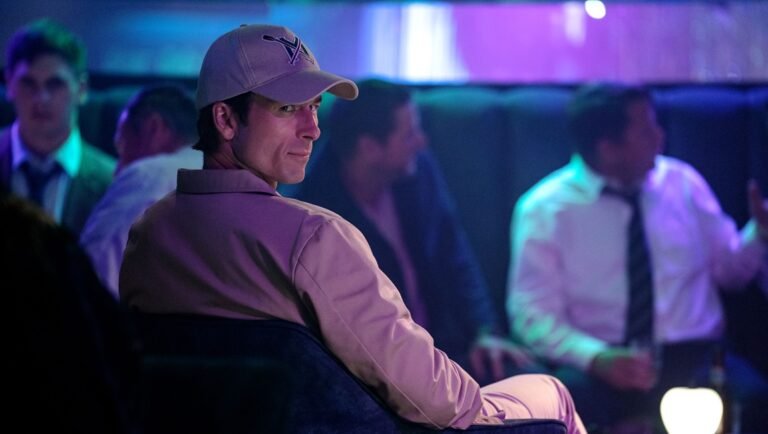
Powell stars as Becket Redfellow, the black sheep of an aristocratic East Coast family. Introduced sitting on death row, Becket confesses his sordid tale of envy, spite, and murder to a priest mere hours before his scheduled execution. We learn that Becket’s mother, the youngest child of the Redfellow clan, found herself pregnant as a teenager from a man of low status and rather than terminate the pregnancy, she was disowned by her family. Cast out and forced to raise Becket alone on her piddling salary working at the DMV, Becket’s mother filled his young head with talk of the vast fortune he might theoretically inherit someday should he outlive the rest of the family. However when mom contracts a terminal disease and the Redfellows refuse to intercede on her behalf — both in paying for medical treatment and denying her final wish of being buried in the family crypt — young Becket swears revenge on the relatives who left him and his mother twisting in the wind. Decades later, while working a menial job as a shop clerk, Becket has a chance encounter with a friend from childhood, the soon-to-be-married and ruthlessly materialistic Julia Steinway (Margaret Qualley), who less-than-innocently plants the idea in his head about murdering the Redfellows and taking back his inheritance.
What follows is a remarkably complication-free bit of subterfuge and consternation-free serial killing. One by one, Becket ingratiates himself to his oblivious relatives and plots their demises, which range from the rubegoldbergian to the dubiously streamlined, all while evading serious scrutiny from the law as members of the elite class continue to drop like flies around him. There’s his uncle, Warren (Bill Camp), an investment banker who complicates Becket’s bloodlust by demonstrating unsolicited contrition for abandoning Becket and his mother, even offering Becket a job in his firm. There’s cousins Steven (Topher Grace), a charlatan preacher with frosted tips and a samurai sword on his desk, and Noah (Zach Woods), a dilettantish photographer whose salt-of-the-earth wife Ruth (Jessica Henwick) catches Becket’s eye. And at the end of the line is the family’s patriarch, grandpa Whitelaw (Ed Harris, who between this and Snowpiercer has carved out a lane for himself as the final boss in “murdering your way up the capitalism ladder” movies). The only hiccup in the plan is that Becket finds himself caught between the recently widowed Ruth, who earnestly wants to start a life with him, and the increasingly financially desperate Julia, whose efforts to get him to loan her large sums of money range from clumsy stabs at seduction — the film frequently frames the actress to emphasize her gams, often propped up awkwardly on a piece of furniture — to outright extortion.
Both Kind Hearts and Coronets as well as How to Make a Killing are based on the 1907 novel Israel Rank: The Autobiography of a Criminal, and that reinforces the challenge of bringing this particular story into the 21st century. Kind Hearts and Coronets was set in Elizabethan England, predating fingerprinting, DNA evidence, and other contemporary policing methods, to say nothing of pervasive video surveillance and Google search histories. Here Becket becomes an expert overnight in homemade bombs and undetectable, naturally-occurring poisons, and the film would very much prefer that you not think about that too much. Nor his highly visible proximity to all of the deceased. But the procession of high-profile deaths, all in the same family, is the sort of thing that’s difficult to look past in an otherwise realistic setting (Becket’s efforts to deflect attention away from himself are half hearted to say the least). That’s only further exacerbated by Ford’s direction, which isn’t terribly far removed from the hardscrabble naturalism of his 2022 indie breakthrough, Emily the Criminal. At the risk of making sweeping generalizations, contrivances and gaps in logic are easier to swallow in a more overtly stylized milieu.
How to Make a Killing is stuck between stations, retaining the cavalier attitude toward murder of the earlier film while failing to iterate on its gallows humor or derive comedic inspiration from the prescient theme of large failsons ruining the world. The Redfellows are louts and boors, but there’s little sport to knocking them off with few dramatic complications along the way. The film also critically abandons Becket’s dalliances with Julia, erasing the character’s culpability in its cruelest twist of fate (Qualley’s character is patently absurd: a haughty femme fatale who practically throws herself at a visibly indifferent Powell). The entire film takes its cues from Powell’s laidback performance, conveying easygoing glibness as though it were content to look handsome and simply go through the motions. And without the singular achievement of Alec Guinness playing all seven murder victims, we’re left instead with broadly portrayed doofuses and anonymous cannon fodder (the exception being Camp, who locks in on the gruff decency of Uncle Warren). Factor in the film unconvincingly filming South Africa for New York (eagle-eyed viewers may spot the occasional steering wheel on the wrong side of the vehicle) and it all adds up to something maddeningly non-specific and tepid, while also being nearly identical to its source material. The result is true proof of the adage: “It’s the singer not the song.”
DIRECTOR: John Patton Ford; CAST: Glen Powell, Margaret Qualley, Bill Camp, Jessica Henwick, Zach Woods; DISTRIBUTOR: A24; IN THEATERS: February 20; RUNTIME: 1 hr. 45 min.
Comments are closed.