
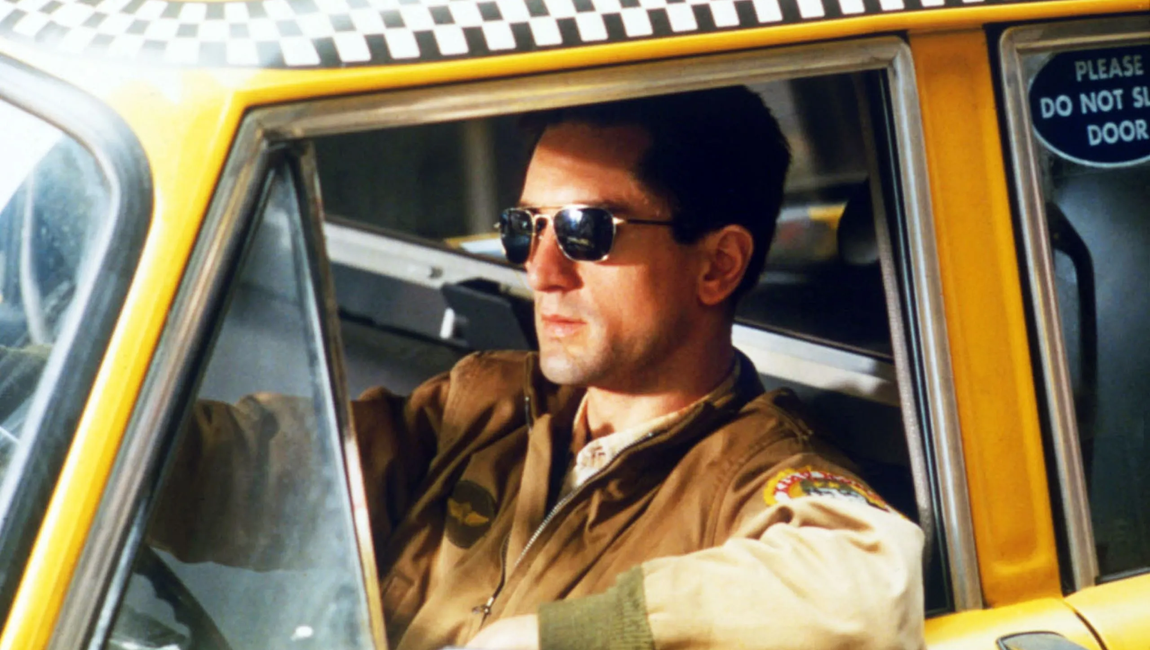
One day there will be a knock on the door and it’ll be me.
Love, Travis.
Happy birthday, Taxi Driver — you’re 50. It smells like cheap cologne, the cigarette it just smoked, and coffee breath even though you’re pretty sure your watch said 11:37 PM when you checked it a few minutes ago. It gets a little too close for comfort, asking invasive questions about your personal life and placing its hands firmly on your shoulders as it forces a hoarse wheeze. You gently remind it that its grasp is too tight, after which it scurries away. Its shift is just about to start, it says. It has to go.
The cases both for and against Taxi Driver have been so exhaustively litigated, and the influences (both up and downstream) so thoroughly pored over, and the memes so widely disseminated, one wonders whether there’s anything left to do with the thing but stare dumbfounded that it exists at all. It’s certainly difficult, in 2026, to find a way in. Should we laugh at its arch, bitter take on electoral politics and dating? Cringe at its disturbing and unblinking depiction of racism, violence, and pederasty? Cry at its bottomless reservoir of inchoate anger, depression, and self-loathing? 50 years on, it remains an ever-transmogrifying and mystifying object — a hard nut to crack, to say the least.
One thing’s for sure, though: it stands alone in both Martin Scorsese’s filmography, as well as the American cinematic tradition writ large. There’s just nothing else quite like it; it’s the very rare American movie to turn the volume low on dramatic action in favor of replicating the experience of discursive conscious thought and work. Taxi Driver doesn’t merely get inside the mind of a man; it is the mind of a man. When Travis walks down the street in a slow-motion telephoto shot wherein all other figures are out of focus, it gets at an alienation and isolation that many previous commentaries have noted. What often goes unremarked upon, though, is what’s at stake with those feelings: the film holds them close and via Travis charges headfirst into a sincere reckoning with the myths from which they are the necessary and putrid afterbirth.
Fundamentally, Taxi Driver is a Vietnam movie, a critique of the militarized mind and the use of violence as a means through which to create spiritual meaning. The opening scene plants the seed: a nameless dispatcher asks about Travis Bickle’s military record, and Travis, in a close-up punctuated with a nice pregnant pause, says, “Honorable discharge. May 1973.” The dispatcher — himself a veteran — warms up to Travis and gives him the job. It’s all we need to know — the word Vietnam is never used, nor are any details of his service evoked: just a big black hole we fill in with our own knowledge of the war. The focus is instead kept on the wounded and wormlike Travis, who uses the cover of this job to scan the concrete jungle as if a predator on the prowl for his prey.
The voiceover is, by now, legendary. “All the animals come out at night,” Travis writes in his journal in between graveyard shifts. “Whores, skunk-pussies, buggers, queens, fairies, dopers, junkies… Someday a real rain will come and wash all this scum off the streets.” Screenwriter Paul Schrader has subsumed Bresson’s religiosity and moral inquiry to varying degrees of success throughout his career, but only in Taxi Driver did he find his fascination (obsession?) with Calvinist purity perfectly integrated with the American idiom: casual vocabulary and a misplaced sense of exceptionalism tied to the logical endpoint of noir and classic man-with-a-gun Western tropes. Scorsese seizes on the mental milieu offered by Schrader’s script, casting New York as an O.K. Corral of the mind in which the sins of America are played out in microcosm, both terribly real and a dreamlike fugue matched in its perverse appeal only by Kubrick’s Eyes Wide Shut.
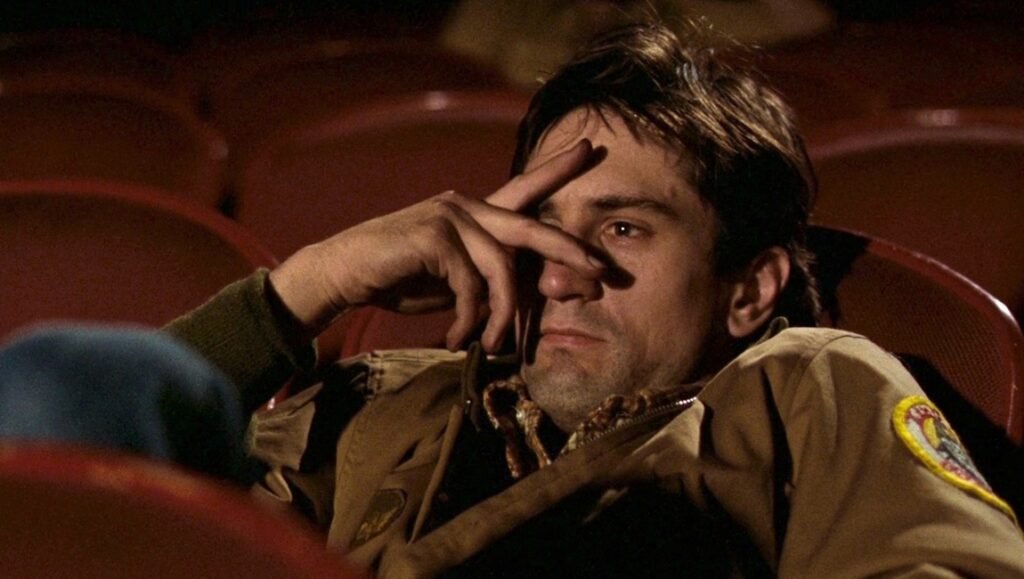
Jean-Luc Godard held the belief that every movie is a documentary of its actors. If that’s true, then so too is a movie a documentary of its locations, and Taxi Driver is Planet Earth. It’s still the most New York movie ever made: soaked in neon and smoke rising from sewer grates, stuffed with inserts of people of all sizes, colors, and persuasions on the street, scored to Bernard Hermann’s brassy and percussive compositions, it is the platonic ideal of New York City on film. Each shot is its own mystery, focused on the “sick, venal” action in front of it, yet reaching out past the yawn of street lights and suggesting the infinite city, one where anything can happen and everything will — dirty, ugly, and romantic at once. It’s what made this writer move there.
The sun also rises on this infinite city, however, and even in the cold light of day Travis sees it as a cesspool in need of washing. Periodically, Scorsese will cut to an overhead shot of items arranged messily on a surface. It could be Goobers and Jujubes (pronounced, spookily, as “Joo-Joobs” by Travis) atop a magazine on the counter at a porno theater, or the pile of memos and notes on a campaign volunteer’s desk, but Travis sees life as something in disarray to be organized, despite the fact that he can’t organize his own: he can’t sleep, he can’t seal the deal with the woman he finds attractive, and he picks up most of his behaviors from others. He gets the idea to buy a .44 Magnum from a rider played by Scorsese, for example, and appropriates the finger gun he puts to his head at the end of the film from a Black cabbie he demonstrates obvious contempt for. Travis Bickle is a proto-Zelig, a man looking for belonging by internalizing what he sees and regurgitating it, badly.
Communication, or its lack, therefore emerges as a key pattern in Taxi Driver: how cabbies communicate with each other in diners after their shifts; how men interact with women; and chiefly, how a man talks to himself. In a conversation outside the diner immediately following the finger-gun incident, Travis seeks counsel from the Wizard (Peter Boyle, as grounded as he’s ever been), who tries to calm Travis down with hard-earned wisdom from a lifetime on the road — Travis instead takes it and runs with it as justification for his actions in the back half of the film. Courting Betsy, Travis postures as an alpha male, only to drop the ball in spectacular fashion by taking her to a porn theater on their second date. Travis even struggles to communicate in his own journal, rehearsing his fire and brimstone “screwheads” speech and tripping over articulations of more vulnerable feelings.
One of the film’s most incredible moments occurs right after the other, more famous phone call scene. In his apartment, licking his wounds following the breakup with Betsy, Travis writes about the flowers he tried to send to her in apology. Scorsese tracks over the dying flowers rotting in Travis’ apartment: “You’re only as healthy as you feel,” Travis says. He tries it out several times, as if rehearsing it, crafting the narrative of his own life. He’s normalizing his own sickness in real time, and De Niro brings so much haunted despondency, so much fear, so much empathy, to the character, that even offscreen we can feel it. When he is on screen, particularly in those in-between moments like when he trains himself to withstand the pain of fire or builds devices to draw weapons from his sleeve Assassin’s Creed-style, he’s got a hopelessly magnetic draw that anticipates his future superstar status.
Robert De Niro has been around so long, and his late career so potholed with phoned-in performances, that the value of his work here has become rather neglected: there’s this incredibly modulated detachment where we can see that Travis is hollowed out but also that he’s a human underneath yearning for connection. He spends half the movie looking past his interlocutor in a post-traumatic stupor, and the other half directly with borderline abusive eye contact. It’s simply extraordinary acting, and he’s not alone. Cybil Shepherd’s performance as Betsy is likewise densely layered: Betsy is a strait-laced woman, but we can see a pert quality in her, an indication that she wants some excitement — a childlike desire for the mature. Contrast that with Jodie Foster’s Old Soul performance as Iris, the 12-year-old prostitute Travis takes it upon himself to liberate after all other avenues of self-expression — including an assassination attempt — fail to materialize into anything concrete. Foster chews up dialogue like an Old Hollywood icon, toggling between Iris’ street-smart put-on and the underlying reality that she is, in fact, a 12-year-old girl. Scorsese sees the soft, viscous souls at the center of each of these characters clearly, yet he unveils them sparingly, in glances and gestures and all that is unspoken. It’s one of the secrets to Taxi Driver’s magic.
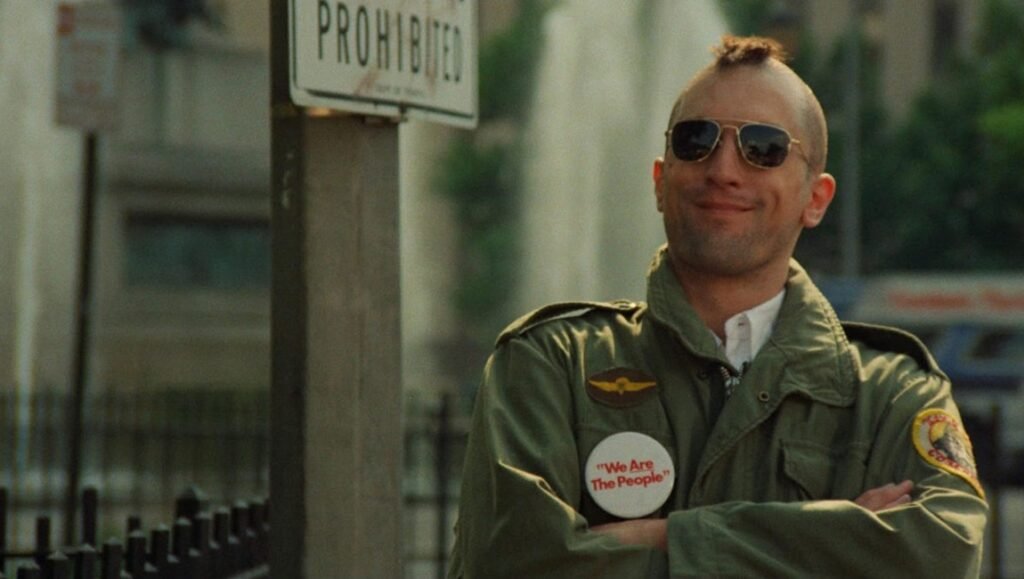
But Travis is determined to make himself heard, and all those wretched, dying flowers finally come into bloom. In a sequence desaturated of color in order to avoid an X rating, Travis takes his anger out on a small cadre of pimps and pedophiles. It’s stomach-turning in its frankness, yet when viewed in 2026, somehow quaint. Everyone already knows it — it’s been viewed over a million times on YouTube — and we’re inundated with equal or greater monstrosities on an hourly basis in the palms of our hands. But there’s a value to viewing these kinds of images organized within a work of narrative art — it helps us to metabolize the experience. If we just receive these images devoid of any context, it drives us, quite literally, insane. Without a director like Scorsese returning to that overhead shot, we fall into the trap of what happens to Travis at the very end of the film, believing our tiny slice of life — the way we organize reality — is the only way to do it righteously. Travis is celebrated for it.
Whether it’s a fantasy in the last spasms of death (a theory, for what it’s worth, this writer has never subscribed to) or a diegetic coda is beside the point: what matters is that the violence has been justified as the narrative shifts from Dostoevskian existential interrogation to pure movie logic: Travis gets the glory and the virtue, and he gets to decline the girl who’s come running back to him after coming to her senses. It’s a movie that justifies violence with a misplaced sense of moral superiority. It’s a movie that perpetuates harmful dogmas about what makes a man a man, and what makes an American an American. It’s a movie that’s still playing in the minds of millions.
Taxi Driver, however, is being played less and less. Once the undisputed dog atop the pile of the 1970s American canon, it finds itself slipping from preeminence as contemporary American society oscillates schizophrenically between digital puritanism and outright fascistic rhetoric: when we experience 100 psychological Vietnams a day and every third person you interact with on the Internet is a Bickle, it’s easy to dismiss a film like this as regressive or (that greatest of all judgments) not useful. But take a look out the window — Taxi Driver is right now: vigilante justice; millions of documents released detailing evidence of child sex abuse; xenophobically-charged political violence; undisguised racism from the world’s most powerful. Taxi Driver points directly at the skeletons we’d rather leave in the closet — both an individual’s and a nation’s. It is more relevant than it was at 40 or 30, and it is more necessary than ever.
You overhear Taxi Driver talking to itself on its way out the door. “So when they continued asking him, he lifted up himself,” it mumbles, “and said unto them, ‘He that is without sin among you, let him first cast a stone at her.’” It returns the opening scene of the movie to your mind. “How’s your driving record?” Travis is asked by the dispatcher. “It’s clean,” Travis says. “Real clean. Like my conscience.” Strange, you think. Cast away.
Comments are closed.