
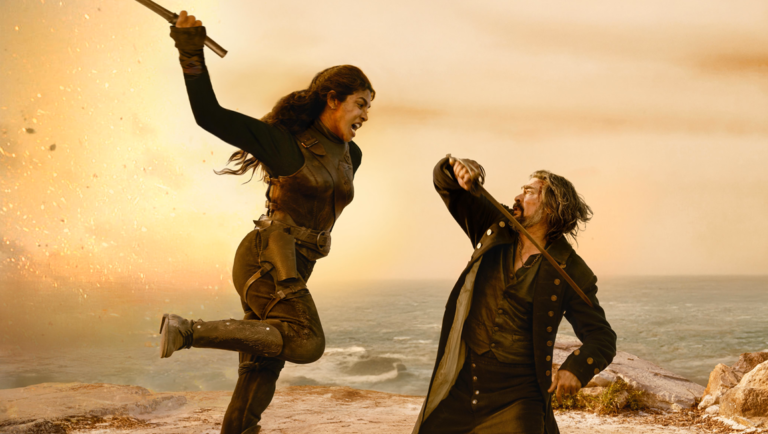
The Bluff isn’t the same kind of pirate film as Pirates of the Caribbean. Unlike the leviathan Disney franchise, The Bluff has very little seafaring, the violence is grueling, and it’s about small folk rather than rich captains and governors’ daughters. The perspective shift is the film’s main draw. Cayman Islands native Frank E. Flowers’ approach to the industry of piracy de-romanticizes the rogue seafarers and uses grim social conditions to realize pirates that a smart viewer can root for without guilt or reprise.
Priyanka Chopra Jonas, Bollywood favorite turned international star, plays a former indentured servant (slave, though she didn’t use that word) turned retired pirate captain in the 1840s. She looks after her sister-in-law (Safia Oakley-Green), who does absolutely nothing, and her own physically disabled son (Vedanten Naidoo). Her husband, T.H. Bodden (Ismael Cruz Córdova), is out at sea when an old rival pirate, Captain Connor (Karl Urban), shows up and disrupts her peaceful domestic life on Cayman Brac, one of the three Cayman Islands. Her nickname once upon a time was “Bloody Mary,” though she, like the Apostle Paul upon his conversion, now goes by a new name: Ercell Bodden. But now Ercell picks up her old blade — and an assortment of other weapons, including an alien-looking harmonica pistol where the bullet cartridge protrudes horizontally from the side of the gun — to become Bloody Mary again in order to keep her family alive.
The film’s title is a double entendre. Its primary reference is to the lesser known geographical feature of a cliff or rockface overlooking a body of water that becomes an important terrestrial location in the film. Specifically, the bluff of the title refers to the iconic cliffs of the Cayman Brac, even though, disappointingly, they had to film in Australia. The title also refers to the falsehoods and general backstabbing in which the criminals trade. Both flavors of bluffs arrive in abundance in The Bluff.
The white-skinned and Commonwealth-accented Urban makes a great foil to Chopra Jonas here, a brown-skinned Indian woman. Indo-Caribbean people arrived much the same way Ercell does: through indentured servitude, slavery, and the colonial treachery of the British Empire. Connor’s crew seems to be international too, another notable detail handled by the casting department. The biggest and most famous pirate films — the aforementioend Johnny Depp films, Hook, Treasure Island — all whitewash or nullify the power of race at sea. They also sanitize the violence about about murders and rapists to make them more appropriate for children. Flowers reclaims the genre on both of these fronts.
Lisa Lassek, a frequent collaborator of the Russo Brothers (who produced The Bluff), knows how to edit action and balances the legibility of the choreography with a sense of velocity. Her best editing comes in a deceptively simple cross-cut between a gun-based action scene and a melee- (mostly blade-) based scene, where the intimate brutality of the skirmish is juxtaposed with the cold distance of a ranged fight. Visually, there is a huge difference, too. One is dirtier, the other cleaner; one simply costs more from the doer of the violence than the other.
Ercell may have a new name now, but she doesn’t deny having earned her imposing nickname. She did whatever it took to survive for a simple reason: when one is put in a survival scenario, that is what they must do. But Ercell is aware of the larger political reality as well and doesn’t shy from preparing her children to take arms against the masked men who come to destroy their family. One of the first scenes finds the mother handing her son a knife… and not one meant for cooking. She understands — and imparts — that when the oppressor speaks the language of violence, one can only attain their freedom by speaking the same tongue.
Martinique psychiatrist and critical theorist Frantz Fanon wrote in The Wretched of the Earth that “Imperialism leaves behind germs of rot which we must clinically detect and remove from our land but from our minds as well.” The image Fanon conjures here is one of contamination and rejection, of a cancerous growth and cutting it out. Ercell literalizes this image of rejecting the germs of colonialism with her spit. And she spits actively, the action accompanied with a “phew” rather than a slow drip, a minimum of four times: the first time at the face of an assailant; the second time to free herself of blood flooding her mouth; the third time with water while cleaning her face; the fourth (a stick) and fifth (a cork) come in quick succession, while she is being medically treated. Every incident is directly connected to her struggle for freedom against the pirate invaders. Once or twice, it could be a coincidence; a comrade of hers also spits, for instance, shortly before being killed in an act of sacrificial solidarity. But this times is unmistakably purposeful.
Connor, by contrast, is gluttonous and sooner to be depicted taking something into his own body and symbolically colonizing it by erasing its matter into his than firing it away from his self. He only finds his way to Cayman Brac after finding gold bearing his marking on T.H.’s ship when hijacking it and begins his pursuit to repossess his vanished treasure. He takes out a slab of a drug, presumably chewing tobacco, and rubs it all over his teeth. (The close-up from cinematographer Greg Baldi makes it look more like a lather of gross mud.) We don’t see it leave his mouth: it’s a poison that goes straight to his black heart. He also smokes a pipe while having a conversation with quartermaster Lee (Temuera Morrison) about the human cost of the war he wages against Ercell: “Blood Mary is a means to an end. Nothing more,” he says. Later, in a rousing pre-war ritual, we watch as Connor sensually places some of the soil-like drug into the mouth of one of his sailors. In this action, we uncover something essential: that he and his men consume with abandon the same horrifying ideological order that Ercell repels from her body. Even saliva can be a rebellion.
DIRECTOR: Frank E. Flowers; CAST: Priyanka Chopra Jonas, Karl Urban, Ismael Cruz Cordova, Safia Oakley-Green; DISTRIBUTOR: Prime Video; STREAMING: February 25; RUNTIME: 1 hr. 43 min.
Comments are closed.