
I’d promised myself to buy one book by a French author when perusing the tourist-heavy English language-friendly bookstores in Paris, and, while of course I bought four, the one I read immediately was Manchette’s Nada. It seemed short, snappy, easy to put down and pick back up in those tiny windows of free time during my trip. I’d never read any previous Manchette, and though I expected a sparse crime novel, I was surprised at just how sparse it was. There’s enough about French leftist infighting to give the novel some sort of impetus to get the plot going, but it’s mostly a play-by-play account of planning a kidnapping, with many characters reduced to their key traits (”the Catalan” or “the alcoholic”). There’s no psychologizing to be found; most characters’ interior thoughts are only revealed when they’re disgusted or turned on. Each car model and every alcohol bottle is named so you know which characters are très cool. I appreciated the simple style, but I felt like I was missing what set Manchette apart from his American pulp forebears.
Reading Nada reminded me of a film I’d been meaning to finally watch: José Bénazéraf’s Joë Caligula. Like Jacques Doniol-Valcroze (whose Game for Six Lovers I’ve covered in this column), Bénazéraf ran with the nouvelle vague crowd in Paris but never received adoring critical attention. Though he’d even appear in Breathless (a cameo even honored in Richard Linklater’s Nouvelle Vague), Bénazéraf never quite aspired to Godard or Truffaut or even Chabrol’s project of a new cinema. Instead, he was a producer for foreign softcore films who happened to work with a similarly low budget as his Cahiers pals; when he became frustrated with his various directors’ poor work, he began to make the films himself. Like Japan’s pinku directors of the 1970s and ’80s, he found the artistic freedom the nouvelle vague sought by working with low-budget sex films where return on investment could be guaranteed with just a titillating poster. Though the French censors had been wary of his work, 1966’s Joë Caligula, his only non-erotica feature at that time, was the picture they banned from release, putting Bénazéraf in financial ruin.
Though Nada cuts its story down to just the bare essentials for a crime story, Joë Caligula does away with even the pretense of setup or characterization or anything standing in the way of sex and violence. One of the first scenes shows brief images of a gang collecting their weapons and entering a café where they steal jewels off anyone they can. Many of them move in unison — more dance troupe antics than military discipline — and all don sunglasses before raising their guns even if the crowd has already seen their faces. None of the gangsters bark orders or chant revolutionary slogans; when we see them again, they’re simply dancing at another café. Their motivations are vague, almost nonexistent, but eventually their targets switch from bejeweled Parisians to pimps and crime lords. This does not spring from a sudden moral turn, nor does it seem related to any kind of personal grudge. They simply commit crimes to remove their competition.
Sequences of robbery, partying, or assassination continue to puzzling lengths, suggesting either the scrappy, low-budget need to include as much footage as possible to extend the running time or a nod to that kind of Bazinian realism that forces a viewer to stick with the scene until the action’s over. Some scenes feel like a blueprint for Le Samouraï, as a wide shot shows wordless gangsters smoking at their hideaway’s lone table in the corner of the frame. Cigarettes, sunglasses, and guns are drawn slowly — nobody’s in a rush even to get away. For these gangsters, perhaps robbery is merely a pretense to hang out, like old friends deciding on a weekly poker night. While these sequences make sense (like the details of characters in Nada, they establish who is très cool), a funeral scene features every stretch of the road the mourners travel as well as every expression each mourner makes when looking at the deceased. A burlesque scene goes on for so long that the backing track of Elvis’ “Trouble” (”Well I’m evil, so don’t mess around with me” being a tad on the nose) plays in its entirety twice. While Godard experimented with what images could make sense even when cut, Bénazéraf pushed what could make sense even if it kept going.
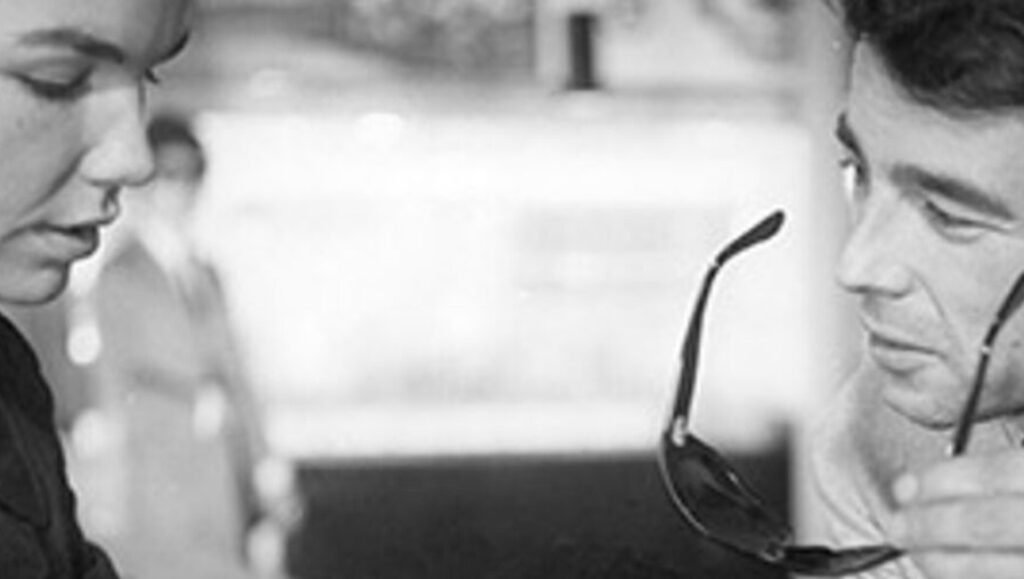
Perhaps this comes from his instinct when shooting softcore sex scenes to simply hold the camera on the interesting action. Here, too, the camera hovers when a woman undresses, though it can be playful as well, with one sequence shot entirely behind a semi-transparent shower curtain to both tease and abstract the image. While it may come across as amateurish to shoot so literally for so long, especially with very little music or dialogue, it’s also comforting to know that Bénazéraf never feels the need to keep the plot going for its own sake.
Speaking of which, there’s hardly anything resembling a plot. When the gangsters aren’t killing mob bosses or dancing, they’re sleeping with each other or perhaps a local prostitute. They get on the nerves of one of the city’s top gangsters, who does not view his career as a never-ending hangout and who subsequently seeks to punish them. The film ends when most of them are dead.
But one detail complicates things. As the mob investigates these kids, they find that the miscreants speak with “Southern accents” and hail from “northern Africa,” a vague detail that would nevertheless connect contemporary audiences to war-torn Algeria. Bénazéraf himself was born in Casablanca and spent his earliest years in Morocco along a distinct French colonialist culture. Given that this is the only detail given about this group, it offers some explanation for why this lot is so comfortable with violence as a means to their mysterious end. Shots of Joë admiring himself in his new stolen hat in the mirrors of a department store are matched with those at the end, as his sister wanders away from their hideout to a store’s display case where she imitates the mannequins. It’s all very Nocturama, and if there’s any definable political commentary here, it’s likely just as brutal.
Joë Caligula was banned on the day before its release due to its depiction of “nihilistic violence,” and, well, it certainly has that. It’s far more likely that the censors were using this as an excuse to shut down Bénazéraf’s work entirely. Regardless, the director was devastated, as he considered it his best film. He made another noir-ish film in Germany, St. Pauli Between Night and Morning, and Joë Caligula eventually did escape the censors’ hold, but Bénazéraf is still best known for his career in directing straightforward, if a bit atmospheric, pornography (example titles: 1978’s SS Bordello and 1983’s La Star Sodomisée).
Like my reading of Nada, I did hanker for the usual bits of context even other minimalist artists include to make their barebones stories work. Is this a critique of self-obsessed youth culture? A defense of it? A commentary on growing up in French North Africa? It’s certainly a document of French malaise mere months before May ‘68. And it serves as a bridge between the low budget demands of pornography and the low budget aspirations of the Cahiers crew (the film even begins with a prostitute enticing a young man into a brothel by promising him new films by Godard and Chabrol). All you may need for a film, as Godard once said, is a girl and a gun. Bénazéraf believed him.
Comments are closed.