
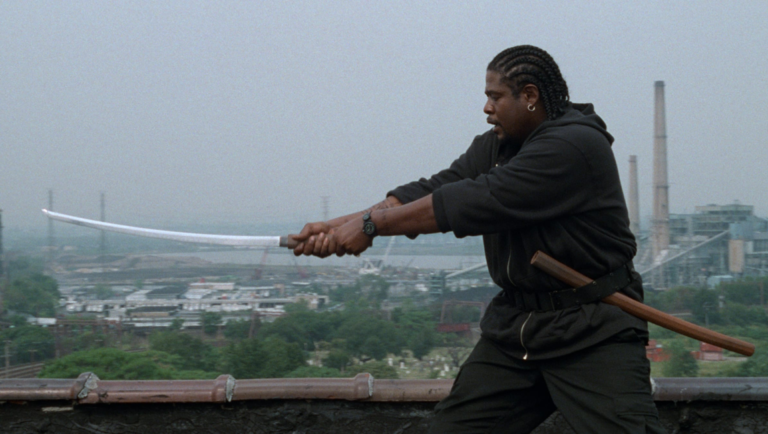
Jim Jarmusch’s characters tend to not be long for their worlds. William Blake, Johnny Depp’s meek and self-effacing protagonist of Dead Man, loses out on gainful employment in booming 19th century industrial America and is relegated to the role of vengeful outlaw in the wilderness. For Tom Hiddleston and Tilda Swinton’s Adam and Eve, the centuries-old vampire companions of 2013’s Only Lovers Left Alive, ennui reigns as suicidal ideation kicks in, their will to live slowly dissipating as they suffocate on the residual rot left behind by “zombies” in modern-day Detroit. And in 1999’s Ghost Dog: The Way of the Samurai, it is the very impermanence of life itself that drives Forest Whitaker’s eponymous warrior, who goes about his existence with this ethos as dictated straight from the Hagakure, a printed guide of the bushido code: “The Way of the Samurai is found in death. Meditation on inevitable death should be performed daily. Every day, when one’s body and mind are at peace, one should meditate upon being ripped apart by arrows, rifles, spears, and swords. Being carried away by surging waves. Being thrown into the midst of a great fire. Being struck by lightning, being shaken to death by a great earthquake. Falling from thousand-foot cliffs, dying of disease, or committing seppuku at the death of one’s master. And every day, without fail, one should consider himself as dead. This is the substance of the Way of the Samurai.”
Airlifting direct cues from the minimalist stylings of Seijun Suzuki and Jean-Pierre Melville — with Le Samouraï being the most prominent touchstone — Jarmusch’s seventh feature film is an impossibly cool remix of the existential loner template, packaged and delivered with the customarily understated verve that only an impossibly cool director like Jarmusch could accomplish. Ghost Dog is the name of a contract killer for the mafia, steadily working off a life debt owed to mobster Louie (John Tormey), who had saved his life several years prior. If there is any other major tenet of the Hagakure Ghost Dog abides by, it is fealty to his master, devoting his sword to Louie as his only law. Skilled, slick, and proficient with a weapon, Ghost Dog carries out his assignments with ruthless efficacy, earning a mythic reputation for the quality of his work. When not working for the mob, he leads an unassuming lifestyle, dressing as a vagrant and caring for a fleet of carrier pigeons on a city rooftop. But when one hit goes sideways, the mob’s higher-ups (including Henry Silva and Cliff Gorman) order Ghost Dog’s death, forcing Louie to turn on his protégé. Unwilling to take this development sitting down, Ghost Dog retaliates against the entire Jersey mob, waging war as a one-man army in what amounts to be a kill-or-be-killed scenario.
Released four years after the gorgeous and sensational acid western Dead Man, Ghost Dog: The Way of the Samurai feels like Jarmusch’s first and last shot at the mainstream. Despite leaning heavily on his aforementioned arthouse inspirations, Jarmusch shrewdly capitalizes on the 1990s’ resurgence of gangster media, blending the growing commercial appeal of these films and television shows with the popularity of hip-hop, crafting his own funky stew of his favorite influences. The surface-level details of Ghost Dog are fun, but what’s truly remarkable is how much of Jarmusch’s own idiosyncratic behavior shines through the convention of it all. Ghost Dog’s assignments are ordered through homing pigeons, and his method of stealing fancy cars has evolved from Alain Delon’s enormous key ring to a handheld electronic device that can seemingly “hack” any expensive motor vehicle. Gangsters are frequently seen watching cartoons, including violent shenanigans of Simpsons mascots Itchy and Scratchy, while elsewhere one gangster’s moll casually reads Rashomon as her paramour is murdered right before her eyes. And Gary Farmer even shows up, revisiting his adage from Dead Man to remind us of the “stupid fucking white man.” Perhaps the most memorable sequence, though, is Ghost Dog’s innovative use of a drain pipe and a laser-sighted pistol to score a headshot on one gangster in his own bathroom. The saga of a warrior’s quest for vengeance against the mob is enjoyable on its own right, but it’s these minute details that Jarmusch fills in between the hits that make the film truly memorable.
Front and center of this all is Whitaker, delivering what could quite handily be considered his career-best work. Stoic and watchful, while also sly and vaguely amused, he gives a commanding performance that undeniably elevates the film, embodying the role of a killer with ease while simultaneous projecting the world-weariness of a man who knows his life is nearing its end. Whitaker is never less than a compelling watch, and some of his best scenes here resistant from violence’s involvement at all, instead luxuriating in the quiet moments of him enjoying ice cream, or conversing with ice cream vendor Raymond (Jarmusch regular Isaach de Bankolé, in his second collaboration with the director), a French-speaking Haitian immigrant, palpably bridging the communication divide despite neither of them seeming able to speak the other’s language. There’s also the crucial but tender bond Ghost Dog forms with Pearline (Camille Winbush), a young girl who shares his own passion for literature. When she laments not having read one particular book yet, he casually mentions to her that she “still has time,” his voice barely concealing the fatalist reality of his own time running out. Ghost Dog: The Way of the Samurai might boast a more conventional outward appearance than had been or has since become expected from the filmmaker, but it’s an undeniable Jarmuschian delight through and through, melding the director’s influences with his strongest instincts as a man with a code of his own to fight for.
Comments are closed.