
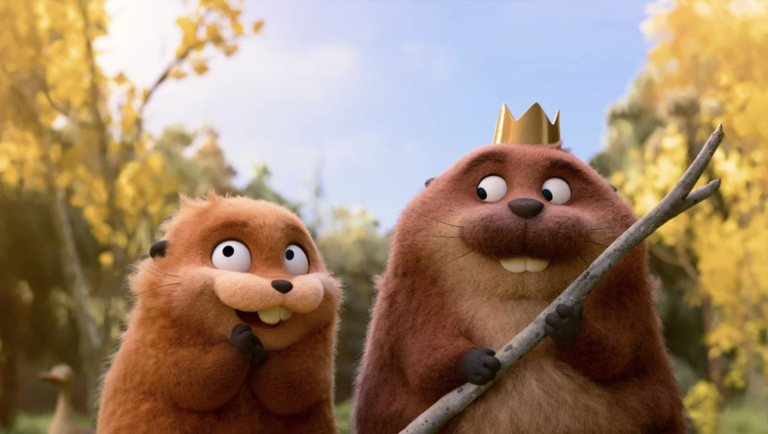
Hoppers, the latest animation project from Pixar/Disney, exceeds according to at least one important metric: it’s a familiar product, offering easily consumable family-fare and realizing a similar quality to the blockbuster animated flicks of the late 2010s and early 2020s. It’s also notably lacking the zeitgeisty zest of Coco or Soul, and it’s certainly without the timelessness of favorites such as Up or Inside Out. But familiar is the zippy, bouncy music and an energetic, emotive script cut tightly along its beats. Pixar has long mastered the foundational animation principle of “Mickey Mousing,” intertwining movements on screen with hits of music, sound effects, and speech so that the delivered effect is a unified whirlwind of energy. And befitting a film with this title, the action scenes truly “hop,” which is important given that Hoppers is being widely exhibited in premium formats, where its kinetic moments are given the chance to become genuine spectacle.
Familiar, too, is the animation itself, which here offers up a computerized, claymation-styled puppetry that Pixar has dedicated itself to since Toy Story. From both a technological and consumerist perspective, then, this age of animation — evidenced by recent mega-hit Super Mario Bros — represents a pinnacle of the medium’s success. From an aesthetic perspective, however, it seems as though the end goal is the “uncanny valley.” Textures are increasingly photo-realistic even while the forms stretch like Play-Doh, and the defining quality of the style could best be described as roundness. Forms are globular, almost rubbery, like a bouncy ball or children’s toys come to life, and while this stylistic trend extends the pliability of movement, it also diminishes the impact of performance, both of the animator and the voice actor. Human performance is squandered by aesthetic confusion — the hyper-real too near the purely imaginary to be distinguished — leaving the likes of skin and fur to be rendered too accurately, with too much fidelity. That’s not to say that we question our eyes and believe a beaver is wearing a crown and typing with emojis, but rather that these aesthetic decisions abuse both our expectations of reality and our desire for imagination. Super Mario Bros, at least, chooses primarily imagination with which to color.
To it’s credit, Pixar has hardly collapsed under the influence of brain rot and the intolerably low bar now permitted for children’s entertainment on platforms such as YouTube and TikTok. Directed by Daniel Chong, Hoppers is tight, well-scripted, and wholesome; if anything, despite its conservationist-minded messaging, the film suffers for having too timid of morals. A general environmentalism, encouraging children’s connection to nature, pervades the film, and is amplified by Hoppers‘ protagonist Mabel Tanaka’s pursuit to preserve the ecology of a glade cherished by her late grandmother. But in its essential conceit, Hoppers loses control of its moral standing. The film hinges on the concept of “hopping,” which is playful in a familiar Pixar way. “This is like Avatar,” Mabel says, when the process is explained to her, which involves her inhabiting the body of a robot beaver in order to go undercover amongst the animals. The technology was developed by a professor at Beaverton University to aid in wildlife observations, but Mabel, who has stood up for Nature all her young life, sees it as more than that: she is willing to jump into the pond herself, to travel deep into the woods and to interfere, a major red flag in scientific observation but an essential part of activism.
Indeed, Hoppers is being released amidst a wave of youth activism — and surely Mabel Tanaka is meant as a model activist — directed to a toddling generation who will one day face their parents’ and grandparents’ staggering inaction regarding environmental collapse. With this in mind, Chong’s film isn’t likely to age well with those who grow up concerned, those arrested in future campus encampments, or who put their bodies before bulldozers. Mabel’s ultimate success is to establish a dialogue with power, a negotiation with industry, progress, and development. Her struggle exists in a world in which goodness is rewarded and stolen rights might be gifted back. Wishful thinking. Our century has already seen the works of environmentalists unwound by elected officials. Wait, but this is a kid’s movie! Still, there is precedent. There have been animated animal movies that push barely buried radical collectivist morals, namely Chicken Run, A Bug’s Life, and Antz. Also, consider Dr. Seuss’s The Lorax, which rather starkly exposes the devastation of old-growth forests, or the Disney classic Bambi, which traumatized generations into a deep concern for Nature. Hoppers however, like Zootopia before it, takes a milder stance by foisting those systems which trouble us — human follies — onto the animal kingdom, as if Nature itself were part of the problem.
And it is a kingdom, literally. In Hoppers, the woods of North America seem to be controlled by an archaic consortium of fiefdoms, each supervised by a monarch from each class of species — birds, amphibians, reptiles, mammals, and insects. Naturally, the Monarch Butterfly, queen of the insects, wields the most influence, while George (Bobby Moynihan), Mabel’s fast beaver friend, is the lowly philosopher king, a happy ruler who espouses a New Age belief in togetherness, which is a slightly ironic stance. The facts of Nature pose a problem for the writers. George explains the “pond rules” to Mabel, which include “eat when you need to eat” — meaning one another — but also “we’re all in this together.” The morality of the story is poised awkwardly between an ecological purism and total nonviolence, two tenets of the hippie canon which don’t necessarily overlap. The council of monarchs agrees with Mabel that the animals need to fight back against human expansion. They will “squish” Mayor Jerry (John Hamm), says the Monarch queen. “They squish us,” says her larval son, Titus (Dave Franco), so why shouldn’t insects squish back. Good question.
Jerry’s reelection bid hinges on the completion of a new super-highway around Beaverton. The massive road will save four minutes of driving and must cut directly through Mabel’s grandmother’s glade. But Mabel’s new mission is to in fact save her archnemesis from the violent wrath of the animal kingdom. This act of saintly — Mabel is at one point even referred to as sort of Joan of Arc — nonviolence will, we hope, lead Jerry toward understanding, and preserve the glade. Mabel is right, of course, that squishing the Mayor won’t permanently halt the road project, nor the gradual deforestation underway. Titus’ method of revolution lacks forethought — he also descends into easy despotism — but can we neglect his anger? In Chicken Run, remember, the stakes are life and death. The coop becomes agitated by a revelation: once they stop laying eggs, they become chicken pot pie. The only solution, then, is to work together to escape. And they do, and it’s glorious. Hoppers includes several similar revelations, including the nefarious ways Mayor Jerry has concocted for removing animals from his proposed highway build. Mabel is given opportunity not only to agitate, but also to organize. The animals could work together, building a mass movement to force a solution that works for Nature as well as for the citizens of Beaverton. Instead, hope is left to a legislative future, offering a denouement that is almost cynically passive and depressingly familiar.
DIRECTOR: Daniel Chong; CAST: Piper Curda, Bobby Moynihan, Meryl Streep, Jon Hamm, Dave Franco; DISTRIBUTOR: Walt Disney Pictures/Pixar; IN THEATERS: March 6; RUNTIME: 1 hr. 45 min.
Comments are closed.