
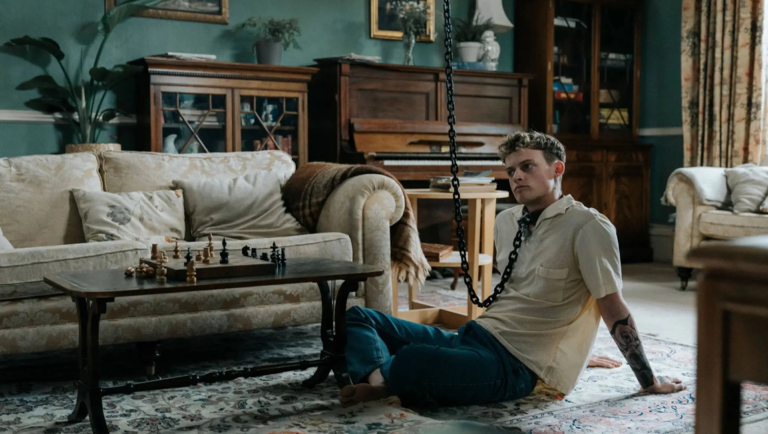
We need to talk about Tommy. In Jan Komasa’s Heel, Tommy (Anson Boon) is a proper hooligan. His nights out mean rails of cocaine in club bathrooms, picking fights with bouncers, and cheating on his girlfriend while she’s in the same room. If you scroll through his TikTok, you might find him crashing his car, crossfaded and cackling, or putting a cigarette out on a uni student’s face. Tommy is the sort of repellant Essex lad whose charm and white skin allow pass after pass from the police, and if you watch his antics for long enough, you might feel inspired to take matters into your own hand.
Which is exactly what Chris (Stephen Graham) endeavors to do. With eyes crusted and head pounding from a night out, Tommy awakens one morning in a strange basement, his neck shackled and chained to the ceiling. A cheery and demure father of one, the toupee’d Chris explains that he and his family have taken Tommy in to do what society couldn’t: shape him into a decent young man. Sound familiar? Heel exists within a sprawling canon of youth-in-reform thrillers, from Black Snake Moan to Heretic, that both lay precedent for Komasa’s own entry and keep the element of surprise just beyond the chain leash’s slack.
Reformation is familiar territory for Heel’s creators, too. Komasa gained international acclaim with 2019’s Corpus Christi, which finds a young man in spiritual revelry within a youth detention center; Stephen Graham finally broken into the international mainstream with Adolescence’s zeitgeisty swing at the manosphere’s underbelly. It can be frustrating to see the tracks laid so far ahead for a thriller, especially within an entertainment ecosystem that champions market-tested provocations that rest comfortably inside the boundaries of taboo. But if Heel fails to innovate, it succeeds, in fits and starts, in its execution. It might not say anything new, but it says it well.
Chris’s preteen son, Jonathan (Kit Rakusen), is over the moon when Tommy joins the family. You get the sense that Jonathan logs quite a bit of alone time — he’s precocious but nervous, introduces himself as someone who loves Disney movies and football, and begs his father to read comic books left behind by someone named Charlie. It’s not clear who Charlie is — he could be a lost son, or maybe Tommy isn’t the first of the family’s reform cases — but his absence casts a dark shadow across Chris’ lavish, gilded estate. Perhaps it’s the missing Charlie that has rendered Chris’s wife, Kathryn (Andrea Riseborough), a shell of her former self.
It’s with Kathryn that Heel evolves beyond the new extreme conventions of modern arthouse thrillers. At first glance, Kathryn seems a whisp of a woman: she floats through the manor, pale and sepulchral, staring at her feet and mumbling one-word replies to Chris’ doting. Movies of Heel’s ilk have trained us to flag Chris’ puritanical timidity as a feint; Kathryn’s brittle grief all but confirms it. But when the parents catch Jonathan with a pack of cigarettes, Kathryn reveals herself as a stronger agent within the family’s disciplinarian dogma than she lets on. “Jonathan,” she calls to her son, his lungs burning after being force-fed the remainder of the pack, “destroy all that destroys you.”
Kathryn’s severity bleeds in all directions. She is extreme in her sadness and her empathy, her warmth and her inscrutability, in her creed and in her body. To Tommy, Kathryn’s as archetypal a mother as the real thing; to the whole of Heel, she’s a reliable foil to the movie’s prepackaged inevitabilities. Heel’s premise demands its beats, however predictable: there is no question that Tommy will eventually escape, that his resistances to Chris’s reform will soften, that he will become a brother to Jonathan and a son to his captors. It’s with Kathryn — her sly calculations and brooding, unknowable love — that these beats become vital. Riseborough has staked her claim as independent cinema’s most valuable weirdo, and her turn in Heel elevates the idea of a mad lad chained in a basement from bankable elevator pitch to active calamity.
What’s to be done with the evil that men — or boys, mates, lads, etc. — do? Heel knows better than to explicitly connect Tommy’s nihilism (made palatable, against all odds, by Boon’s bottomless charm) to the bloated horsemen of Online Men, but the math seems easy enough. When Chris loops Tommy’s debauched TikToks on a TV placed in front of his chain, rubbing his nose in it like a dog and its own shit, Tommy only grins like a child. He’s made it to the same small screen as Joe Rogan and Andrew Tate, Dave Portnoy and Clavicular. Tommy is of a set that seems beyond the tipping point, the collateral of a movement metastasized past treatment. Heel can feel dull in its litany of certainties, but it cradles a spark when the family’s mission pivots from reformation to reclamation: they may not be able to change Tommy, but they can provide him a home. The chain is just another thing to figure out.
DIRECTOR: Jan Komasa; CAST: Stephen Graham, Andrew Riseborough, Anson Boon, Kit Rakusen; DISTRIBUTOR: Magnolia Pictures; IN THEATERS/STREAMING: March 6; RUNTIME: 1 hr. 50 min.
Comments are closed.