
Maggie Gyllenhaal’s The Bride! brashly announces in its opening title card that Mary Shelley wrote Frankenstein on a dare, and that’s an ethos the film itself has internalized. A postmodern, thumb-in-the-eye of a film that wears its politics loudly, the film functions as an exceedingly loose adaptation of both Shelley’s 1818 novel — which itself was recently brought to the screen in a more faithful form by Guillermo del Toro — as well as James Whale’s revolutionary at its time Bride of Frankenstein. Reconceiving the tale as an art deco, neon-infused, lovers-on-the-run story — as much Wild at Heart as Bonnie & Clyde — with a highly animated feminist perspective, the shape of the film can barely contain all the competing themes, homages, and provocations, which jut out awkwardly and poke through the surface. There may be no bad ideas in a brainstorm, but plenty have survived the crucible of bringing this story to the screen and all are on full display in The Bride!
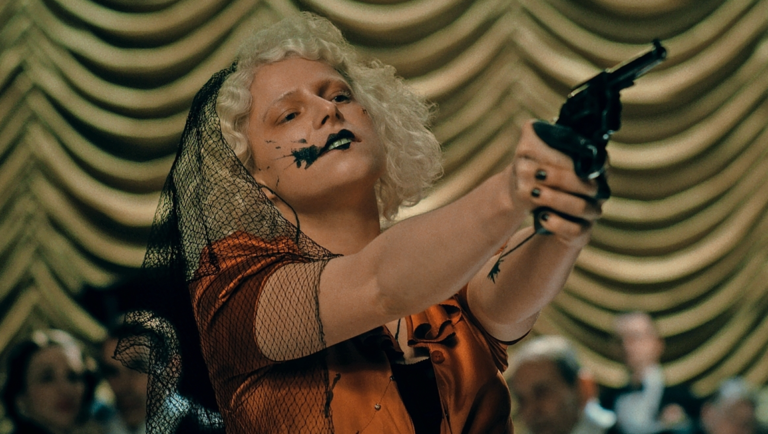
Set in 1936 for largely aesthetic reasons, we’re first greeted by a towering, screen-filling close-up of star Jessie Buckley (on a glidepath to her first Oscar for Hamnet, only through the grace of this film not opening a few weeks earlier) as Shelley herself. A verbose shit-talker, prone to stream of conscious-sounding digressions, Shelley announces that we’re about to watch the sequel her seminal work actually deserved, before projecting her essence across time and space into the body of gangster’s moll, Ida (also played by Buckley in an era-appropriate platinum bob). We meet Ida as she’s being pawed over by disgusting mobsters who urge her to kiss another woman as though they were frat boys on spring break (even feeding the character oysters on the half shell lacks consent), only for her body to become inopportunely overtaken by the spirit of Shelley. Appearing as though she were in the throes of a schizophrenic episode (Buckley alternates between a clipped British accent and an exaggerated Chicago drawl on a nearly line-by-line basis), Ida crawls on the table and makes a spectacle of herself, even blabbing about the murders perpetrated by a fearsome local crime boss Lupino (Zlatko Burić). After efforts to calm Ida down result in her being thrown down a flight of stairs, her broken body is hastily dumped in a potter’s grave by a couple of goons, and there she rests awaiting a mad scientist in search of a fresh corpse.
As luck would have it, Frankenstein— the film dispenses with the “actually, it’s ‘Frankenstein’s monster’” pedantry — is in Chicago and looking for a mate. Played by Christian Bale under heavy prosthetics (the performance is more in the soulful and soft-spoken Jacob Elordi vein than the lumbering, monosyllabic Boris Karloff one), “Frank” searches out the eccentric Dr. Euphronious (Annette Bening), eager to exploit her discredited research in re-animation to remedy his crippling loneliness. After convincing her to build him a female monster to be his companion, Euphronious and Frank dig up Ida, and faster than you can bellow “it’s alive!,” she’s been brought back to life — albeit with selective amnesia (when it’s required to advance the plot, you better believe the character remembers some stuff). Unaware that she was even dead and at the mercy of the lies that Frank tells her — he says her name is Penny and that they’re already married — Ida is looking to cut loose in the Second City. That means sneaking out of Euphronious’ lab like a teenager breaking curfew to go to the movies (Frank is fond of musicals starring the filmmaker’s brother, Jake Gyllenhaal, as a matinee idol, often imagining himself projected on the screen and hoofing with a top hat and cane) and dancing with reckless abandon at a queer-coded underground nightclub. However, after a couple of ruffians try to sexually assault Ida/Penny, Frank is reluctantly drawn into action, leaving the assailants with faces resembling meat sauce. Now being hunted by the police in the form of the anachronistically evolved detective Jake Wiles (Peter Sarsgaard) and his resourceful secretary Myrna Malloy (Penélope Cruz), Frankenstein and his “bride” crisscross the country trying to outrun the law while hungrily lapping up every moment of their doomed romance.
For whatever else can be said about The Bride!, it believes it’s not taking itself overly seriously. Gyllenhaal’s approach is to throw anything and everything at the wall and see what sticks, but the film carries itself with an impertinent puckishness that at least creates the impression that it’s in on the joke. How else can one reconcile scenes like the one where Frank and Ida perform an elaborate dance number to “Putting on the Ritz,” famously featured in Mel Brooks’ Young Frankenstein? Or, for that matter, the ironic needle drop employed for the film’s end credits that, true to the film’s opening title card, feels like Gyllenhaal paying off a lost bet. And then there’s Buckley, who plays her role as though she were literally in conversation with herself, as Ida and Mary trade droll knock-knock jokes with “one another” while the actress engages in the sort of “look at me,” scattershot riffing rarely seen on screen since Robin Williams’ passing.
At the same time, the film’s overall tone is scolding and humorless, with repeated allusions to rape and the subjugation of women; there’s an unfocused rage coursing through the project that dampens even the daffiest of scenarios. That leads to scenes that are simultaneously po-faced and nonsensical, which is as much a winning combo as milk and lemon juice. When Sarsgaard’s self-professed ally reassures Cruz’s character (the actual brain of their investigative operation, in a choice that comes across a little pandering) that someday women will be able to do any number of jobs that men do, including being an “astronaut” — and remember, the film is set in the ’30s — it’s unclear whether the film is having some fun with the audience or if it simply has rocks in its head.
What is clear is that Gyllenhaal has thoughts on how women are historically mistreated or reduced to playthings for men, and her touch is sledgehammer gentle. A traffic stop on a country road devolves into the uniformed officer not only groping a powerless Ida, but heightening the indignity by reciting dirty limericks as he does it. A handsy teenager who refuses to take “no” for an answer from his date nearly causes a stampede in a movie theater when Ida attempts to intercede. A male character, fighting back tears, confesses that he exploited vulnerable women by sleeping with them and then refusing to heed their concerns (this sort of introspection in a pre-WWII setting feels particularly rose-tinted). On and on it goes, with the film reaching its forehead-slapping nadir in a scene where a pistol-packing Buckley starts screaming “me too” over and over.
And yet, for as prominent as “believe women” is within the film, it still runs the risk of being crowded out by the sheer amount of half-digested thought-starters and visual bric-a-brac that Gyllenhaal crams into every corner of The Bride! Making Shelley not only a character in the film — technically a conceit carried over from the Whale film — but the almost omnipotent conscience of Ida never feels fully fleshed out as either a storytelling or rhetorical device. The film seems uncertain as to whether Bale’s character is a literary creation, born of Shelley’s pen, or a historical one who’s roamed the earth for more than a century (regardless, the character keeps referencing events from the novel and the 1933 film made from it). And one could argue making a Frankenstein film where the reanimated body is coincidentally also inhabited by the spirit of the novel’s author is a hat on a hat, but that’s just kind of the film that The Bride! is.
The film also fails to really expand upon its relationship to the cinema of the ’30s, which extends to winkingly naming most of the female characters after leading ladies of the era — something that really slaps you in the face when Ida is sharing scenes with a character named Lupino — and Frank’s idolization of Jake Gyllenhaal’s character (who we learn overcame polio, which Frankenstein equates with his own “disability”). And the same with a brief tangent where Buckley’s character becomes a proto-influencer and feminist icon, inspiring the women of America to smear black makeup on their faces (emulating Buckley’s permanently stained face), take to the streets with guns, and… well, the payoff to that thread is left dangling as much as nearly everything else in the film. In general, The Bride! appears inconvenienced by both the mores and logistics of life during the Depression, and so it mostly barrels past them as a performative bit of rebellion.
What remains then is the film’s capacity for spectacle. Gyllenhaal’s previous film, 2021’s The Lost Daughter, didn’t allow for these sorts of expressionistic flights of fancy, noir-influenced lighting, and worldbuilding (the film makes smart of use of the boxy IMAX frame to emphasize both the actors’ faces as well as all that expensive-looking production design). Yet all the phantasmagoric flights of fancy remain compartmentalized; poorly integrated within the body of the film. A dreamlike dance sequence here, a trippy light show there, and all the while Gyllenhaal’s film limps along, undergirded by a punk energy that’s as authentic as a T-shirt from Hot Topic. But what this film ultimately recalls more than anything, with all its garish clown makeup, nihilism, and stylistic overkill that never quite integrates itself within the larger narrative, is Joker: Folie à Deux. Like that overconfident dud, The Bride! is but another handsome-looking, deeply stupid film from a filmmaker whose reach exceeds their grasp.
DIRECTOR: Maggie Gyllenhaal; CAST: Jessie Buckley, Christian Bale, Peter Sarsgaard, Jake Gyllenhaal, Annette Bening; DISTRIBUTOR: Warner Bros.; IN THEATERS: March 6; RUNTIME: 2 hr. 6 min.
Comments are closed.