
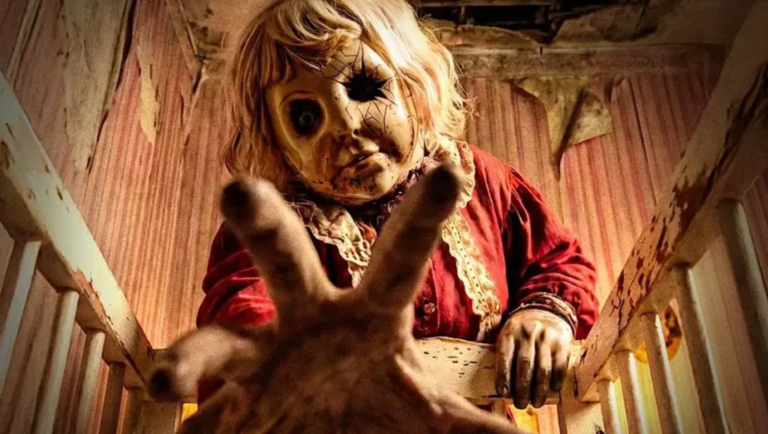
Dolly lays its porcelain head at the altar of Leatherface. Rod Blackhurst’s bootstraps indie horror is unabashedly pious toward The Texas Chainsaw Massacre, the seminal cult classic that both serves as Dolly’s North Star and marks the borders of its imagination. Blackhurst’s late-nite video nasty pores over Massacre like a codex: it’s shot on 16mm film, gleefully exploits the antics of its silent, superhuman killer, and even apes Tobe Hooper’s indelible final frames. The result is a tight and lean 82-minute slasher that never overstays its welcome — often at the cost of its own momentum.
Macy and Chase are hopelessly in love. Chase (Seann William Scott) is giddy and nervous as he drops his daughter off with his mom, running his lines before taking Macy (Fabienne Therese) on a hike through the Chattanooga mountains to propose. But their trek toward the perfect scenic overlook hits a snag: their path is littered with classically creepy, dirty, and disheveled dolls. One is nailed to a tree, another festers in mud, a dozen or so more sit arranged with ritualistic vigor. It’s easy enough to laugh off — maybe it’s an art project? — but when Chase is finally ready to take a knee, he can’t quite ignore the warbled hum of a music box tinkling through the woods. That’s when he sees her.
Dolly, brought between life and death by NWA wrestler Max the Impaler, is hideous. She towers feet above her subjects of torture, speaks only in infantile squeaks and grunts, and peers out of the cracked cupola of a giant, porcelain doll mask. Her fingers, twitching and bound in neonatal knots, are perpetually caked in the blood of her victims. For a Leatherface surrogate, you could do worse.
When Chase disrupts Dolly setting up another liturgy of dolls, she wastes no time in showing her strength. She lifts Chase by the neck as if he were a doll himself, snaps his shin with a shovel, and in a moment of inspired, glorious gore, uses the same shovel to pry Chase’s jaw from his face. It’s a brilliantly executed bit of violence, the sort of thing that drives the midnight masses from dark homes to dark theaters in search of the kill beyond kills. But for Dolly, a shovel to the jaw comes too early and sets a high watermark that the film struggles to reach for its remaining hour.
With Chase incapacitated — improbably, miraculously, he survives — Dolly is free to do with Macy as she pleases. Which, it turns out, is to have a living doll of her own. After smashing her head on a rock while trying to flee, Macy awakes in an oversized crib in a nightmarish, decaying room for a young girl. Set design might be Dolly’s greatest feat. Dolly’s home is one you can smell through the screen, a repulsive miasma of mold and mildew, the ghosts of every stripe of bodily fluid caked to its wallpapers. A mysterious voice from the other side of the wall seems to be on Macy’s side; it tells her that if she wants to survive, she’ll have to play Dolly’s game. And with that, Macy is set loose to amble her way through every horror trope Rod Blackhurst can manage to squeeze.
There’s nothing wrong, necessarily, with playing the hits, and it can be fun to watch Macy pratfall her way through Dolly’s litany of horror-classic mousetraps. The movie never quite repeats the high of its first pop of violence, but it does offer a few consolation prizes — it is absolutely nauseating to watch Dolly force-feed Macy curdled milk and rancid baby food. When Chase comes to, he wears his prosthetic gore well as he claws his way toward Dolly’s house to save his bride to be. There are knives in backs, knives in thighs and sides, shovels to the head. Dolly isn’t immune to lulls, but it ably keeps its 82 minutes safe from boredom.
But cycling through trope after trope without examination brings with it the baggage of horror’s thorny history. Dolly isn’t quite a cruel movie, but it does become grading to watch Macy endure her tortures for the sake of genre fealty. That her captor is also a woman adds a wrinkle — in a sense, Dolly feels like it’s cheating its way to a passing grade on the Bechdel test — but it seems incidental in execution. Horror is a space for transgression and shouldn’t be subject to purity tests. But in the absence of innovation or excellence, when provocations crest serviceability at their peak, it’s hard not to wonder whether we’re watching a woman’s torture for anything beyond the sake of tradition. Dolly knows which notes to play, but a cover band can only fill so many seats.
DIRECTOR: Rod Blackhurst; CAST: Fabianne Therese, Sean William Scott, Ethan Suplee, Max the Impaler; DISTRIBUTOR: Independent Film Company; IN THEATERS: March 6; RUNTIME: 1 hr. 24 min.
Comments are closed.