
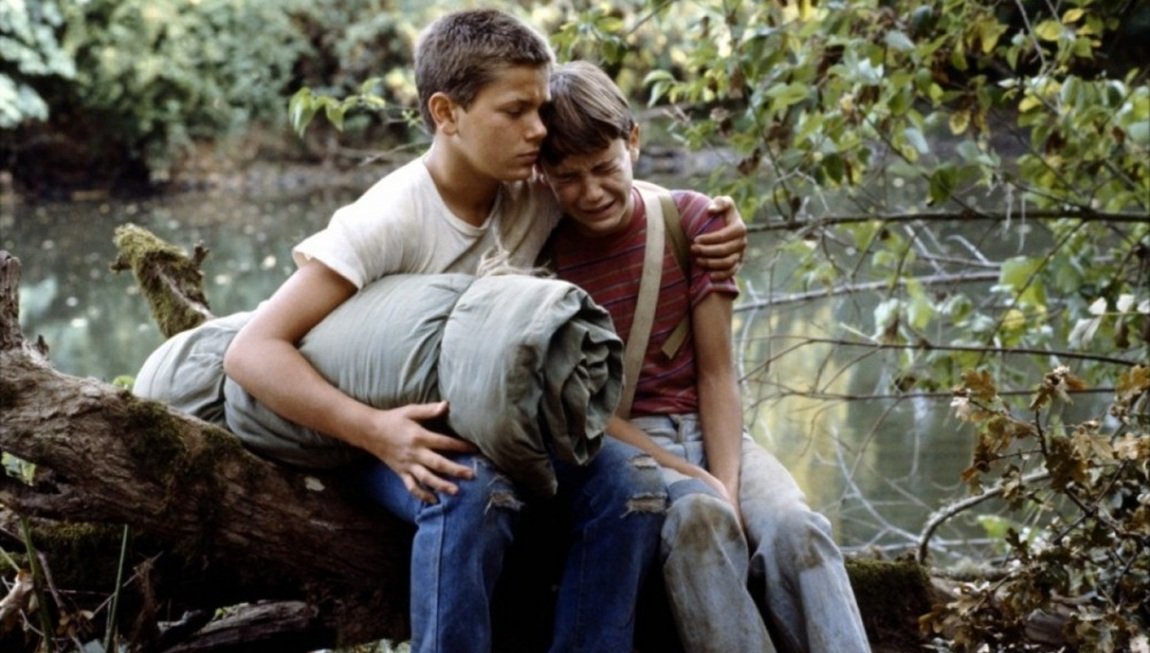
“And you may make revelations that cost you dearly only to have people look at you in a funny way, not understanding what you’ve said at all, or why you thought it was so important that you almost cried while you were saying it. That’s the worst, I think. When the secret stays locked within not for want of a teller but for want of an understanding ear.” – Stephen King, The Body
“And then, quite suddenly, summer was over.” – Ray Bradbury, Dandelion Wine
Rob Reiner’s Stand by Me (1986) understands the core preoccupations of Stephen King’s source material, The Body (1982). This is a narrative about the tensions between exuberant vitality and consciousness of mortality, but it is also about the socially engendered conflicts between masculine tenderness and brutality. Reiner’s film is notably less brutal and perhaps a touch tenderer than King’s novella, but like all Bildungsroman stories, Stand by Me is fundamentally melancholy — it understands the in-built revelation that with maturing experience comes the inevitable loss of innocence. The Body signals this existential paradox through quiet social observation: “We had a treehouse in a big elm which overhung a vacant lot in Castle Rock. There’s a moving company on that lot today, and the elm is gone. Progress.” Indeed, King’s novella quartet Different Seasons duly slots The Body under the section heading “Fall from Innocence.” In this respect, King’s piece takes tonal inspiration from the waning summer ache of Ray Bradbury’s Dandelion Wine (1957), to which it pays homage at the outset: “No one had anything to put up that summer, except maybe dandelion wine.”
Screenwriters Raynold Gideon and Bruce A. Evans shift King’s fictional town of Castle Rock from Maine to Oregon, where four preteen boys embark on a quest to find the dead body of a kid named Ray Brower. This morbid adventure is not so much a journey into unseen territory as it is a reckoning with relentless reality. Death and violence permeate the impoverished world inhabited by Gordie Lachance (Wil Wheaton), Chris Chambers (River Phoenix), Teddy Duchamp (Corey Feldman), and Vern Tessio (Jerry O’Connell). Stand by Me has less dirt under its fingernails than The Body does — the film’s engagement with poverty is less direct — but it retains many of its source text’s crucially somber details, such as the death of Gordie’s older brother, Dennis (John Cusack). When Gordie buys group provisions at the corner store, the clerk addresses Dennis’ passing and grimly notes that “the Bible says in the midst of life we are in death.” Indeed, Dennis’s spectral presence hovers over the Lachance household, a constant reminder of life’s inherent frailty. Stand by Me also includes a disturbing incident from the novella that has marked Teddy for life: his PTSD-afflicted WWII veteran father once flew into a rage and burned off Teddy’s ear on the kitchen stove.
Stand by Me is a work of tonal complexity. It locates the sympathy and mournfulness of King’s text while also amplifying its humor. This tonal balance can be accredited to director Rob Reiner, who had directed two features to date: the comic rock mockumentary This is Spinal Tap (1984) and the romcom The Sure Thing (1985). Reiner deftly foregrounds Stand by Me’s humorous moments, thereby counterbalancing the tragedy without undercutting it. He achieves this tonal breadth by including his source’s retrospective structure: Richard Dreyfuss plays Gordie as an adult writer reflecting on his childhood, providing snippets of voiceover narration lifted directly from King’s prose in a manner that recalls Harvey Keitel’s angst-ridden musings in Scorsese’s Mean Streets. Despite this reflective distancing, Reiner emphasizes the wide-eyed wonder of his characters’ subjectivity — their journey is punctuated by slapstick episodes, impromptu doo-wop singalongs, and gleefully vulgar banter. Amidst these antics, though, Reiner finds room for pensive pause. “Going to see a dead kid,” Gordie contemplates early in their journey, “maybe it shouldn’t be a party.”
This thorny tonal interplay underscores the film’s continual interrogation of tenderness and brutality. Stand by Me finds its thematic core in the friendship between Gordie and Chris, who both perform masculine toughness to protect their mutually innate sensitivity. Chris is poor and socially disadvantaged. Like Teddy, he is victim to a violently abusive father. Chris is a notorious troublemaker with an uncanny knack for social observation; he stole his classroom’s milk money, but in an emotional fireside confession scene, he reveals to Gordie that he tried returning the cash and confessing to his teacher (who suspended him nevertheless and bought herself a new skirt with the stolen money). “Just suppose that I told this story,” Chris says to Gordie. “Do you think that anybody would have believed it?” He and Gordie agree the teacher would not have done this to him if he was “one of those douchebags from up on the View.”
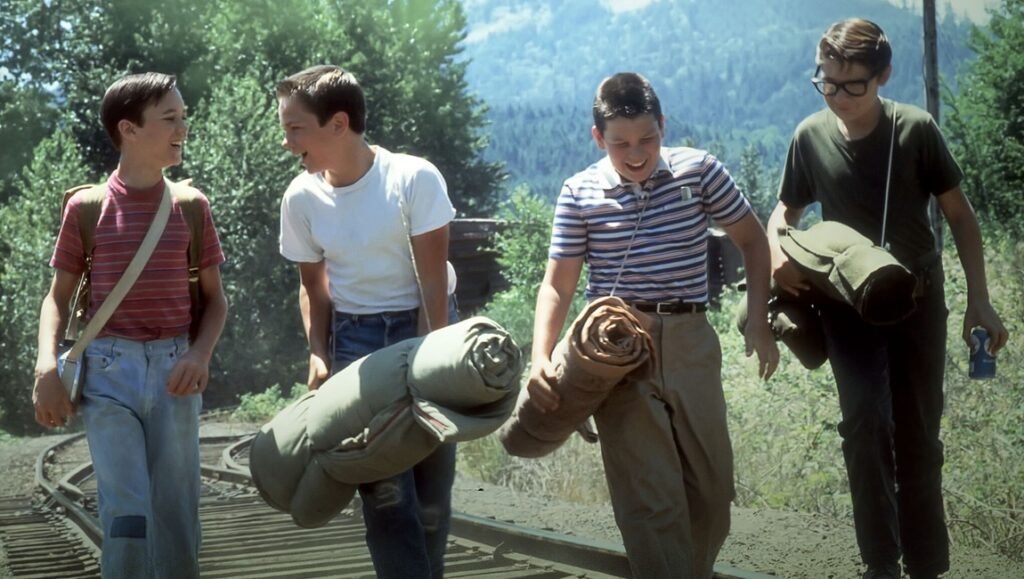
Phoenix, already an actor of extraordinarily nuanced technique, showcases heartbreakingly honest vulnerability in his fireside confession. Chris drops his conditioned machismo and starts weeping. “I just wish that I could go someplace where nobody knows me,” he says between sobs. Looking at Gordie, he says, “I guess I’m just a pussy, huh?” “No way, man,” Gordie says, comfortingly rubbing his friend’s arm. This scene is an extraordinarily compassionate display of homosocial friendship, and it is central to the film’s complex dialectic of tenderness and brutality. Chris’s loss of innocence means recognizing the classist and rigidly gendered systems that bind him. To keep the stolen money would be to accept his station as an anti-social criminal; to return the money would be to surrender his assigned masculinity; to express his pain would be to mark himself “a pussy.” Tender or brutal, Chris is doomed in any event. He is the person Gordie might have been if not for a bit of creative talent and a lot of luck.
In King’s novella, the aged Gordie reflects on his friend group’s fate with a kind of sad resignation: “Friends come in and out of your life like busboys in a restaurant, did you ever notice that? But when I think of that dream, the corpses under the water pulling implacably at my legs, it seems right that it should be that way. Some people drown, that’s all. It’s not fair, but it happens. Some people drown.” Like Chris, Gordie finds himself pulled between tenderness and brutality. Finally facing Brower’s dead body, he reckons with the loss of his brother: “Why did you have to die?” he mutters. He, too, breaks down in tears. “I’m no good,” he says. “My dad said it, I’m no good.” Chris holds him the way a loving father might, and when Gordie declares, “my dad hates me,” Chris responds, “he just doesn’t know you.” Much like Chris’ confession, the pain of this scene hinges on judgment: these boys are broken by their realization that they are always already judged by a harsh, classist, patriarchal world. This is their hurt.
King wrote an appropriately vulnerable piece for the New York Times following Rob Reiner’s tragic death, in which he admitted that The Body “remains the only nakedly autobiographical story [he has] ever done.” Describing Gordie crying in Chris’ arms, he confesses, “That weeping boy was me.” King’s oeuvre is pulled constantly between tenderness and brutality. It is marked by a perpetually open-hearted sympathy for the socially ostracized and abused, but also by the reluctant belief that plain evil exists, and must be ruthlessly dealt with in kind. In his article, King admits that, like Gordie, he “had felt just that torn between the writing life and the lives of my friends, who were living for the moment and not going anywhere in particular, except maybe Vietnam.” “I chose writing,” he reflects, “but it was a near thing.” He admits also to “surprising the hell” out of himself by hugging Reiner after he first saw Stand by Me: “I’m not ordinarily a hugging man, and I don’t think [Reiner] was used to getting them. He stiffened, muttered something about being glad I liked it, and we both stepped away.” One cannot help thinking about those timid moments of vulnerability between Chris and Gordie. Despite all the brutality that lurks on its peripheries, Stand by Me clearly believes in the power and possibility of tenderness.
Comments are closed.