
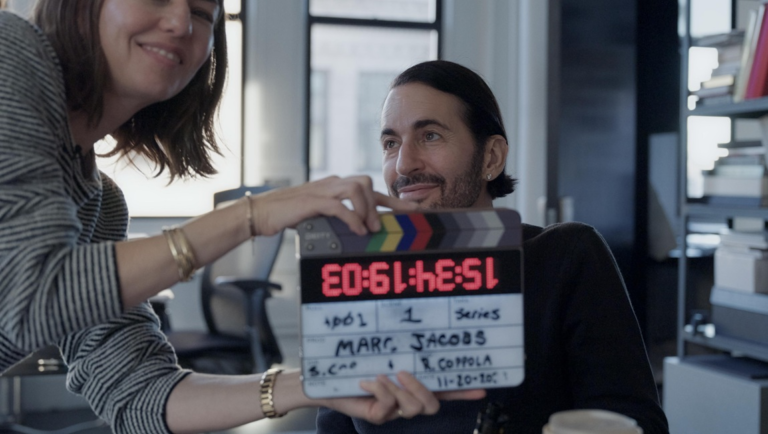
Marc Jacobs is everywhere. In Marc by Sofia — the Sofia of the title being Coppola — the Lost in Translation director makes a case for her longtime friend and collaborator as a monolith of American ubiquity. His designs channel Old Hollywood and straddle the forefront of international cinema; he’s touched modern music from new age to punk to grunge to hip-hop. Coppola’s documentary functions as a love letter to Jacobs’ craft, and her seasoned chops as an aesthetic curator cater a palatable 97 minutes. But profiling a friend can be tricky — Marc by Sofia isn’t quite hagiography, but it struggles to find a groove that balances Coppola’s reverence for Jacobs against insight toward a fixture of American artistry and capitalism.
With her brother Roman behind the camera, Sofia Coppola follows Marc Jacobs in the weeks before a 2024 runway show as he pores over fabric swatches, fusses with stitch placement, and takes nervous, compulsive sips from his vape across dressing rooms and cutting tables. The show itself is styled after the monumental office-park works of Robert Therrien; models parade Jacobs’ streetwise luxury designs under giant tables and through metal chair legs. Marc by Sofia posits the show’s artworld dogma as a notch within a career of cultural curation.
“In another life, I wanted to be a theater director,” Jacobs drolls in a talking-head interview. He could just as easily have said rockstar, DJ, auteurist director, or chainsmoking hypebeast. Coppola frames her organic footage with a trove of archival documents to comprise Jacobs’ sartorial palate: he drinks greedily from the films of Bob Fosse and Rainer Werner Fassbinder, takes cues from mentors and contemporaries from Yves Saint Laurent and Vivienne Westwood to Takashi Murakami and Kate Spade, and collaborates with fashion outsiders like Pharrell and Sofia Coppola herself. Even to an audience disconnected from contemporary designer brands, Marc by Sofia proves Jacobs’ work as an indelible texture within pop culture. If you’ve somehow escaped his name, you’ll know his oversized totes, Kiki boots, and patchwork jeans.
Sofia Coppola might be modern cinema’s preeminent needle dropper, and Marc by Sofia’s soundtrack works as a sly tool to further cement Jacobs’ place on the mantle of pop culture dominance. The documentary opens with Sonic Youth’s “Total Trash,” a nod to Jacobs’ decades of collaboration with Kim Gordon. Songs from Blondie and The Strokes score the designer’s work across each side of NYC’s millennial border; Bryan Ferry and Cibo Matto mix with Jacobs’ flirtations with the avant garde; for his shows, Jacobs channels the austere, modernist classicism of Max Richter and Philip Glass. Coppola’s soundtracks boast utilitarian efficiency and trendsetting mood-board affectations — her best OST, for Marie Antoinette, manages to reinvent a historical attitude and offer a modern cultural mandate with music anachronistic to both its subject and release date. Coppola transfers that muscle seamlessly in Marc by Sofia, architecting an aural portrait of an artist threaded as deeply into the American aughts as the clothing he creates.
Beyond those creations, though, Marc by Sofia doesn’t seem interested in revealing much about its subject. We learn that Jacobs is the son of a William Morris agent, that his father died while Jacobs was young, that he lived with his grandmother. In an interview with a young fashion student, Jacobs mumbles that his time at the Parsons School of Design was rewarding. That’s about it; the film and Jacobs alike treat insight as a perfunctory obligation and content themselves to instead focus on hem lengths. The duty of a documentary isn’t necessarily to present a holistic picture of its subject, to unearth scandal, or peel back a figure to its emotional core. But it ought to offer something. Marc by Sofia is calculatedly benign, so mathematically removed from Jacobs’ id and ethos that its omissions eventually become more interesting than the movie itself.
Marc Jacobs has never shied from controversy. He’s met the scandals that have dogged his career — accusations of cultural appropriation, protests over the use of animal fur, bribery, copyright infringement — with defiance, an eagerness to roll up his sleeves and defend his art and honor. Sofia Coppola is a close friend of Marc Jacobs, and the decision to favor his art over his celebrity is not only justified, but could arguably serve a more interesting document; there’s likely little juice Coppola could offer that TMZ hasn’t already. But Marc by Sofia keeps such a deliberate distance from Jacobs’ personhood that even his output can feel underserved. Jacobs crafted his reputation as grunge’s Elizabeth Taylor with the same care as his oversized sweaters. Why shouldn’t a picture of the man who proudly styled the trials of Winona Ryder and Courtney Love carry a discernable edge?
Marc Jacobs has fostered a lifelong fascination with NYC counterculture, and Marc by Sofia routinely returns to the notion of “punk.” It’s a concept for which Jacobs seems to carry a slippery definition: guitar rock and Pharrell, tote bags and Rachel Feinstein. Instructively, he cites Marcel Duchamp’s Fountain, the notorious urophilic challenge of artistic acceptance, as a key text to his punk creed. Fountain’s controversies were hermetic to art circles, and if they once riled the odd museum patron, they’ve since simmered into casual references for lapsed art history majors. It’s telling that, within a documentary that prides itself on alleged intimacy, Jacobs checks his punk bona fides with Fountain — a work gilded and sanded by reputation and fame — over the enduring subversions of figures like Andres Serrano or Günter Brus. As Marc by Sofia tells it, Marc Jacobs is only as punk as the runway is long, an artist who reigns his provocations ten feet behind the borders of his bottom line. In its practice, Marc by Sofia feels about as substantive and subversive as a brand deck, a well-rendered proof of concept of Jacobs’ next show.
DIRECTOR: Sofia Coppola; CAST: Marc Jacobs; DISTRIBUTOR: A24; IN THEATERS: March 20; RUNTIME: 1 hr. 37 min.
Comments are closed.