
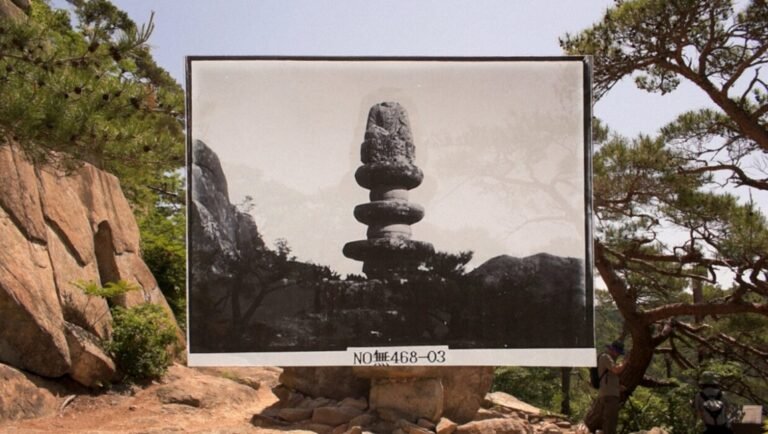
At the center of Justin Jinsoo Kim’s And the Moon Sets Over the Temple That Was lies an impulse to excavate the past through memory. What at first might seem like sovereign images on the screen ultimately get damaged, dispersed, and made to survive in fragments to catalog one’s personal history. It is to this end that the film layers inherited pictures over contemporary footage, so a photograph becomes a relived reality and a now-dead memory of a beachside trip, a rock-face, a suburban road is granted a second life today. What is noteworthy here is Kim’s reluctance to treat nostalgia as an act of yearning. In his visual grammar, images function as mere conveyors, each altering the meaning of what came before and what would come after.
Borrowing its title from Debussy’s famous composition, the film sets out on a search for a temple, for the headless Buddha statues scattered across Namsan Mountain in Gyeongju. During the trip, we scour urban spaces, rural outskirts, religious monuments, without a coherent itinerary to orient our attention. We soon realize what is really being pursued here is not really the lost objects themselves, nor even the forensics behind their mutilation. At no point in the film does Kim resort to justifying his search by historical restitution; instead, he tries to figure out what the vanished pieces mean in the face of cultural amnesia, who should be the beholder/recorder/caretaker of their symbolic afterlife, and in what ways their symbolism can be remembered and reenacted in today’s world. In the process, he allows all layers of personal, familial, and national history to accumulate on top of one another, each a porous surface through which several pasts can simultaneously be projected and gazed upon.
Perhaps that’s why virtually nothing in And the Moon Sets Over the Temple That Was offers a sense of finality. Every frame and gesture is a blatant work-in-progress, a building block to a larger mnemonic architecture. Even the Buddha figures are deprived of their wholeness and, like everything else about the film, survive as torsos, as evidence of historical erasure. Instead of taking on an academic rigidity, Kim drifts his lens through mountain paths, riversides, and coastal stretches to mimic the unpredictability of a traveler, a mere tourist. Like him, almost everyone that swims in and out of the frame strolls about the damaged monuments, pauses, photographs what’s left behind, and moves on. Their act of recording is being interspersed with old photographs (or, at times, 3D scans of the said place) that are laid over present-day views, and the resulting superimposition not only brings together past and present, but also forges a refreshed field of perception for the viewer.
Such a malleable and loose approach to the subject matter at hand also gives the film its unique visual sensibility. Kim’s images are often static, though never inert. Each holds the world in a state of constant pressure in the same way the missing monuments occupy a gravity in their wake. An otherwise idyllic view of a hillside becomes charged with meaning through the ominous presumption that something irreversible has taken place here and we are now left behind with the obligation to keep looking, to make out the shape of its absence. In this sense, it can be argued that the film’s essayistic structure stems less from theory than demonstration. Sure, from time to time, Kim lays out some historical tidbits from Korea’s participation in the Chicago World Fair to an accidental excavation of an archeological site in Italy, but these instances function less as expository anchors than as connective tissue. It’s only by performance, by the accumulation of images, gestures, and revisitations, that the structure of the scenes takes its ultimate shape.
There’s also an often overlooked cultural significance at play here. The question of the missing heads is inseparable from a broader meditation on what a nation chooses to preserve, forget, and fetishize. The so-called fetishization is also evident in some of the film’s seemingly mundane passages where we see throngs of tourists congregating in the shops to buy souvenir-shaped replicas of the Buddha. Kim’s oeuvre is too subtle to collapse any of these registers into a statement on national identity, or even history. What he’s more interested in is how each of us would respond to these moments through our own experiences. Personal memory takes precedence here and helps us make sense of the filmmaker’s motivations. Familial memory infiltrates the narrative not as a sentimental counterweight, but as its intimate correlative: the old photograph, the revisited site, the stubbornly unassimilated image of a childhood; they all suggest that history is first experienced as a disturbance in one’s relation to time and place, then grasped as part of a shared inheritance, a public consciousness.
In the light of all this, And the Moon Sets Over the Temple That Was can be most closely described as a film about what is gained after loss, on a variety of scales. Absence, as a structuring force, echoes through Kim’s narrative and assumes its own tangible afterlife on the screen. Just as Debussy’s compositions hover between ruin and reverie, we see the Korean landscape as a site where several temporalities pool and diverge in uneven measure. Nature is ancient, the photograph modern, the digital frame contemporary, and yet none is granted supremacy over the others in the way Kim builds his spatial compositions or in the way we make sense of them. The result is a cinema of delicate disjunction, one in which even the very need for excavation comes under scrutiny. Every attempt to retrieve the past risks aestheticizing the trauma, on both a collective and personal scale.
That’s perhaps why we leave the film with less certainty than one might expect from a work so plainly organized around history. Even the other sojourners that Kim comes across in his quest give him contradictory instructions, advising him to either climb higher or go back down a little in order to find the headless Buddha statues. Like many works that traffic in memory and myth-building, we are left behind by a keener sense of how our minds give the visible world its fluid edges. In the end, what is certain is that the statues persist against the test of time somewhere outside the screen, the mountains and the photographs linger within the frame, yet both are now altered by their transmission in their own way, by the very act of looking. And the Moon Sets Over the Temple That Was understands this as a formal problem in its frugal finale: it puts the actual itinerary of the filmmaker into a wider context, breaking down its surfaces and textures as the constituent materials of a never-ending semi-fictional personal narrative. While wavering between the tactile density of the place and the diaphanous instability of its map, we can’t help but wonder whether we traversed the road at all or have been nothing but mere bystanders.
Published as part of Cinéma du Réel 2026 — Dispatch 1.
Comments are closed.