
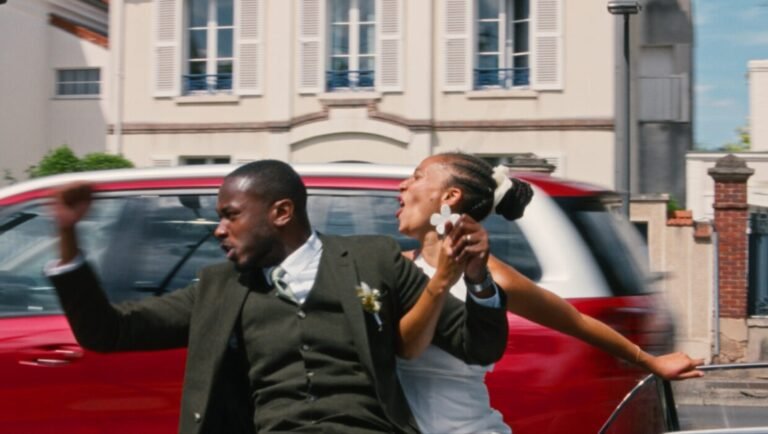
Alain Gomis’ new film achieves something both impressive and paradoxical. It is simultaneously intimate and panoramic. Dao is built around two very large family gatherings, a wedding in France and a memorial service in Guinea-Bissau, and Gomis deftly cuts between these two ceremonies across a three-hour running time. The effect for the viewer is also somewhat paradoxical, since we are fully immersed in these events while also feeling free to drift off or withdraw our close attention. In other words, Gomis creates an environment that we respond to in attenuated terms, producing a very distinctive experience of film time.
Part of this has to do with the two events we are observing and the way they are represented. Although there are very specific cues that tell us where we are — the wedding or the memorial — Gomis never makes it clear which one happened first. The director’s cross-cutting provides a sense of simultaneity, even as the events themselves cannot possibly be happening at the same time. This element, together with the nature of the celebrations and the very long breaks between narrative incidents, means that we experience Dao a bit like being in a flotation tank, buoyed by the procession of ritual acts: songs of praise for the bride and groom, a funeral in effigy, lots of drinking and sharing of stories. We notice patterns and continuity, despite the very different tenor of these two family gatherings.
Even though Dao is driven by family and friends as a broad collective subject, Gomis gives us a personal anchor point in Gloria (Katy Correa), the mother of the bride (D’Johé Kouadio) and one of the daughters of the deceased family patriarch. While Gloria is not always onscreen, hers is the presence that the audience feels closest to, since she ushers us into the gatherings at the start of the film. She and her daughter Nour live in France, part of the Guinean diaspora, and as the two of them ride the bus to the village where Gloria grew up, it’s clear that she has been away a long time. Nour, meanwhile, has never been there before. One of the key themes of the film, seldom stated outright but never out of mind, is the liminal position of the immigrant returning home, someone experiencing both the joys and struggles of living between two cultures. In the memorial scenes in particular, Gomis lets us see Gloria reacclimating to Guinean life and ritual, as they return to her like muscle memory.
But there is an additional layer of meaning that Gomis uses to complicate the events we’re watching and our relationship to them. Near the beginning of Dao, we see Correa and Kouadio in a bare studio area, speaking with an offscreen Gomis about the film and the roles they are going to play. We frequently return to this studio to hear from the various performers — some professional actors, but most of them not. They reflect on their lives and roles in their families, as well as the pull between tradition and modernity in Guinea-Bissau. This documentary material reminds us that, despite Gomis’ remarkably casual, naturalistic filmmaking, we are not actually watching a wedding or a ritual for the dead. Instead, we are observing two meticulously constructed filmic simulacra.
This recognition places the viewer in a fascinating position with regard to Gomis’ aesthetic project. The wedding sequences, with their singing and dancing, arguments and recriminations, recall such classic wedding-ensemble films as Jonathan Demme’s Rachel Getting Married and Mira Nair’s Monsoon Wedding. The memorial sequences in Guinea, meanwhile, directly echo the ethnographic fictions of Jean Rouch. This distinction is most notable for the ways in which it frequently evaporates due to the fluidity of Gomis’ directorial style. This slippage reminds us of two things we often forget: one, that every family ritual is a performance of some kind; and two, that the cultural practices of both the Western and the developing world are equally amenable to the ethnographic gaze. Neither is truer or more authentic than the other.
The conceptual acuity of Dao is clearly connected to its use of expanded film time, and so this viewer finds himself of two minds about the project in its present form. On the one hand, there’s no question that within these 185 minutes, there is a possible two-and-a-half-hour edit of Dao that would be an unqualified masterpiece. But on the other hand, Gomis isn’t being indulgent by asking so much more of us. Dao isn’t a film that wants us to lock in from start to finish. Instead, we are intended to ride it like a wave. The point isn’t to move from one narrative event to the next. In its very essence, Dao simply invites us to just be there.
Published as part of Cinéma du Réel 2026 — Dispatch 1.
Comments are closed.