
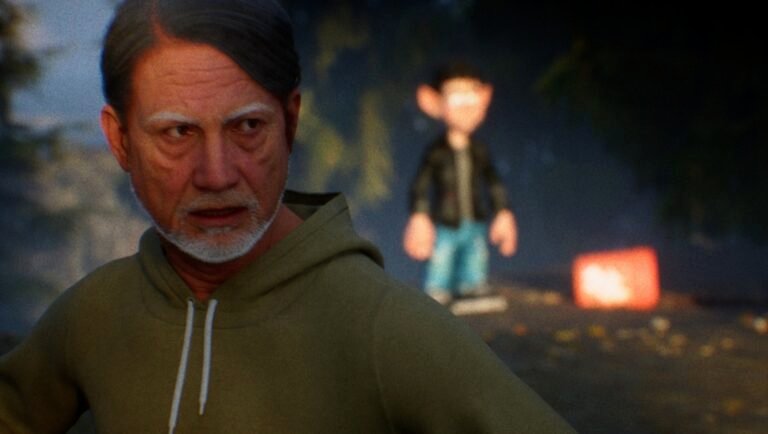
Inside a brightly lit Dunkin’ Donuts, Tyler, a construction worker, meets another, Widgey, who is about to hire him for a home renovation job. Tyler is a single dad handling primary child care. He needs the job. Widgey assures him, disingenuously, that the pay is weekly. The music accompanying the scene punches through The Misconceived’s last title card like the Kool-Aid man, brash and manufactured, corporately optimistic; the kind of tune you’d hear watching a pharmaceutical giant’s onboarding video for new hires. The cheery musical confection colliding with the sigh of working life creates a tonal purgatory, sending the whole scene into the uncanny valley. No surprise, as director James N. Kienitz Wilkins culled the song, along with the rest of the film’s score, from Pond5, a royalty-free music platform. Similarly, the 3D-animated world in which this Dunkin Donuts resides was built in Unreal Engine, an open source video game software, and its winking rolodex of name-brand imagery — Dunkin’ included — pulled from digital image marketplaces. The characters, too, are animated, their movements translated from real-life actors into this rendered universe through motion capture technology and matched to pre-recorded voice performances.
Most of the characters are unmistakably human, but, as with the music, their renderings are just a few degrees shy of reality. Mouths lack the musculature necessary to match the words they speak, and hands never seem to fully grasp objects. Physics in general function according to a mysterious set of rules. Those characters that Kienitz Wilkins deems caricatures, however, like Tyler’s Gen-Z coworker Mikey, are simply cartoons; in this case, resembling something like the demonic sibling to the Rice Krispies mascots, Snap, Crackle, and Pop — you’re surprised he’s not named Squirt, such is the manner in which a stream of crass, anti-woke provocations escape from his rudimentarily rendered mouth.
Kienitz Wilkins’ brand of satire frames Tyler as a provocation all his own. His jaded detachment from careerist impulses frustrate and intrigue the people around him, and his unadorned sense of self affords him no delusions that he’s just one lucky break away from a successful career in filmmaking. One day he explains to an incredulous Tobin — a fame-obsessed sculptor, as well as Tyler’s former college roommate and new boss — his lack of follow-through on his long-gestating screenplay. It’s here when the content of the film and its means of creation force the viewer to consider the tools at a working artist’s disposal and the socio-economic conditions that make it nearly impossible to survive as one. Framed as he is in the story as an artist at heart but construction worker by trade, and positioned between the working class crew and creative class bosses, Tyler’s very existence threatens the already fragile social order. When money and drugs go missing from the house, and suspicions and blame fly left and right, it’s no surprise that the long-fermenting, interclass resentments amongst the characters begin to fizzle and burst.
As was the case with its spiritual predecessor, The Plagiarists (2019), in which Kienitz Wilkins turned digital editing and awkward social interactions into dialectical exercises, The Misconceived‘s obvious accoutrements — 3D animation, motion capture, stock music — obscure the more nuanced trickery simmering underneath their surfaces. For those familiar with his body of work, finally being let in on every secret Kienitz Wilkins has kept up his sleeve over the course of the film prompts not only an emotional release, but feels like an intellectual triumph.
This strategy of withholding in The Misconceived might have come across as alienating if it weren’t for the fact that it’s a wildly entertaining film. One wonders why this single location film with a small ensemble couldn’t have worked as a live-action chamber piece with A- and B-list stars; no doubt Kienitz Wilkins himself has wondered the same thing. And that is part of the reason The Misconceived works so well. Whether the film itself is, as suggested in press materials, “an argument for and against its right to exist,” is neither here nor there. It does exist, and by virtue of a number of legitimizing factors Kienitz Wilkins’ films have not enjoyed: a prominent festival premiere, a PR firm handling publicity, and a sales agent negotiating distribution deals. Perhaps Kienitz Wilkins sits somewhere between the careerist Tobin, foaming at the mouth for a placement in the upcoming Whitney Biennial by a 21-year old curator for whom he barely contains his resentment, and the half-defeated Tyler, a true artist because, as the same curator remarks, he just sounds like one. One imagines such a position is uncomfortable, stress-inducing, and financially unreliable. It’s too bad that’s where great art often finds its home.
Published as part of IFFR 2026 — Dispatch 2.
Comments are closed.