
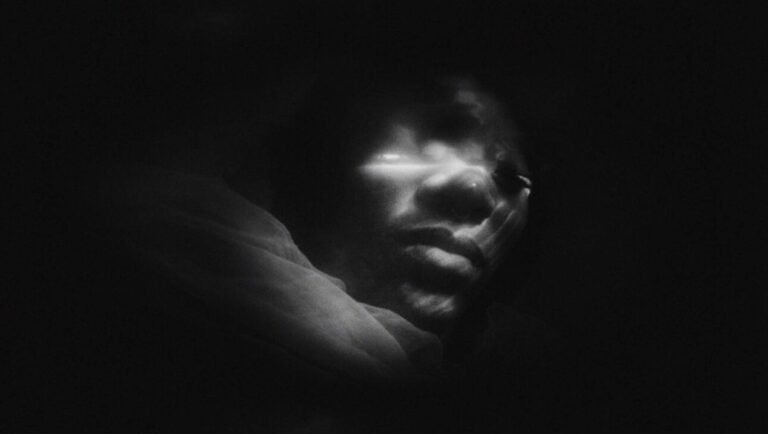
Kim Allamand and Michael Karrer’s new film First Days begins with a brief opening text, which reads in part, “in your first days after death you must enter a house where no words remain… you wander into the light, only to be left behind… the house is never empty and the waiting never ends.” This is the only context provided for what follows, a plotless 60-minute sorta-narrative that features no spoken dialogue. One might call it a tone poem. A brief, black-and-white prologue begins with undulating waves of light, a swirling morass of opaque textures that slowly coalesce into a recognizable image — a woman’s arm, then a face.
The film cuts to color, as the woman (Nasheeka Nedsreal) awakens and begins traversing a path through a pitch-black forest with only a torch to light her way. It’s a quiet journey, eerie but not quite threatening. The camera is low to the ground, pointing up at the treeline, flickers from the torch illuminating the edges of the space. She comes upon an empty house, enters, and begins to explore its various rooms. All is calm and still, darkness eventually giving way to sun-dappled light. Soon, another woman, Jia-Yu Corti, arrives at the door and joins Nasheeka inside the home. The two spend an indeterminate amount of time together, going about various tasks in silence, before the film ends in another black-and-white sequence featuring a return to abstracted, monochrome images.
Given the presence of the opening text, it’s impossible to read the film as anything other than two recently deceased souls occupying a purgatorial space before eventually moving on to some sort of afterlife. But what’s most intoxicating about First Days is not any metaphysical mumbo-jumbo or spiritualized navel-gazing, but its fascination with the mundane and the material, the corporeal quality of this place-out-of-time. Photographed by Fabian Kimoto on what appears to be 16mm film, with a droning, unintrusive score by Peter Bräker, Allamand and Karrer conjure a wonderfully plaintive vision of moving through our world. The colors are soft but saturated, the light diffuse, the greens and browns of the surrounding wooded area lovingly captured in fine detail. Nasheeka and Corti, meanwhile, stay in close proximity throughout, tethered together by their shared experience despite never exchanging words.
Critics often disagree about how much narrative should or should not be present in otherwise experimental films; Tone Glow and InRO contributor Alex Fields, writing about Rhayne Vermette’s Levers, suggests that “we’re invited to make meaning of what little we can see in this darkened world, but not to consider meaning as something settled or determined.” With First Days, the filmmakers suggest a number of potential quasi-narratives: the actresses are both women of color, and their wanderings around the house are filmed in such a way that one half expects a ghost or slasher villain to jump out from around a corner. But as they venture outside, the film shifts into an almost documentary-like form, emphasizing the landscape, and the women traversing the grounds with a wagon suggest some (unknown to us, the viewer) purpose.
The title First Days also pairs nicely as an antonym of sorts to Gus Van Sant’s Last Days, another film at least in part about free-form wandering through nature. There are traces here too of Apichatpong Weerasethakul’s work, as well as the aforementioned Vermette, and if First Days isn’t quite as accomplished as any of these antecedents, it does present a clearly articulated vision of a film form in direct opposition to standardized mainstream entertainments. There’s no need for plot and dialogue and action when you can simply capture the beauty of the world and what it means to fully inhabit it. If we all must shuffle off this mortal coil, here is a wonderful document of what we’re leaving behind.
Published as part of IFFR 2026 — Dispatch 2.
Comments are closed.