
It’s low on the list of 21st century horrors, but there’s something uniquely off-putting about watching a self-recorded video of someone crying. It’s tough to say how it became a phenomenon — maybe our increasing isolation demands new avenues for empathy, maybe prefab vulnerability fit itself snugly into The Algorithm — but at the consumer level, self-taped sob fests tend to feel like a consciously curated pile of dirty laundry. The tensions authenticity faces while stretched between poles of practice and performance wind their way through Tell Me What You Feel. Łukasz Ronduda’s movie sits uncomfortably in a gulf between art and artist, therapy-speak and catharsis; it hitches overbearing sincerity as a third wheel to young love.
Patryk (Jan Sałasiński) is a bleach-blond and boney artist from the Polish countryside who haggles with junk-shop owners to hang his creations on their walls. Dejected and with an unsold painting in hand, he ambles past a shop called Skup, which he discovers to be a “Tear Dealer:” an art installation in which folks can sell their tears in the way college kids might donate plasma for beer money. Naturally, most of Skup’s clientele is poor. Class dichotomy may not have been the Tear Dealer’s intention, but under the helm of lead artist Maria (Izabella Dudziak), a rich girl from the city, it’s certainly a byproduct.
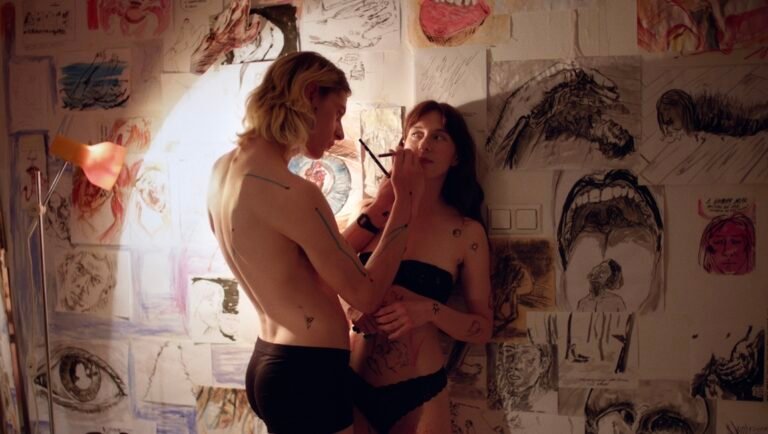
Still, Patryk is charmed enough to pursue Maria, and he quickly learns that her performative vulnerability is less a concept for an installation than a lifestyle. Their first date is among Maria’s circle of fellow wealthy artists — including her soon-to-be-ex–boyfriend — who’ve quite literally turned radical empathy into a game. They pass around a bag of prying prompts and questions (Where do you carry your tensions and sadness? What’s your biggest insecurity in bed?) like a spliff and expect one another to answer without hesitation. It makes for a heavy meet-cute. In a prompt that demands Patryk and Maria swap roles, Maria-as-Patryk declares herself “a sad boy… setting up quite the trap for one poor girl;” Patryk-as-Maria admits that the Tear Dealer project is “classist therapy for the poor.” It’s an exercise that casts a long shadow across their relationship.
It’s easy to frame a therapized life as a privilege — or, less generously, the indulgent runoff from a life of nepotistic navel-gazing. Maria’s art and philosophy are the kind that seem tailored to give a boomer raised on Norman Rockwell paintings a conniption (a thesis proven when they eventually collide with Patryk’s working-class parents). Still, there’s an earnestness that betrays the posturing of her projects, and it doubles to posit Tell Me What You Feel as a slyly sweet romcom. As easy as it is to cringe at Maria’s high-concept swings at postmodern self-acceptance (let’s piss ourselves in public and declare we’re not ashamed), Ronduda renders a relationship otherwise defined by the giddiness of puppy love. Patryk and Maria carry themselves with the unburdened aperture of having your whole life ahead of you; their enthusiasm is infectious enough to make you wonder whether you should try your hand at the occasional flash-mob therapy, too.
Especially against Maria’s moneyed instillations, Patryk — whose character and art are loosely based on Polish artist Patryk Różycki — draws with frenetic and scattershot impulsivity; he’s more likely to paint on the back of a popcorn box than a formal canvas. But in the modern art world, his pop-forward tendencies read drolly traditional. “Why are these images so literal?” a prospective gallerist asks him. It’s a criticism that points a few fingers back at Tell Me What You Feel’s own form. Patryck and Maria’s sweetness can sometimes topple toward saccharine, a tendency buoyed by the movie’s gauzy and vibe-forward needle drops. It’s not quite enough to hobble the movie’s critiques toward therapized art projects or the sincerity of Patryk and Maria’s relationship, but it’s easy to wish that Rodunda followed the restraint — or maybe even the cutthroat bravado — of the artists he depicts instead of the indiepop twee that runs renegade of its own expiration date.
Patryk takes a minute to answer the gallerist’s challenge. “I wanted it to be something my parents could understand,” he eventually replies. Of course, people like Patryk’s parents — who couldn’t afford to take Patryk’s late sister to the doctor — don’t frequent galleries in the city. Young love rarely survives for more than a year or two on equal footing, but the class divide and pursuant divergences of wellbeing bear a chasm across which Patryk and Maria can’t seem to cross without falling. Counter to his indie-friendly concessions, Ronduda handles this with remarkable nuance. Patryk and Maria skate across rivers of subtext until the ice cracks, and even then, remain defiant toward devolving into an art school Jack and Rose. Their relationship, doomed as it is, is handled with enough care to elevate Tell Me What You Feel from what might have been a disposable indie romance to something closer to The Worst Person in the World and the better works of Joe Swanberg. It’s sweet and specific and disarmingly curious, a movie that will follow you through every installation of the next eyeroll-inducing art exhibit you find yourself suffering through.
Published as part of IFFR 2026 — Dispatch 2.
Comments are closed.