
Jonathan Rosenbaum included an anecdote on Paul Schrader when writing about the revival of Robert Bresson’s first feature, Les Affaires Publiques (1934). As always, Schrader apparently prattled on and on about Bresson’s transcendentalism before the screening began, and the film turned out to be in stark contrast to his highfalutin philosophizing. In order to not eat their words, certain auteurists approach these early and unreleased works with much trepidation and reverence, proclaiming any of the said auteur’s works to be valuable, as they scour the early films for the elusive aesthetic easter eggs that connect these works to the style the auteur is renowned for. Knee-jerk dismissals of these early works (and even later works) a la Schrader are far more common, tying the auteur’s value solely to discerned style. This is especially the case if a director has dabbled in blatant for-hire projects or disreputable genres, because the production can be easily used as a scapegoat. While I do not subscribe to either of the vulgar auteurist strains, there still is a kernel of truth to either of their claims. Any work by an auteur needn’t be automatically interesting as early developments and dry runs, though the fascination is indeed higher if it is an auteur one loves; nor should films that go against the grain of expectation, aesthetically, financially, or reputationally, be casually dismissed. The positions of these two extremities pose a challenge to both the programmer and the viewer who love the auteur’s work, requiring a willingness to expand ideas about cinema and auteurism while still not elevating the film solely on the basis of the auteur’s reputation despite the irrepressible interest in the work because of the auteur’s involvement.
Fortunately, the programmer behind the V-Cinema section — Japanese films made exclusively for video, primarily dealing with action, softcore, and yakuza films — of this year’s Rotterdam Film Festival, Tom Mes, struck a balance between both positions, by selecting a film each from Aoyama, Kurosawa, and Miike which he, whether right or wrong, deemed were of interest, and not populating the entire section with the works of these auteurs. The elephant in the room, Eureka (2000, which itself is less screened compared to films of his contemporaries), was immediately addressed, with Mes dismissing any similarities to this seemingly forbidding film while insisting on the innovative artistry on display in this work. With a brutally direct alternative title of The Cop, The Bitch, and The Killer, A Weapon in My Heart makes no effort to conceal its seedier origins and genre, but rather, like the artistic forbear of Japanese B-cinema, Seijun Suzuki (whose Branded to Kill Aoyama probably alludes to by making his cop the third best marksman), Aoyama explores the possibilities for experimentation lurking within the confines of the action-thriller genre.
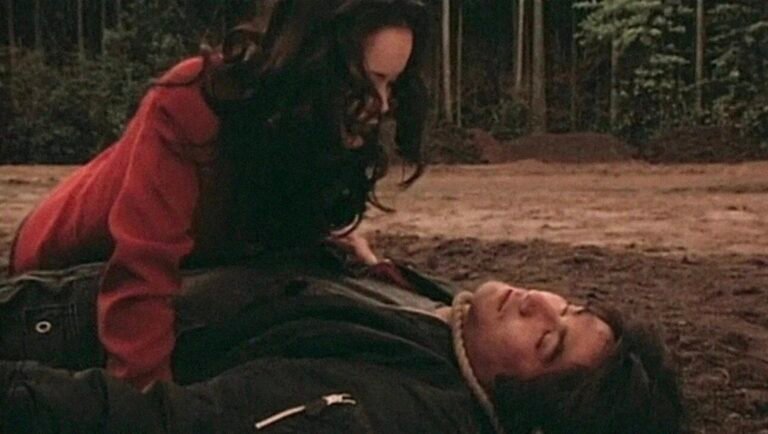
As the alternative title indicates, there is indeed a cop (Kojiro Shimizu), a “bitch” (Alice, played by Mika Aoba, though contrary to the archetype of the title, the film’s most interesting character) and a killer (Taro Suwa), all embroiled in a tussle motivated by professional and personal considerations involving a load of heroin. Aoyama begins in media res, as we are rapidly introduced to Alice and a possible killing through a stop-start series of cuts punctuated by the credits. Aoyama’s approach to action is familiar in its structure to other touchstones of the genre, where the setup laid out is charged with suspense, following the eventual action and establishment of the competing factions, but Aoyama’s uniqueness lies in his kamikaze fragmentation, with cross-cuts to shooting practice and shoot-outs doubling as match cuts, overlaid with the cheap gun-and-kick sound effects. By plunging whole-heartedly into the luridness of his premise, not only through the flashy red-lipstick on Alice, but also in the distorted, deep voice of Alice and the killer’s boss, Aoyama pushes it further into experimentation, with the angularity of his shots, the flurry of back-and-forth action, and the pulp premise eventually forming the shards of Alice’s action-fever dream, sliced by both her perspective and that of the cop and killer. This surreal sequence, however dazzling in its form, also hints at the emotional struggles undergirding the character actions, which Aoyama develops by taking a brief interlude from the action after the collision of the three main characters.
Throughout the film, secondary characters almost display a zen-like acceptance of death after it is clear that their struggles are futile, which Aoyama weights beautifully with a pause before the eventual gunshot. As much as I resisted the pitfalls of falling into the auteurist trap of the reverent kind when observing these deaths, the connections to Aoyama’s more known later films are keenly felt in the interlude where Alice, the cop, and the killer let the melancholy behind the action seep in as they reflect on their decisions. Tracking shots and expansions of space initially used to set the stage for action transform into traumatic presences emerging from the aftermath of their actions, and if Eureka had undercurrents of violence lingering in the overt trauma of his characters, this film almost works in reverse, with the melancholy underlying their propulsive actions. Perhaps I have fallen for the same trap as the auteurists I criticized in the first paragraph, but this is not without acknowledging the differences that make A Weapon in My Heart a unique object that could easily reframe the way I looked at Eureka if I had seen the former film first. My auteurist sympathies might have skewered my viewing and responses to the film, but seeing films like A Weapon in My Heart that do not fit into pre-conditioned moulds allows one to expand their notions on auteurism and cinema.
Published as part of IFFR 2026 — Dispatch 2.
Comments are closed.