
Even when Jorge Luis Borges wrote screenplays, they weren’t necessarily “Borgesian” — not, that is, distilled into the particular pleasure of following one of Borges’ threads through maybe-real obscure texts to arrive at a sort of academic horror. His screenplay for Hugo Santiago’s Invasión (1969) is a masterful and surreal political thriller, and his work for the same director’s Les Autres (1974) certainly has tell-tale philosophical twists on an otherwise simple mystery story. But any fan of Borges will tell you there is nothing quite like the thrill of falling into his particularly literary labyrinths.
The tantalizing journey from one undiscovered bit of research to the next we now colloquially refer to as “rabbit holes” — a term which itself has a tinge of the fantastical, being named after the rabbit hole that shoots Alice into her Wonderland. But Borges is a macabre guide for his journeys, as his worlds promise forbidden knowledge; inaccessible knowledge; knowledge incompatible with reality as we know it; knowledge, usually by happenstance, safeguarded by curators and clerks who know not what they possess. But the distinct pleasure of a Borges story is not merely in the tale of academics lost in archives, but the text itself; the reader is invited on the same journey as the story’s protagonist, if there even is one. That’s what shoves the author’s works into that always uncomfortable, always inaccurate category of being “unadaptable” — a category filmmakers should always take as a challenge.
Chronovisor has taken up that challenge and has successfully earned the descriptor “Borgesian” by doing something so simple yet so daring: showing the text. The film itself is mostly just text, and the audience is simply expected to read along with the protagonist, no matter if the text is in Latin, Greek, Italian, French, or English. Consequently, it’s also one of the most formally inventive and genuinely thrilling new movies in years.
The story’s half the fun. A Columbia University philosophy professor (who possibly lies about her ever-increasing credentials throughout the film), Béatrice Courte (Anne-Laure Sellier), during one of her nights researching the neurological basis for memory, comes across a remarkable claim. A Benedictine musicologist named Pellegrino Ernetti had discovered, parallel to his research in musical decay, that memory itself still exists as waves in the ether, and we’d simply need a device, like a radio or television, to tune into these waves. He also claimed to have invented this very device, the Chronovisor, and has since pieced together a proto-Indo-European language and witnessed the crucifixion of Christ. It’s a scifi-noir setup straight out of Philip K. Dick, and Béatrice is hooked, though she provides no commentary; only the rare reverse-shots revealing her fluttering eyelids provide a window into her thinking. Well, that and her constant late-night visits to New York City’s vast libraries. Through her research we find out about Ernetti’s colleagues and detractors, the subsequent scandals and forged evidence of the Chronovisor, the secret truths behind those scandals and forgeries, and the many visits Ernetti made to the Vatican. Slowly, Courte runs out of these primary sources and can only go further by getting directly in contact with those who knew him, all of whom offer stern warnings about the authorities who silenced Ernetti and even sterner warnings about the Chronovisor itself. She ignores them and proceeds.
What’s even wilder is that it’s all true. Well, at the very least, Pellegrino Ernetti was a real Benedictine musicologist who really did claim to have invented the Chronovisor, exactly as the film states. From what I can tell, the primary sources — in French, Italian, English — are real as well. (I found the Ernetti-directed Gregorian chant album featured in the film for sale for under $10 on Discogs; the last seller being listed on March 3 of last year made me want to go through a Courtean dive of my own to see if it was sold to the production.) This is all to say that, while this would have still been a thrilling tale if invented from whole-cloth, it’s an even more fascinating recycling and remixing of archive materials, taking what the world once considered a simple hoax and shifting the details ever so slightly to create a plausible conspiracy.
But plenty of films about forbidden research tell a similar tale: The Name of the Rose, The Ninth Gate, even Eyes Wide Shut (which this film gives a nod through its slow hood-mounted driving sequences through Central Park). What makes Chronovisor special is its stubborn refusal to pry away from the research itself; we’re stuck in Courte’s brain as she reads through old academic journals and orders more. To help guide us through the paragraphs of text, only certain selections are highlighted with superimposed (and typeface-correct) glowing text, as if the good bits are adorned with a halo. This angelic force also translates those texts not in English and sometimes wipes away the dense paragraphs around it.
But this process is not done haphazardly; there’s a rhythm to how and how often the text is revealed. As Courte discovers more haunting passages, the score swells and the text is reduced to a single word in the frame, progressing quickly through one of Ernetti’s more startling admissions and repeating, remixing key words in a fashion similar to Hollis Frampton’s poetic structuralist work Zorns Lemma (1970). Phone calls are accompanied by found footage video of unsettling subjects: a séance, a funeral, and a trek through rural Portugal that should probably remind me of Jem Cohen or another classic work of the avant-garde, but instead kept bringing to mind that Mexican news broadcast in Signs (2002). Memory is a funny thing.
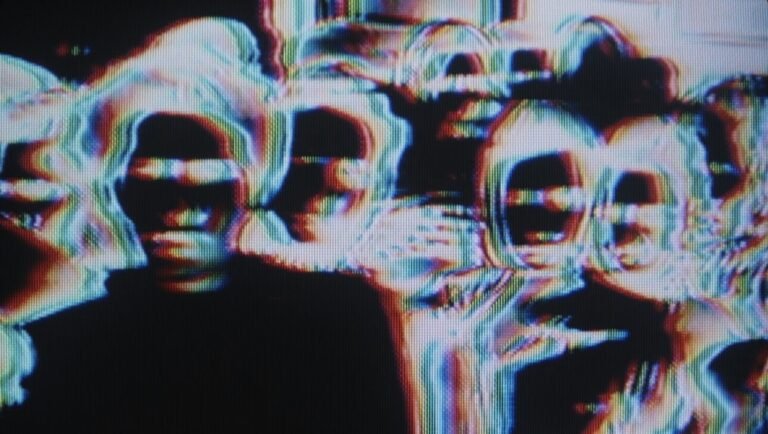
Even footage of Béatrice herself, footage that almost operates only as establishing shots here, are shot in low light and on the intimate grain of 16mm. Warm golden light illuminates her lone desk in a research library; a cold blue lights up only her face while using the library’s old VCRs in darkness. Even the endless shots of text on paper are carefully photographed to replicate reading under those signature library lamps. And then there’s a Chronovisor itself, with its otherworldly RGB phosphor dots approximating figures and voices indistinguishable from the more abstract works of Nam June Paik or other early video artists. The text, the images of Béatrice, the Chronovisor: all three elements are shot as if making three different experimental films, but the narrative along with the omnipresent and at times overwhelming Gustav Holst score lend coherence and a deceptively simple beauty to the whole project.
Chronovisor is many things: a nod to the excellent (and excellent-looking) libraries in New York City, an accurate portrayal of the exhilarating journeys that research into niche subjects can lead you through, and a structuralist film disguised as a scifi-noir — or vice versa. But, in the way that I’m always impressed with a successful hangout film, a genre that has no familiar structure or dramatic moments to grab the audience’s attention, the best part of watching Chronovisor is to witness it accomplish so much with so little. For, just as Michael Snow’s Wavelength can be facetiously referred to as “just a zoom,” or, a much more apt comparison, Chris Marker’s La Jetée can be deemed “just a few still pictures,” Chronovisor should be cheekily celebrated as masterwork of “just text.”
Published as part of IFFR 2026 — Dispatch 1.
Comments are closed.