
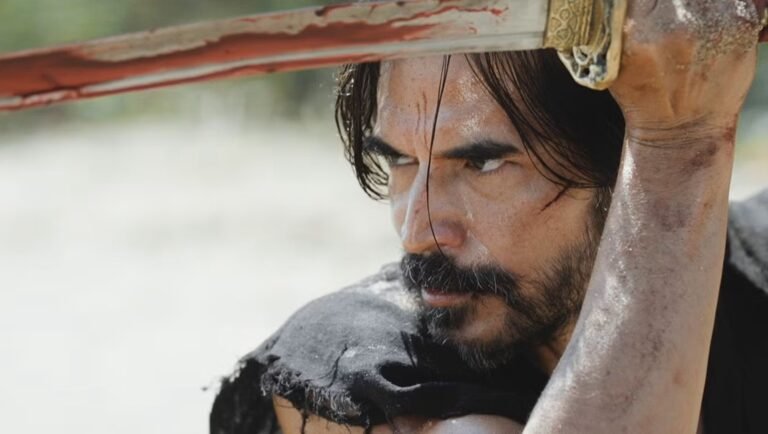
If you like Bone Tomahawk, Lucio Fulci’s Conquest, samurai poetry, and Yayan Ruhian being cool as hell, then there’s a new movie just screaming your name. Lone Samurai dropped unceremoniously on VOD in the U.S. last December, but it’s playing at the 2026 International Film Festival of Rotterdam, and with Well Go USA soon releasing the film on home video, maybe it will find the cult audience it’s destined for. Then again, the same could have been said about Marko Zaror’s similarly spiritual martial arts film Fist of the Condor, and that has seemingly yet to materialize. But we can always hope.
A prologue introduces us to an unnamed samurai who takes part in the second battle to stop the invading Mongol fleet in the 13th century, the one that, thanks to a timely storm that destroyed the Khan’s ships, gave rise to the concept of the kamikaze, or “divine wind.” A narrator asserts that, in addition to the wind, the Japanese also sent a select group of samurai onto the Mongol ships to kill everyone they found there. One of these samurai, played by Okinawan actor Shogen (star of Brillante Mendoza’s Gensan Punch), awakens on a deserted beach, with a piece of boat jammed in his thigh. The first third of the Lone Samurai follows him as he hobbles around the beach, gathers various materials, writes some poetry, and has visions of his wife and children, all on his way to find a good spot to commit seppuku.
But just before he’s able to complete his mission, he’s suddenly captured by a tribe of cannibals. The second third of the film, then, finds him trapped in a cave, drugged, and witness to the horrors of human sacrifice. Indonesian martial arts legend Yayan Ruhian appears as a kind of shaman, and Rama Ramadhan, a veteran stuntman from such films as The Night Comes for Us and The Raid: Redemption, plays the tribal leader. This middle section of the film plays as a horror movie, the spiritual opposite of the movie’s beautiful opening section. Proceedings here remain locked in a torchlit cave, in contrast to the first third that leaves viewers marveling at forests and waterfalls and sunsets. We see nature, and then we see what humanity has chosen instead.
Lone Samurai’s final third follows the samurai’s escape and his methodical cutting down of his enemies. This is where almost all of the film’s action lies, and it’s up to the standards set by previous Indonesian gems featuring Ruhian and Iko Uwais (whose company was one of Lone Samurai’s producers). The action here bears some resemblance to Crazy Samurai Musashi, in that it is basically just 30 minutes of one dude slicing up a near endless supply of other dudes, but American director Josh Waller — more successful lately as a producer (Mandy, A Girl Walks Home Alone at Night) his last feature as a director was the 2015 Zoe Bell vehicle Camino — and the stunt team give it more variety in weapons and settings (watch out when the samurai gets both his swords back!). It all builds quite nicely to the final two fights with Ruhian and Ramadhan, with the different styles employed by the key opponents requiring Shogen to adapt. Speaking of, Shogen himself is a magnetic presence, carrying the film’s almost completely non-verbal opening third as well as the relentless action of the finale. His samurai is a poet-warrior in the classic sense, a fully-realized version of an idealized character. In the end, Lone Samurai uses the right recipe to deliver everything one wants in a low-budget genre film: it’s short, nasty, pretentious, and exhilarating.
Published as part of IFFR 2026 — Dispatch 1.
Comments are closed.