
Although the draft was last sprung more than five decades ago, America’s fortunate sons have since fathered their own lucky offspring. Called to arms out of a misplaced love for country or a displaced sense of self, these valiant heroes have ventured forth into battle and returned, whether in hordes of body bags or in the masses of zombified flesh spent, coked-up, and forever traumatized. On paper they are immortalized with eulogies and medals; in person, they lurk in the shadows, frequently anonymous and lost to the living dead. For Daniel Aaron Torres, this anonymity is official: he was deported back to Mexico, after his tours in Iraq and Afghanistan, because he never was a citizen to begin with. Having mobilized Torres and countless other young illegal immigrants to fight a trillion-dollar war without paying much heed to their status, the U.S. military apparatus just as quickly found them dispensable afterward, and dispensed with them accordingly.
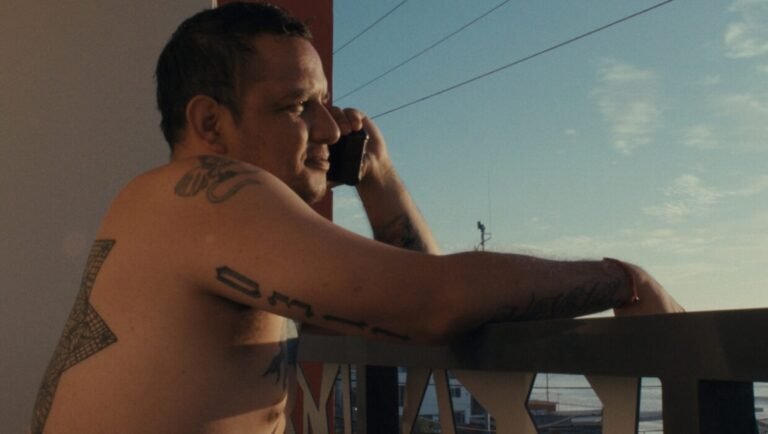
Torres is the tragic subject of I Crossed the Desert With a Gun in Hand, the latest documentary feature from French filmmaker Laurence Garret. Born in Tijuana but having spent most of his years in Salt Lake City, the Iraq vet and later law student switches seamlessly between his mother tongues; his tattoos and bulky stature form a rugged if gentle demeanor, suggesting a sense of peaceful, moral temperance. But years prior to the reinstatement of his right to reside and eventual approval of citizenship, Torres was broken, suicidal, and wracked with PTSD. “Names, numbers, events. They were all a blur for me,” he confesses, not only to the aimlessness of life after wartime or the crushing fog of betrayal from the country he offered his life for, but also to the brutal exigencies of combat. Recounting a harrowing in-camp story of soldiers hardening themselves to death by shooting a pig repeatedly, Torres disappears from the camera’s view, replaced by the barren landscapes of desert Americana flitting past.
Garret’s miniature portrait of her subject is slight in narrative but nonetheless creepingly somber. As she follows Torres on both sides of the border, from his younger sister in Utah (unable to visit him for the longest time for fear of deportation) to Torres’ relatives and friends in Mexico, I Crossed the Desert raises, quite naturally, the metaphorical question: whose desert is this? The film’s contemplative and unhurried rhythm resembles that of a road trip, and Torres has had plenty of time, both in exile and upon his return, to reflect on the desolate terrain of his life, saved by a thread by a support group of veterans that campaigned and fought for his constitutional rights. These “bare dead mountains” are at once the province of the United States, the arid Baja California of Mexico, and the sands of the Arabian Peninsula. They constitute the myth of American exceptionalism, fetishized in Alex Garland’s Warfare and crystallized in the lone sojourner of America’s “A Horse with No Name.” Sing the trio: “I’ve been through the desert / On a horse with no name / It felt good to be out of the rain” — until the drought itself is dead from shame.
Published as part of Cinéma du Réel 2026 — Dispatch 1.
Comments are closed.