
Sixto Muñoz lives alone, but he likes to visit town to have a few beers (which his friends are happy to buy for him) and dance. Thus we are introduced to the character of the last survivor of the Tinigua people, most of whom were murdered around 1950 by a bandit named Hernando Palma as vengeance when one of their women rejected him. This massacre happened only a couple of decades after the first recorded contact of the Tinigua by Spanish-speaking missionaries. Only Sixto and his family escaped, and lived in hiding in the jungle for eight years after. Even after it was safe to reemerge, they lived in relative seclusion; Sixto’s aunt and brother never learned Spanish, and nearly everything known about their history was recorded by researchers who came to interview the lone available survivor.
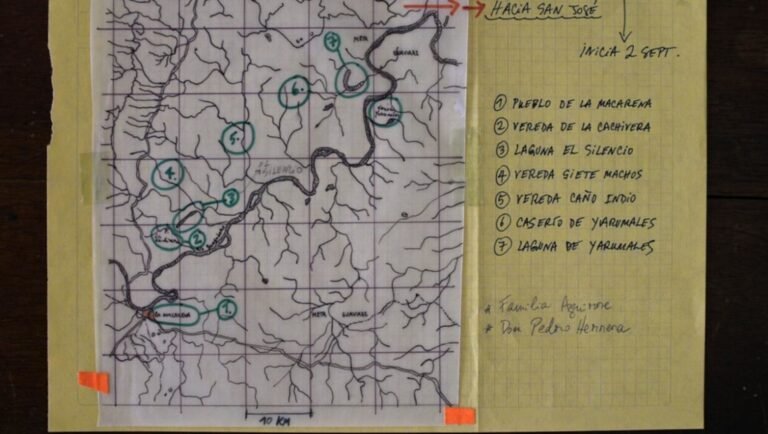
Filmmaker Guillermo Quintero travels to the small town of La Macarena in hopes of finding the last Tinigua, who had reportedly vanished alone into the jungle in a canoe several years earlier. Quintero’s voiceover notes and camera record the stories of those who used to know Muñoz, and speculate on where he might have gone. These recollections blur the line between memories and tall tales. Sixto is said to be 105 or 110 years old, and to never have aged. He is a healer who could mix wild herbs to cure headaches and other pains in an instant. He could see perfectly in the dark and bullseye small animals in the brush or fish in the water in the middle of night.
Such an exaggerated, even mythical character study can’t help but play into exoticized notions of indigeneity. To an extent, then, Relicto can be seen as a study of how the rural Spanish-speaking populace recalls their former neighbor through that distorted lens, but the filmmaking plays into it as well, and not just through its editorial choices. Recurring shots of canoes paddling into the waters of the jungle or guides leading the filmmaker through brambly paths suggest an epic journey toward a primordial destination, even bringing to mind comparisons with Apocalypse Now or Aguirre or, even more closely, Embrace of the Serpent.
The effect is surely intentional, and likely meant to be visible to the audience, but it’s not a pure flight of fancy. Quintero’s conversations with interviewees mostly take place over mundane daily work, and many of the subjects in the middle section of the film — as it moves from the town into more rural farmland around a lagoon — worked with Sixto or his brother as farmers, and speak about that work, how he moved his farm about the land, planting a mango tree whenever he relocated and sold off his previous property to another family. (The land here had once all belonged to his people, and much of it ultimately therefore to him.) A contrast, albeit a fluid one, is established between the more fanciful memories of the man’s life, and the real economic terms on which the life was lived.
All of this leads to a very different concluding section, which is both more definitive and more ambiguous than the earlier parts of the film. It may be odd to talk about spoilers for a biographical documentary, but the film is structured in such a way that there is real suspense about where it’s going until it gets there, and those who plan to see the film may want to skip the rest of this review until they do so. But it’s impossible to evaluate all that came before without discussing this conclusion.
Relicto begins with a prologue that asks, “what is a relic?” The Latin root of the word refers to something left alone or abandoned, like a widow. Obviously, the question posed is what it means to be a relic of an extinct people and way of life, though this preamble also makes a questionable visual analogy by including drawings of extinct animal species along with the text.
For the last 15 minutes or so of the film, we watch a new subject at work on similar tasks to those we’ve seen throughout. But this person doesn’t speak, and as the duration runs on, it becomes clear we’re watching Sixto himself, whose discovery was never announced by the film (and who had never even been confirmed to be alive or have been seen in the past five years). He is indeed very old, but seems to get around quite well for a man who must actually be at least 90, if not truly over 100 years old. He lives alone with a dog, whom he seems to communicate with only by hand gestures.
Quintero has spoken earlier of his hope that he will find Sixto and in doing so clear up what is real and what is legend in all these accumulated accounts, but we get none of that. We learn nothing at all of the truth, beyond the appearance of the man’s hut and how he prepares some meals. When his voice is finally heard, he speaks in his native language, which no other living person can understand, and which is not translated for the film, and then it ends. There’s no doubt this simple and quiet ending has emotional and thematic power. What has been speculated on so frequently and fancifully for the previous 80 minutes can’t be answered by what is “real,” nor is this latter even legible to an outsider. But was the whole exercise a critical interrogation of such an outsider’s view, or just an elaborate confirmation of the mythical unknowability of the Indian? Has the film achieved any greater cultural or epistemological wisdom than the townspeople who gossiped about Sixto’s magical secret herbs and “jungle medicine”? Probably not, but it does at least try to pose the problem in a formal and aesthetic frame, which can’t be simply reduced to the academic one.
Published as part of Cinéma du Réel 2026 — Dispatch 1.
Comments are closed.