
Suburbia, There and Back is a landscape film set in the area around Paris, and eventually in the city itself. With static shots ranging from less than a minute to over four (but averaging around two), a compositional emphasis on geometry and negative space, and a thematic inclination toward the political economy of landscape, it is much in the style of James Benning’s California Trilogy. The film’s first and longest shot, which prefigures the rest of its structure, opens with a rainbow in the sky over a tranquil suburban landscape, birds chirping. We see houses and trees in the foreground, followed toward the horizon by a large cleared field and then a series of taller buildings which could be offices or apartments. A road is just visible in front of these. The whole upper half of the frame consists of a blue grey sky, and as the storm and rainbow clear away the distant skyline of Paris is gradually revealed.
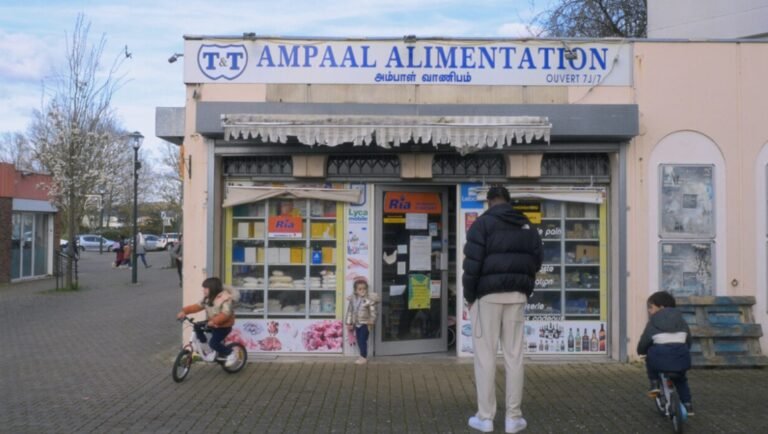
After the title card ends this prologue, there’s a sequence of agricultural scenes of grain-harvesting machines, hand-pushed plows, rows of nearly planted fruit, oil rigs, and so on. Then there are small shops and rail stations and children playing in fields, and eventually scenes of the city itself, including for the first time interior shots and relative close-ups of human figures. In one, a Black teenager in a blue jersey sits reading contemplatively on a concrete structure, skaters and apartment high rises and a French flag behind her, while Josephine Foster’s “I’m a Dreamer” plays, perhaps the first obviously non-diegetic sound in the film. (In many, perhaps a majority, of the film’s images, either roads or rails with moving vehicles are seen, constantly reinforcing the logistical connections between all that is shown.) In this way, like the best of the Benning tradition he follows, Cattinari puts plenty of material on screen for his audience to reflect on as material evidence of our civilization and its imprint on the natural world, but never hammers home a political thesis. The film rather gives space for viewers to explore its (and their own) world.
Just as importantly, it understands that the success of this cinematic grammar relies as much or more on building formal interest through composition and editing as on anything more transparently ideological. As we move closer into the metropole, the wide shots and expansive landscapes evolve into closer and tighter frames whose shapes are informed not so much by the literal horizon and the sun’s light as by the camera’s framing of manmade structures and patterns of electrical light. In the middle sections, buildings, statues, or trains are the major geometric units that negative space is framed around. Later, images of a couple on a couch in front of a TV or a can on a road are spotlighted by highly directional artificial light and the negative is darkness. The glowing yellow rectangles of a bus stop or a train car take this nocturnal unreality to a further extreme.
All of this makes for a successful venture into familiar territory, but the prevalence of Benning look-alikes in every arthouse documentary or experimental film program for the past many years raises questions about what we want from experimental film, or whether that’s the appropriate term for a work like this, given the decades of tradition around this formal vocabulary and its many contemporary proponents. It can be called formalist or avant-garde relative to the dominant commercial cinemas of today or any other period, but its audience is different, and that audience is accustomed to everything that happens here. Perhaps there is still new territory to explore, and some artists are pushing this form in new directions, but one can’t help but wonder what it means that the best films in this vein are largely the ones that are comfortable sticking with what clearly works.
Published as part of Cinéma du Réel 2026 — Dispatch 1.
Comments are closed.